
The Ultimate NYC Halal Cart Guide
20 carts. 5 corridors. The sauces, the science, and the street-level map to eating your way across New York City’s most democratic culinary institution.
The halal cart platter — chicken and lamb over rice, doused in white sauce and a reckless zigzag of hot sauce — is as defining a New York food as pizza, bagels, or pastrami. There are an estimated 4,000 food carts operating on NYC streets at any given time, and a substantial percentage of them serve some version of this dish. But not all halal carts are created equal, and the gap between the best and the average is as wide as 6th Avenue itself. Later after reading this, you can check out our NYC Chinatown Dumpling Guide!
This guide maps the 20 carts worth seeking out, explains what actually separates them, and gives you the vocabulary and ordering strategy to eat like a local instead of a tourist. We’ve organized everything by corridor — because halal cart geography is its own discipline — and included a printable crawl itinerary, an interactive map, and a vendor matrix you can screenshot for the field. Many of NYC’s best halal carts draw directly from South Asian culinary traditions — our NYC South Asian Street Food Guide maps out the vendors, dishes, and neighborhoods behind that influence.
The demographic shift that brought halal carts to Midtown in the 1990s has a Queens parallel worth knowing: the Korean corn dog and tteokbokki boom transforming Flushing’s Roosevelt Avenue corridor. We broke down all twelve verified vendors in our NYC Korean Street Food Guide.
The NYC Halal Cart Map
Open full map in Google Maps → | Download the printable crawl itinerary →
Anatomy of a Halal Cart
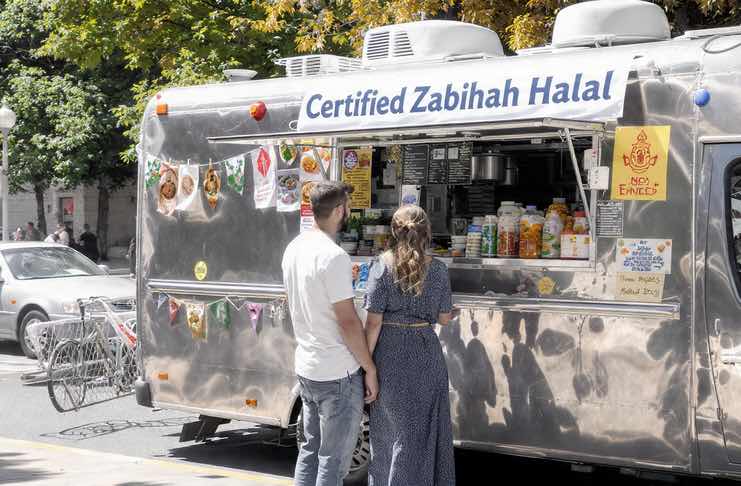
Every halal cart in New York runs on the same basic architecture. Understanding the machine helps you read the quality signals before you commit to the line.
The flat-top griddle is the heart of the operation — a rectangular steel surface where chicken and gyro meat cook simultaneously. At better carts, the griddle is divided into zones: one for chicken, one for lamb or gyro, and often a third for onions and vegetables. Watch how the operator manages these zones. If everything is piled together in one greasy heap, keep walking. If the proteins are kept separate, the meat is being cooked to order rather than reheated, and the griddle surface is visibly clean, you’ve found a cart that cares.
The vertical spit — a rotating cone of seasoned, processed meat — is the gyro station. Most halal carts in NYC use a pre-formed beef-and-lamb blend that’s roasted on the spit and shaved to order. This is what you get when you order “lamb.” If you want actual whole-cut lamb, you’ll need to find an Afghani-style cart like Mr. Khan’s Best Halal Food, where the chapli kabob is ground and formed fresh.
The steam trays hold rice (yellow, orange, or basmati depending on the cart’s cuisine style), lettuce, tomato, and sometimes grilled vegetables or falafel. The rice is the tell: at Middle Eastern-style carts, it’s a short-grain yellow or orange turmeric rice. At Indian and South Asian-style carts, it’s long-grain basmati. The grain type signals the entire flavor universe of the cart.
And then there are the sauce bottles. White, red, and — if you’re lucky — green. These are covered in depth below, because the sauce is where most of the flavor differentiation actually lives.
The Sauce Trinity: White, Red, and Green
The three sauces of the NYC halal cart are as essential to the dish as the meat and rice. They’re also where the biggest variation exists from cart to cart. Two platters with identical chicken and identical rice can taste completely different depending on whose sauce is on top.
White Sauce
White sauce is the signature condiment of the NYC halal cart — the one thing you won’t find in exactly this form anywhere else in the world. It’s typically built on a mayonnaise base, thinned with white vinegar or lemon juice, and seasoned with salt, pepper, and sometimes a touch of sugar or dried herbs. The Halal Guys’ version is the most famous and the most closely guarded — food writers at publications from Grub Street to Thrillist have attempted to decode it, describing it as a “cult condiment” whose precise recipe remains undisclosed. It’s been called a distant cousin of tzatziki, but that comparison doesn’t quite capture it. Tzatziki is yogurt-forward with cucumber and dill. White sauce is richer, tangier, more deliberately neutral — it’s designed to coat rice and amplify meat rather than compete with them.
At Adel’s Famous Halal, the white sauce runs thicker and creamier. At Sammy’s Halal, it’s slightly thinner but balanced against the green sauce. At Chef G Halal & Healthy, there’s also a balsamic dressing option for those getting salad instead of rice — a rare departure from the standard sauce set.
Watch this video to get a glimpse of Sammy’s Halal cart:
Hot Sauce (Red Sauce)
The red sauce is chili-based and ranges from politely warm to genuinely dangerous depending on the cart. The Halal Guys’ red sauce is notorious — a few drops will redden your face, and there are countless stories of tourists drowning their platters before realizing the heat level. Adel’s runs similarly hot. Chef G keeps a second, unlabeled bottle of extra-spicy behind the counter — you have to ask for it and assure them you can handle it. The universal protocol: start with less than you think you need. A thin zigzag line down the center of the platter is sufficient. You can always add; you cannot subtract.
Green Sauce (Green Chutney)
Not every cart carries green sauce, and that’s one of the clearest quality signals on the street. Green sauce — a bright, herby, spicy chutney typically built on cilantro and green chilies — tends to appear at South Asian and Indian-influenced carts more than Middle Eastern ones. Sammy’s Halal is famous for it. Tariq’s #1 Halal carries it. If a cart offers green sauce, it generally means the operator is thinking beyond the bare minimum. Always say yes.
The sauce strategy: White as the base layer across the entire platter. Hot sauce in a controlled line down the center. Green sauce (if available) in dots along the edges. This creates three distinct flavor zones in every forkful depending on where you dig in.
Two Schools: Middle Eastern vs. South Asian Halal
The single most important thing to understand about NYC halal carts is that the term covers two fundamentally different culinary traditions operating under the same umbrella.
Middle Eastern-Style
This is the classic — the style that The Halal Guys established and that most tourists picture. The rice is yellow or orange, tinted with turmeric, and cooked in a shorter grain. The chicken is marinated in a Middle Eastern spice profile: paprika, cumin, coriander, and garlic. The “lamb” is gyro meat shaved from a vertical spit. The sauces are white and red. The platters are big, heavy, and designed to fill a cab driver’s stomach for a ten-hour shift. Carts in this style include The Halal Guys, Adel’s Famous Halal, Gold Street Halal, and Kabab Express.
South Asian / Indian-Style
This is the other half of the halal cart universe, and it’s where some of the most interesting food lives. The rice is basmati — long-grained, fragrant, and delicate. The chicken carries a tikka or biryani marinade with yogurt, turmeric, garam masala, and green cardamom. The menu expands beyond platters to include kati rolls (Kolkata-style stuffed parathas), biryani, and samosas. Green chutney joins the sauce lineup. Carts in this style include Indian Tasty Halal Food, Biryani Cart, Royal Grill Halal Food, Tariq’s #1 Halal, and Famous Dal Wagon.
There’s also an emerging Afghani style, represented by Kwik Meal and Mr. Khan’s, where you’ll find chapli kabobs, open-flame grilling, and a spice profile built on cumin, coriander, and green chilies. And then there’s King of Falafel & Shawarma in Astoria, which brings an explicitly Palestinian approach — chickpea-only falafel (no fava beans), hand-shaved shawarma, and a recipe lineage that traces back to Ramallah.
The point is: “halal cart” is not a single cuisine. It’s a format — a silver cart on a sidewalk — that holds multiple culinary traditions. Knowing which tradition a cart belongs to changes what you should order and how you should evaluate it.
The Five Corridors
Halal carts cluster geographically. These five corridors are where the density is highest and the quality is most consistent.
The 6th Avenue Corridor (Midtown Manhattan)
The halal cart capital of the world. Between 44th Street and 55th Street on 6th Avenue, you can walk past eight of the best carts in the city in under fifteen minutes. This is where The Halal Guys started in 1990, where Adel’s holds court after dark, where Biryani Cart has won two Vendy People’s Choice Awards, and where Royal Grill earned the 2018 Vendy with its chicken tikka biryani. The corridor runs the full spectrum from Middle Eastern (Halal Guys, Adel’s, Kabab Express) to Indian/Bangladeshi (Biryani Cart, Royal Grill) to Afghani (Kwik Meal, Mr. Khan’s). If you only have one lunch in Midtown, eat it on 6th Avenue.
The Jackson Heights Corridor (Queens)
Jackson Heights is where halal overlaps with the broader South Asian street food ecosystem. Sammy’s Halal at 73rd & Broadway is the anchor — the 2006 Vendy Cup winner serving 24 hours a day with the city’s most famous green sauce. Indian Tasty Halal Food works the Indian end of the spectrum with sweet chili chicken over basmati. And the 74th Street corridor around Diversity Plaza is where the annual Halalathon goes down — a competitive eating and vendor showcase that draws crowds from across the borough.
This corridor also overlaps directly with the Himalayan street food scene. Sammy’s cart at 73rd & Broadway sits within the same few-block radius as the Momo vendors, Laphing carts, and Tibetan grocers covered in our Jackson Heights Himalayan Street Food Guide. The two food worlds share geography but serve entirely different communities — which is what makes Jackson Heights one of the most extraordinary food destinations in America.
The same Queens immigrant food economy also produced the city’s best arepa and empanada scene — our NYC Empanadas & Arepas Guide covers the Colombian and Venezuelan vendors on Roosevelt Avenue and 74th Street.
The Astoria Corridor (Queens)
Astoria brings the Palestinian and broader Middle Eastern perspective. King of Falafel & Shawarma on Broadway is the anchor — founded in 2002 by Freddy Zeideia, who won the 2010 Vendy Award and eventually opened a brick-and-mortar restaurant near his original cart location. The falafel is chickpea-only, made from his mother’s recipe with coriander, anise, and cayenne. Mahmoud’s Corner at the Steinway Street subway stop serves an enhanced platter format with fried eggplant and fries mixed directly into the aluminum tray.
One warning before you order falafel off any halal cart: at most carts it’s a reheated side dish, not the main event. For falafel that’s actually fried to order, from Egyptian fava ta’ameya at Zuccotti Park to Palestinian patties on Broadway in Astoria and the Little Egypt counters on Steinway Street, see our NYC Falafel & Shawarma Guide.
Downtown Manhattan
Scattered but strong. Tariq’s #1 Halal covers the Flatiron and Union Square area with Indian-spiced biryani and kati rolls. Sammy’s East Village outpost at Broadway & 4th Street brings the green sauce downtown. And Gold Street Halal at Gold & Maiden Lane serves the FiDi lunch crowd from a nondescript silver cart that punches well above its weight.
Brooklyn & the Outer Boroughs
Bay Ridge is the Brooklyn stronghold — the neighborhood’s large Arab-American community supports multiple halal carts along 5th Avenue, with the cart at 86th & 5th going viral on TikTok. Shah’s Halal operates as a multi-location chain across Queens, Brooklyn, and the Bronx — inconsistent between locations but useful as a baseline to compare the artisan carts against. And Rana’s Halal in Jamaica, Queens, represents the neighborhood-cart model: not a destination, but a daily staple for its community.
The Vendor Matrix
| Cart | Location | Style | Signature Order | Price |
|---|---|---|---|---|
| The Halal Guys | 53rd & 6th Ave | Egyptian / American | Combo over rice, white + hot sauce | $8–12 |
| Adel’s Famous Halal | 49th & 6th Ave | Egyptian | Combo over spicy rice + fries | $9–12 |
| Kwik Meal | 45th & 6th Ave | Pakistani / Afghani | Marinated lamb in pita | $9–14 |
| Mr. Khan’s | 45th & 6th Ave (NE) | Afghani | Chapli kabob + grilled veggies | $6–10 |
| Royal Grill | 44th & 6th Ave | Indian | Chicken tikka biryani | $8–12 |
| Biryani Cart | 46th & 6th Ave | Bangladeshi | Zach’s Combo | $6–10 |
| Kabab Express | 55th & 6th Ave | Afghani | Afghani kababs + fish & chips | $6–10 |
| Chef G Halal | 55th & Park Ave | Healthy / Elevated | Grilled combo over brown rice | $7–10 |
| Sammy’s (JH) | 73rd & Broadway, JH | South Asian | Chicken over rice + green sauce | $8–10 |
| Indian Tasty Halal | 74th & Roosevelt, JH | Indian | Sweet chili chicken over basmati | $6–9 |
| 74th St Halalathon | 74th St, Jackson Heights | Multi-vendor | Crawl zone | $5–10 |
| King of Falafel | 30-15 Broadway, Astoria | Palestinian | Chickpea falafel + shawarma | $10–17 |
| Mahmoud’s Corner | Steinway & 34th, Astoria | Middle Eastern | Combo w/ fried eggplant | $8–10 |
| Sammy’s (EV) | Broadway & E 4th St | South Asian | Chicken over rice + green sauce | $8–10 |
| Gold Street Halal | Gold & Maiden Lane, FiDi | Middle Eastern | Chicken over rice | $5–8 |
| Tariq’s #1 Halal | 19th & Park Ave S | Indian | Biryani w/ grilled eggplant | $5–9 |
| Famous Dal Wagon | 39th & 6th Ave | Indian | Keema masala + puri bhajji | $6–9 |
| Bay Ridge Halal | 86th & 5th Ave, BK | Middle Eastern | Lamb over rice | $7–10 |
| Shah’s Halal | Multiple outer boroughs | Middle Eastern | Combo over rice | $7–9 |
| Rana’s Halal | 168th St, Jamaica | South Asian | Combo + crispy falafel | $7–10 |
How to Order Like a New Yorker
There is a protocol. Violating it won’t get you kicked out of line, but following it will get you better food, faster.
Know what you want before you reach the window. The operator is cooking for a line of people. Staring at the menu while six people wait behind you is the fastest way to get a phoned-in platter. Decide while you’re in line: protein (chicken, lamb, combo), base (rice or pita), and sauces (white and hot is the default; add green if they have it).
Say “combo over rice, white sauce, hot sauce.” That’s the order. Seven words. You can append “and green sauce” or “extra hot” or “with fries” depending on the cart. But the core order is a sentence, not a negotiation.
Bring cash. Most carts accept cards now, but cash is faster and some operators still prefer it. A $10 bill for a $9 platter — tell them to keep it. You’re building goodwill with someone who’s going to remember your face.
Don’t ask for extra white sauce. They’ll give you enough. If they don’t, that’s a signal about the cart. The best carts are generous with sauce by default.
Eat it within ten minutes. Halal cart platters degrade fast. The rice absorbs the sauce, the lettuce wilts, and the pita loses its warmth. This is not food that travels well. Find a bench, a park, a stoop. Eat it while the chicken is still steaming.
More Than Chicken Over Rice
The halal cart’s origin story is also an immigration story. When The Halal Guys launched their hot dog cart on 53rd & 6th in 1990, they were three Egyptian immigrants serving a sidewalk. When they pivoted to halal platters in 1992, their customer base was almost entirely Muslim cab drivers — a workforce that had almost no affordable halal options in Midtown Manhattan. A Queens College study found that the number of street vendors from Egypt, Bangladesh, and Afghanistan in New York City rose from 69 in 1990 to 563 by 2005. Over the same period, vendors from Germany and Italy dropped from 306 to zero. The halal cart didn’t just displace the hot dog stand — it reflected a fundamental demographic shift in who was working New York’s streets and feeding its workforce.
Today, the halal cart is arguably the most democratic food institution in the city. A hedge fund analyst and a bike messenger eat the same combo platter at the same cart for the same price. The Vendy Awards — the annual street food competition run by the Street Vendor Project — have elevated vendors like Sammy’s, King of Falafel, and Royal Grill from anonymous carts to recognized culinary figures. And the format itself has spawned a global franchise in The Halal Guys, which now operates over 100 locations worldwide while the original cart at 53rd & 6th still pulls a line down the block.
For a deeper dive into the halal landscape beyond the carts, including sit-down restaurants with verified zabihah certification, see our Ultimate Guide to Certified Zabihah Halal Restaurants in NYC. And if you’re in Jackson Heights picking up a platter from Sammy’s, don’t leave the neighborhood without exploring the Himalayan street food scene — our Jackson Heights Himalayan Street Food Guide covers the momos, laphing, and Tibetan vendors operating just blocks away.
Resources & Downloads
- Interactive Map: The Ultimate NYC Halal Cart Map — 20 pins, 5 corridors
- Printable Crawl Itinerary: The NYC Halal Cart Crawl — 8 stops, 2 boroughs
- Explore: All NYSF Halal Coverage →
- Explore: All NYSF Food Cart Reviews →
- Explore: Red Hook Food Vendors Guide
- Explore: NYC Falafel & Shawarma Guide
🌮 NYC Street Taco Guide — 18 taco trucks and carts across six corridors. The Jackson Heights and Midtown 6th Ave corridors overlap directly with the halal cart map.