

In This Guide
Why Jackson Heights Is the Himalayan Food Capital of America
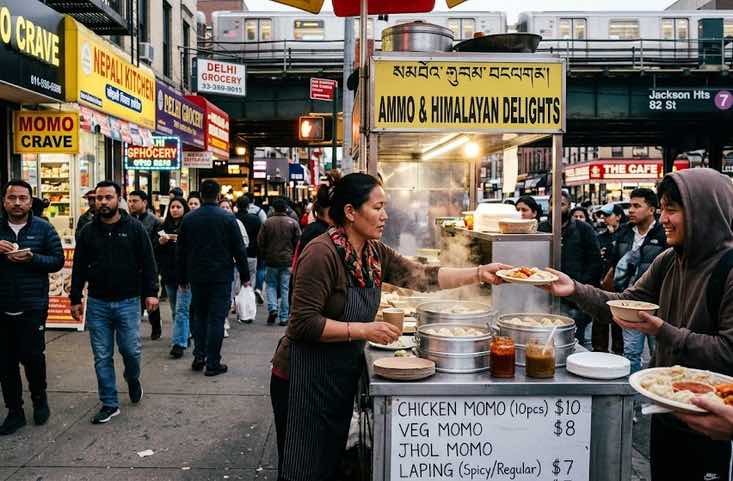
If you’ve spent any time eating your way through New York City, you already know that Queens reigns supreme for global street food. But within Queens, there’s a micro-corridor that most food media still hasn’t caught up to: the stretch of Roosevelt Avenue between 73rd and 76th Streets in Jackson Heights. This is where Himalayan cuisine — Tibetan, Nepali, Bhutanese, and the diaspora traditions in between — reaches a density and authenticity that doesn’t exist anywhere else in the Western Hemisphere. Explore more Tibetan street food coverage on NYSF and our NYC Chinatown Dumpling Guide!
The South Asian vendors just blocks away on 74th Street are part of the same Jackson Heights food story — our NYC South Asian Street Food Guide covers the full Indian, Pakistani, and Bangladeshi corridor.
I’m not being hyperbolic. In a four-block radius, you can eat hand-pleated momos steamed to order in bamboo baskets, slurp thukpa pulled fresh from broth pots that have been simmering since 6 a.m., and eat laphing — cold mung bean noodle sheets slicked with Sichuan chili oil — that most New Yorkers have never heard of. This isn’t fusion or adaptation. These are kitchens run by first-generation Tibetan and Nepali immigrants cooking the recipes they grew up on, using imported spice blends that don’t show up in mainstream supply chains. The Jackson Heights corridor also overlaps with one of the city’s great halal cart zones — Sammy’s Halal at 73rd & Broadway is a Vendy Cup winner serving 24/7. See our Ultimate NYC Halal Cart Guide for the full map.
If you’re building a full Jackson Heights food crawl, pair this guide with our NYC Empanadas & Arepas Guide — the Colombian and Venezuelan vendors on Roosevelt Avenue operate on the same blocks as the Himalayan carts covered here.
Want to stretch a Queens food day even further? The M or R from Jackson Heights to Steinway Street puts you a short walk from the falafel and shawarma counters in Astoria’s Little Egypt, including King of Falafel & Shawarma, the Palestinian cart-turned-storefront that won the 2010 Vendy Cup.
Watch this video to get a glimpse:
This guide exists because the Jackson Heights Himalayan food scene deserves the same obsessive, street-level documentation we give to taco corridors and dumpling houses. Every vendor listed here has been visited multiple times across different days and dayparts. Every dish note comes from direct observation, not secondhand reporting.
Interactive Vendor Map
Every vendor in this guide is pinned on our curated Google My Map below. Each pin includes the vendor name, specific address, and signature dish metadata. Zoom in on the Roosevelt Avenue corridor to plan your crawl route.
📍 Jackson Heights Himalayan Street Food Map — 10 curated vendor pins with signature dishes and addresses. Open full map →
Momo Anatomy: What Separates Great From Forgettable
The momo is the gateway dish. Everybody starts here, and most people stop here, which means they miss the enormous variation hiding inside what looks like a simple dumpling. A truly great Momo is an engineering project with three distinct failure points: the wrapper, the filling, and the seal.
Momo carts aren’t the only Queens food scene worth a subway detour. A few stops further out on the 7 train, Flushing runs its own dense corridor of Korean corn dog stalls, tteokbokki counters, and kimbap shops, all mapped in our NYC Korean Street Food Guide.
The Wrapper
Factory-made wonton skins are the first red flag. The best Jackson Heights momo vendors — Amdo Kitchen and Lhasa Fast Food among them — use hand-rolled wrappers made from a high-gluten flour dough rested for a minimum of 30 minutes. The result is a wrapper that’s thin enough to be slightly translucent when steamed, but with enough tensile strength to hold a pocket of soup-rich filling without tearing. You can test this yourself: pick up a steamed momo with chopsticks. If the wrapper stretches and sags without ripping, the dough was properly developed.
The Filling
Tibetan-style momos traditionally use yak meat, but in Jackson Heights the standard is a blend of ground beef and onion, seasoned with ginger, garlic, cilantro, and Sichuan pepper. The critical variable is the fat ratio. Too lean and the filling dries out during steaming; too fatty and you get a greasy slick instead of clean, concentrated meaty flavor. The benchmark is around 80/20 — the same ratio you’d use for a good burger. Nepali-style momos skew toward chicken or buff (water buffalo) and incorporate more green chili and cumin into the mix.
The Seal
The pleat pattern isn’t decorative — it’s structural. A Tibetan momo traditionally carries 12 to 18 pleats converging at the top, forming a sealed pouch that traps steam inside. That internal steam pressure is what finishes cooking the filling from the inside out. Sloppy pleating means steam escapes, which means dry filling. Watch the momo makers at Nepali Bhanchha Ghar — they pleat at a speed that borders on mechanical, and every single momo holds its shape.
The Vendor Matrix — 10 Essential Stops
This is not a “best of” ranking — it’s a tactical matrix. Each vendor excels at a specific dish or format, and the goal is to eat strategically, not redundantly. Use this table to plan which stops matter most for your palate.
| Vendor | Specialty | Signature Dish | Price Range | Best Time |
|---|---|---|---|---|
| Amdo Kitchen | Amdo-style Tibetan | Hand-pulled wrapper momos w/ chili oil | $8–$12 | Lunch (11a–2p) |
| Lhasa Fast Food | Central Tibetan | Beef momos & mung bean laphing | $7–$11 | All day |
| Nepali Bhanchha Ghar | Nepali home-style | Jhol momo (soup-based) w/ tomato achar | $9–$14 | Dinner (5p–9p) |
| Himalayan Yak | Tibetan-Nepali fusion | Yak meat thukpa | $10–$15 | Lunch |
| Phayul | Tibetan regional | Thenthuk (hand-pulled noodle soup) | $8–$13 | Weekday lunch |
| Mustang Thakali Kitchen | Nepali Thakali set meals | Dal Bhat Tarkari thali | $12–$16 | All day |
| Taste of Tibet | Comfort Tibetan | Tingmo (steamed bread) + stew | $7–$10 | Weekend brunch |
| Lali Guras | Nepali street snacks | Sel roti & chatpate | $5–$9 | Afternoon (2p–5p) |
| Cholha Ghar | Bhutanese-Nepali | Ema datshi w/ red rice | $10–$14 | Dinner |
| Bini’s Kitchen | Modern Nepali | Chili chicken momo | $9–$13 | Lunch & dinner |
Laphing Texture: Queens’ Cold Noodle Revolution
If momos are the gateway, laphing is the litmus test. This is the dish that separates the curious tourist from the committed eater, and it’s the single most underappreciated item in the entire Jackson Heights Himalayan food scene.
Laphing is a cold Tibetan dish made from mung bean starch — essentially a starch jelly that’s been set, cut into sheets or noodles, and dressed with a sauce of chili oil, Sichuan pepper, soy sauce, garlic, and black vinegar. The texture is unlike anything in the Western culinary vocabulary. It’s simultaneously slippery, chewy, and almost gelatinous — a quality the Tibetan word “laphing” captures better than any English translation. The closest analogue might be Korean acorn jelly (dotori-muk) or Chinese liangfen, but laphing has a denser bite and a more aggressive chili oil application.
There are two main formats you’ll encounter in Jackson Heights. Sheet-cut laphing arrives as flat, wide slabs — almost like cold lasagna noodles — stacked and dressed. This is the traditional Lhasa preparation. Noodle-cut laphing is julienned into thin strips that tangle and soak up more sauce per surface area. Both formats work, but they deliver different textural experiences, and most vendors only offer one.
The critical variable is the starch set. Under-set laphing crumbles into a gritty paste when you try to pick it up. Over-set laphing is rubbery and bouncy, like bad Jello. The ideal laphing has a clean snap when you bite through it — firm enough to hold its shape on chopsticks, soft enough to yield immediately once your teeth hit it. Lhasa Fast Food consistently nails this ratio, and their chili oil — made in-house with a Sichuan peppercorn base — adds a numbing, tingling heat that builds slowly across the palate.
The Small Batch Protocol — Why Timing Matters
Here’s something most food guides won’t tell you: the quality of Himalayan street food in Jackson Heights varies dramatically by time of day, and it’s not random. It follows what I call the “Small Batch Protocol” — the operational rhythm of kitchens that make everything to order in limited quantities.
These aren’t commissary kitchens cranking out hundreds of units from a central prep facility. Most Jackson Heights Himalayan vendors prep their momo filling in the morning, hand-pleat dumplings throughout the day, and steam or fry in batches of 20 to 40 at a time. When a batch sells out, you wait for the next one. This means the momos you eat at 11:30 a.m. — from the first batch of the day, made with freshly mixed filling and rested dough — are categorically different from the momos you eat at 8:45 p.m., when the dough has been sitting and the filling has oxidized slightly.
The same principle applies to laphing (best when freshly set, typically mid-morning), thukpa (best after the broth has had 4+ hours of simmering, so early afternoon), and sel roti (best within 20 minutes of frying, which usually happens in cycles around 3 p.m. at Lali Guras). Timing your crawl to intersect with these production windows is the single biggest quality upgrade you can make — and it costs nothing.
The 7-Train Momo Crawl: A 7-Stop Itinerary
We built a complete, stop-by-stop itinerary for this crawl as a standalone utility document. It covers all seven stops in optimal eating order, with transit directions between vendors, estimated time at each stop, and dish-specific ordering notes.
The full itinerary is published as a live, printable Google Doc that you can bookmark or save to your phone for offline use:
Access the Full Itinerary
📄 7-Train Momo Crawl Itinerary (Google Doc)
📍 Interactive Vendor Map (Google My Map)
The crawl begins at the 74th Street-Broadway station and works eastward along Roosevelt Avenue. Plan for approximately 3.5 to 4 hours if you’re eating at a moderate pace, or 2.5 hours if you’re splitting dishes with a partner and moving briskly. Bring water — the chili oil at several stops is not decorative.
Himalayan Culinary Glossary
If you’re new to Himalayan cuisine, this glossary covers the core vocabulary you’ll encounter at Jackson Heights vendors. Knowing these terms will help you order with confidence and understand the menus, many of which are only partially translated.
- Momo (མོག་མོག)
- Tibetan/Nepali dumpling, typically steamed or fried, filled with meat or vegetables. Analogous to Chinese jiaozi but with distinct spice profiles and pleat structures.
- Jhol Momo
- Nepali preparation where steamed momos are served swimming in a spiced tomato-sesame broth. “Jhol” means soup/gravy in Nepali.
- Laphing (ལ་ཕིང་)
- Cold Tibetan mung bean starch noodle/sheet dressed with chili oil, Sichuan pepper, soy, and vinegar. Served as a snack or appetizer.
- Thukpa (ཐུག་པ)
- Tibetan noodle soup with hand-pulled or hand-cut wheat noodles in a bone or vegetable broth, typically with meat and greens.
- Thenthuk (འཐེན་ཐུག)
- A variation of thukpa using hand-pulled, flat, irregular noodle pieces rather than round-cut noodles. Heartier and chewier.
- Tingmo (ཏིང་མོ)
- Steamed Tibetan bread, unsweetened, with a soft and airy crumb. Traditionally served alongside stews and curries for dipping.
- Sel Roti
- Ring-shaped Nepali rice bread, deep-fried to a crisp exterior with a soft, slightly sweet interior. Made from a fermented rice flour batter.
- Achar (अचार)
- Nepali-style condiment or pickle, ranging from fresh tomato-chili chutneys to fermented sesame pastes. Essential momo accompaniment.
- Dal Bhat Tarkari
- The foundational Nepali meal: lentil soup (dal), steamed rice (bhat), and vegetable curry (tarkari), typically served with achar and greens.
- Ema Datshi
- Bhutanese national dish of chili peppers cooked in a cheese sauce. Extremely spicy. Served with red rice.
- Chatpate
- Nepali street snack of puffed rice, chopped onions, tomatoes, cilantro, chili, and lemon juice tossed together. Crunchy, tangy, and spicy.
Further Reading & Entity Resources
This hub page is part of a comprehensive content ecosystem covering Jackson Heights Himalayan street food. Explore the supporting resources below for deeper dives into specific topics, downloadable assets, and interactive tools.
Supporting Deep-Dive Articles
These companion posts explore specific threads from this guide in greater depth:
- The Evolution of the Momo: From Lhasa to Roosevelt Avenue — Tracing the momo’s 700-year journey from Tibetan monastery kitchens to the 7-Train corridor.
- A Beginner’s Guide to Tibetan Laphing: Queens’ Cold Noodle Revolution — A technical breakdown of mung bean starch preparation, texture science, and the best laphing vendors in NYC.