
Last Updated: June 2026
It’s a Saturday in late May. You step off the B61 bus at Columbia and Bay Street and the smell hits you before you even round the corner — griddled masa, caramelizing onions, the faint char of peppers on an open flame. The Red Hook Ball Fields stretch out ahead of you, a patchwork of folding tables and hand-painted signs, the Atlantic glinting two blocks south. You’ve got $40 in your pocket, a full afternoon, and one of the best street food markets in the Western Hemisphere in front of you.
Here’s what no food magazine will tell you: the Red Hook Food Vendors aren’t a tourist attraction. They’re a community institution that’s been feeding Red Hook since 1974 — and the families running these stalls have Vendy Awards on their shelves and decades of craft in their hands. This isn’t a food festival. This is the real thing.
Red Hook’s ball field vendors run on a strict weekends-only schedule, which makes a backup plan useful. Flushing’s Korean street food corridor runs daily, and our NYC Korean Street Food Guide maps twelve vendors across corn dogs, tteokbokki, kimbap, and more for the days Red Hook isn’t an option.
Key Takeaway
The Red Hook Food Vendors — operating weekends from late April through October at the Brooklyn Ball Fields — are the longest-running Latin American street food market in NYC, anchored by two Vendy Award champions and representing at least six Central American and Mexican culinary traditions under one roof. Bring cash, arrive before noon, and plan for at least four stops.
Where Are the Red Hook Food Vendors?
The Red Hook Food Vendors set up at the Red Hook Ball Fields, along Bay Street and Clinton Street in Red Hook, Brooklyn. The market runs weekends only, late April through October, roughly 11am–8pm. There is no fixed date for opening weekend — follow redhookfoodvendors.com for the official season opener announcement each spring.
📍 Bay St & Clinton St, Red Hook, Brooklyn, NY 11231 | Open full interactive vendor map
Getting There
- Bus (easiest): B61 to Columbia St & Bay St — 2-minute walk to the fields
- Subway + walk: F/G to Smith–9th St (15 min walk) or Carroll St (18 min walk)
- Bike: Brooklyn Waterfront Greenway — racks at the fields
- Car: Street parking on Bay St; arrive before 11am or you’re circling for 20 minutes
- Cash only at all ball fields stalls — ATM on Van Brunt St
What’s the History Behind the Red Hook Food Vendors?
The Red Hook Food Vendors trace their roots to 1974, when the first Latin American families began selling food from folding tables at the ball fields to serve the neighborhood’s growing Central American immigrant community. What started as informal weekend cooking became a seasonal institution — a place where Salvadoran, Guatemalan, Mexican, and Colombian vendors cooked the food of home for a community that had built a new one in Brooklyn.

The market survived decades of neighborhood flux, the Giuliani-era permit crackdowns of the late 1990s, and most dramatically, Hurricane Sandy in 2012, which flooded Red Hook and shuttered the market for an entire season. Vendors rebuilt. Regulars returned. The ball fields came back stronger, with an official nonprofit structure — the Red Hook Food Vendors organization — formalizing vendor membership, food safety, and seasonal coordination.
The Vendy Awards — New York’s street food Oscars — have taken notice twice. El Olomega won the Vendy Cup in 2013. Solber Pupusas won in 2011. Both vendors still work the same stalls they’ve occupied for years. That kind of continuity is extraordinary in a city that reinvents itself every 18 months.
“In our years covering NYC street food, we’ve never found a market where the vendors’ tenure is this long, the craft this deep, and the prices this honest. The Red Hook Ball Fields are the benchmark for what a community food market should be — and almost no national food publication covers them with the seriousness they deserve.”
— NewYorkStreetFood.com
Who Are the Red Hook Food Vendors? The Complete Stall Guide
Ten vendors, six culinary traditions, one ball field. Here’s the full lineup — ranked by must-visit priority for first-timers.
| Vendor | Cuisine | Must Order | Price Range | Notable |
|---|---|---|---|---|
| El Olomega | Salvadoran | Loroco & chicharrón pupusa | $5–8 | 2013 Vendy Champion |
| Solber Pupusas | Salvadoran | Chicken tamale + horchata | $6–9 | 2011 Vendy Cup |
| Huarache King | Mexican | Huarache al pastor | $8–10 | Official RHFV vendor |
| Piaztlan | Mexican | Barbacoa taco + chorizo taco | $7–10 | Mexico City-style |
| Carrillo | Guatemalan | Guatemalan tostada | $4–6 | Most underrated stop |
| Vaquero Elotes | Mexican | Elote + hibiscus agua fresca | $5–7 | Start here |
| Ceron | Colombian | Chicharrón + arepa | $6–9 | |
| Ochoa | Mexican | Tamales | $4–6 | |
| Country Boys | Mexican | Fish taco | $4–7 | |
| Red Hook Lobster Pound | New England | Maine lobster roll | $22–28 | Card accepted; 284 Van Dyke St |
What’s the Best Strategy for Eating at Red Hook Ball Fields?
Go in order. Scout while you wait. Budget $35–45 for a full crawl across seven stops. Here’s the sequence we’ve dialed in over multiple visits.
View this post on Instagram
The 7-Stop NYSF Crawl
- Vaquero Elotes — Order the elote and an agua fresca. This is your scout lap.
- El Olomega — Join the line immediately. Order: loroco & chicharrón pupusa + one revuelta. Expect a 30-min wait by 1pm on Sundays.
- Solber Pupusas — Skip the pupusa on your first visit; order the chicken tamale instead. You’ll thank us.
- Carrillo — The Guatemalan tostada (fried tortilla, pickled beets, hard-boiled egg, queso, ground beef) is the most underrated plate at the entire market.
- Piaztlan — Barbacoa taco + chorizo taco. The beef cheek is slow-braised, mineral-deep, and the closest thing to a Mexico City taqueria you’ll find in Brooklyn.
- Huarache King — One huarache al pastor: oblong masa cake, griddled crisp, beans, meat, crema, queso fresco. Your savory anchor.
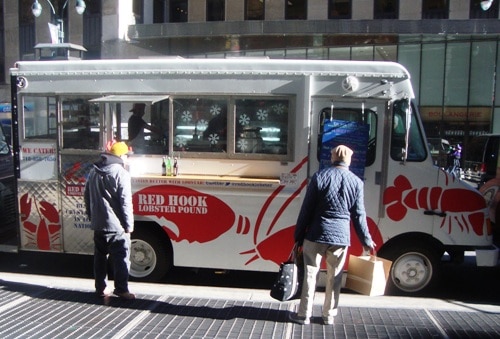
- Red Hook Lobster Pound (bonus) — Walk 10 minutes south on Van Brunt to 284 Van Dyke St. Maine lobster roll, cold and mayo-dressed on a split-top bun. Cards accepted. Budget $22–28.
The complete step-by-step crawl with timing notes, line strategy, and ordering tips lives in our printable guide: Red Hook Food Vendors: The NYSF Crawl Itinerary
What Makes Red Hook’s Food Different From Any Other NYC Street Market?
The short answer: masa. The long answer is what we call the masa continuum — and it’s one of the most fascinating food stories playing out on a single block in New York City.
View this post on Instagram
Masa is nixtamalized corn dough, ancient in origin, central to Mesoamerican cooking. At the Red Hook Ball Fields, you encounter it in three radically different forms within a 50-foot radius:
- Pupusa (El Olomega, Solber) — thick, hand-patted, griddled masa disk, stuffed and sealed before cooking. Salvadoran in origin. The exterior gets a light char; the interior stays molten and yielding. Served with curtido (fermented cabbage slaw) and a thin tomato salsa.
- Huarache (Huarache King) — masa elongated into a sandal shape, par-cooked, then finished on a griddle until the exterior crisps. Mexican in origin. Structurally sturdier than a pupusa — this is a platform, not a pocket.
- Tamale (Solber, Ochoa) — masa wrapped around filling, sealed in corn husks or banana leaves, then steamed. The cooking method transforms the texture entirely: soft, almost custard-like, with none of the griddle char of the other two.
Same grain. Three civilizations. Three completely different philosophies about what corn should become. No other market in New York puts all three in direct comparison like this.
That same masa tradition extends across the boroughs — our NYC Empanadas & Arepas Guide maps the Colombian and Venezuelan arepa and empanada vendors in Jackson Heights and Astoria who share the same corn-dough lineage as the Red Hook vendors.
Our Experience
We visited the ball fields on a Sunday in May 2026. El Olomega’s loroco and chicharrón pupusa had a griddle-charred exterior that gave way to a filling of tender pork cracklings and loroco flowers — a flavor combination that’s savory, slightly floral, and impossible to replicate. The curtido alongside it had been fermenting long enough to develop real sourness, not just quick-pickled crunch. At Piaztlan, the barbacoa taco was built on a corn tortilla that had been pressed and cooked to order — soft, slightly thick, with enough body to hold the slow-braised beef cheek without disintegrating. We counted six separate vendors selling some form of masa product. We ate all of them. Zero regrets, zero leftovers.
Is Red Hook Worth the Trip? An Honest Breakdown
Red Hook is not on the subway. That’s the one legitimate objection to this market — and it’s also why it stayed under the radar long enough to become this good.
| Reader Type | Worth It? | Reason |
|---|---|---|
| NYC local, food-obsessed | Yes — mandatory | This is the benchmark. You should know it the way you know Katz’s. |
| Visitor with 1+ weekend day | Yes | B61 from Downtown Brooklyn is 20 minutes. Build in the afternoon. |
| Budget eater | Yes | $20 gets you a full meal across 3 stops. Best value-per-quality in Brooklyn. |
| Group of 4+ | Depends | Great for grazing groups; bad for anyone who needs a table and shade in August. |
| Visitor with only weekday availability | No | Ball fields vendors operate weekends only. Plan accordingly. |
Plan Your Visit
Before you go, download the NYSF Neighborhood Street Food Walking Route Map Pack — our curated walking sequences for Red Hook and six other NYC food corridors, with timing grids and ordering notes built in.
What Else Is in the NYSF Street Food Universe?
Red Hook is one node in a larger spiderweb. If you’re building your NYC street food literacy, these are the adjacent guides worth reading next:
- NYC Street Taco Guide — Piaztlan at the ball fields is the Red Hook node of a taco ecosystem that runs from Corona to Sunset Park. This guide maps all of it.
- NYC Halal Cart Guide — The other great outdoor street food tradition in the five boroughs. Different borough, different culinary lineage, same level of craft.
- Jackson Heights Himalayan Street Food Guide — For when you want to see what happens when a food community builds something just as deep and just as long-running, 45 minutes north in Queens.
- NYC Chinatown Dumpling Guide — Because every serious street food eater in this city should know their way around Eldridge Street as well as Bay Street.
Red Hook Food Vendors: Frequently Asked Questions
When do the Red Hook Food Vendors open for the season?
The ball fields market typically opens in late April and runs through October, weekends only, approximately 11am–8pm. The exact opening weekend varies by year — check redhookfoodvendors.com for the official announcement.
Is it cash only at Red Hook Ball Fields?
Yes — all ball fields vendors are cash only. The nearest ATM is on Van Brunt Street. Red Hook Lobster Pound at 284 Van Dyke Street (10 minutes away on foot) does accept cards.
What is a pupusa and where should I get one at Red Hook?
A pupusa is a thick, hand-shaped masa disc stuffed with fillings — typically cheese, chicharrón (pork), beans, or loroco (an edible flower), then griddled until the exterior is lightly charred. At Red Hook, El Olomega (2013 Vendy Champion) and Solber Pupusas (2011 Vendy Cup) are both Salvadoran vendors with decades of experience. El Olomega’s loroco and chicharrón pupusa is the move for first-timers.
What is a huarache?
A huarache is a Mexican street food made from masa that’s shaped into an elongated oval (like the sandal it’s named after), par-cooked, then finished on a griddle until the exterior crisps. It’s topped with beans, your choice of meat, crema, and queso fresco. At Red Hook, Huarache King is the place.
How much does it cost to eat at Red Hook Ball Fields?
Individual items range from $4 (tamales, tostadas) to $10 (huaraches, tacos with premium proteins). A full crawl across four to five stops — enough to feel completely satisfied — typically runs $25–40 per person. The Red Hook Lobster Pound nearby is the one splurge on the crawl at $22–28 for a lobster roll.
Did Red Hook Food Vendors survive Hurricane Sandy?
Yes. Hurricane Sandy in October 2012 flooded Red Hook and shut down the ball fields market for a full season. The vendors rebuilt and returned in 2013 — the same year El Olomega won the Vendy Cup, which many regulars regard as a kind of symbolic comeback.