
Last Updated: June 2026
You’re standing at a Jackson Heights street cart. There are two arepas on the griddle. One is flat, maybe half an inch thick, with char marks on both sides and what looks like melted cheese oozing from the center. The other is on the menu board above you — thick, round, and listed with fillings: reina pepiada, pabellon, carne mechada. Same word on both menus. Completely different food. And nobody around you is going to explain the difference unless you already know to ask.
This is the NYC arepa literacy problem. Every food guide in the city uses the word “arepa” as though it describes a single thing. It doesn’t. Colombian and Venezuelan arepas are built from different ingredients, using different processes, producing different textures and different eating experiences. The empanada situation is the same: three separate traditions — Colombian cornmeal, Argentine wheat pastry, Puerto Rican pastelillo — that most food writers have collapsed into one word. This guide teaches you how to read the food. Walk up to any cart or counter in New York City and immediately know what you’re looking at, what to order, and how to eat it.
Key Takeaway
Two questions unlock every arepa and empanada menu in NYC: (1) Is the arepa flat or thick? Flat = Colombian, thick = Venezuelan. (2) Is the empanada shell cornmeal or pastry? Cornmeal = Colombian, pastry = Argentine. Answer those two questions and the rest of the menu decodes itself. This post gives you the ingredient-level science behind both distinctions — so you’re never confused at a street cart again.
What Is the Actual Difference Between Colombian and Venezuelan Arepa Dough?
The ingredient difference is corn. The functional difference is what happens to that corn before it becomes dough — and that distinction determines everything about texture, structure, and how the arepa behaves on the griddle.
Colombian arepa dough is masa de maíz: corn that has been soaked, ground, and worked into a wet dough with some salt and fat. The starch in masa de maíz is largely in its native, uncooked state — which means when it hits the griddle, the heat gelatinizes it in place, creating a dense, slightly gritty structure that cooks from the outside in. The result is a flat cake, firm throughout, with no air pockets. It doesn’t puff. It doesn’t split. It grills like a cornmeal patty.
Venezuelan arepa dough uses masarepa: corn that has been cooked, dried, and ground into a fine flour before it ever reaches your kitchen. P.A.N. is the dominant commercial brand — as Serious Eats explains in their arepa deep-dive, P.A.N. cornmeal has a pre-gelatinized starch structure, meaning the starch has already been cooked once and then dried. When you rehydrate masarepa and form it into a thick round, then cook it on a dry griddle and finish it in the oven, the exterior gelatinizes rapidly into a crackling crust while the interior retains moisture and produces steam. That steam is what creates the hollow interior. The arepa puffs. It can be split horizontally along the equator without crumbling, because the pre-gelatinized starch structure holds the walls intact.
Watch this video to learn more:
“The reason the Venezuelan arepa puffs and the Colombian one stays flat is not a style preference — it’s a starch chemistry difference. You cannot make a puffing arepa from masa de maíz, and you cannot make a proper flat choclo arepa from P.A.N. They are not interchangeable ingredients.”
Colombian vs. Venezuelan Arepa Dough Science
| Factor | Colombian (Masa de Maíz) | Venezuelan (Masarepa / P.A.N.) |
|---|---|---|
| Corn processing | Raw/soaked, ground fresh or dried | Cooked, dried, pre-ground (pre-gelatinized) |
| Starch state | Native (raw starch) | Pre-gelatinized |
| Profile | Flat, under 1 inch thick | Thick, 1.5+ inches, puffed |
| Interior texture | Dense, slightly gritty throughout | Soft, doughy interior; crackling crust |
| Can be filled? | Before griddling (stuffed) or topped | Split after cooking and filled |
| Primary cooking method | Griddle only | Griddle + oven finish |
How Do You Identify a Colombian Arepa at a Street Cart?
Flat profile — under one inch — is your first visual tell. At Roosevelt Avenue sidewalk carts, you’ll see them on the griddle directly, and you can read the geometry immediately: a Colombian arepa lies nearly flush with the cooking surface, developing char spots on both faces. A Venezuelan arepa sits up from the surface on its own structure.
The varieties to know at Colombian street carts:
- Arepa de choclo — the Arepa Lady’s signature. Sweet fresh corn (choclo, not dried corn), white cheese mixed into or melted onto the center. Slightly sweet, rich. Order this first.
- Arepa de queso — salted dried-corn masa with white cheese mixed directly into the dough. More savory, denser, less sweet than choclo.
- Arepa rellena — stuffed before griddling, typically with beef, chicken, or cheese. Sealed shut, no split required. You bite into it.
- Arepa mixta — flat arepa topped after griddling, usually with shrimp, hogao (tomato-onion sofrito), or chicharrón. The toppings version.
How to order at Jackson Heights carts: Point to the arepa de choclo first. If the cart has arepas rellenas displayed, ask what the filling is — most will answer in Spanish, and “pollo” or “carne” covers most options. Price as of 2026: $4–$6 each at sidewalk carts.
Watch this video to learn more:
Our Experience
We visited El Pequeño Colombia on 84th Street and the Arepa Lady’s cart on 79th and Roosevelt on the same evening in May 2026. At El Pequeño Colombia, the arepa de queso arrived dense and hot with a slight crust, served with a small cup of hogao on the side — $4. At the Arepa Lady’s cart at around 10:30 PM, the arepa de choclo took about seven minutes: edges slightly charred, center molten with white cheese, sweet corn flavor dominant. $6. Two Colombian empanadas (beef and potato, fried) from the adjacent cart came with aji amarillo, two for $5. Full field meal for $15, standing on Roosevelt Avenue. This is what the food is actually supposed to be.
How Do You Identify a Venezuelan Arepa at a Counter or Cart?
Thick round, pale exterior, and a menu organized around fillings rather than toppings or varieties — that’s your visual and textual identification at a glance. Venezuelan arepa counters display the fillings prominently because the arepa itself is structurally neutral: it’s a vessel. The flavor is in the filling.
The interior should be soft and slightly doughy — not raw, not bready. When split along the equator, a properly cooked Venezuelan arepa holds together at the walls and has a hollow center, ready to receive filling. If the interior is gummy or collapses, the cooking time was wrong. If it’s dry and bready, the hydration was off in the dough.
Key fillings at NYC Venezuelan operations:
- Reina pepiada — shredded chicken, avocado, mayonnaise. The Venezuelan national default filling. Creamy, cool, rich. Order this if you’re deciding.
- Pabellon — shredded beef (carne mechada), black beans, sweet plantain, white cheese. The full Venezuelan plate compressed into an arepa. Most complex flavor profile on the menu.
- Carne mechada — shredded beef only, dry-braised. Clean, meaty, no sweetness.
- Caraotas negras — black beans with white cheese. Vegetarian, filling, earthy. The most underrated item on most Venezuelan menus in NYC.
How to order at Arepas Cafe, Shachi’s, or Guacuco: Name the filling, not the arepa style. Say “reina pepiada” and they’ll build it. Price as of 2026: $12–$16 at sit-down Venezuelan spots; $8–$10 at counter operations. Time Out New York’s arepa roundup covers current Venezuelan operations citywide.
“Anti-ad check: the most-photographed Venezuelan arepa in NYC is usually the reina pepiada at a branded Midtown spot. The best one — significantly cheaper, identical filling, 35-minute wait shorter — is at Arepas Cafe in Astoria, which has been making these since 2000 and doesn’t advertise.”
What Are the Different Styles of NYC Street Empanadas — and How Do You Tell Them Apart?
Three empanada traditions coexist in New York. Shell material and size are the two identification markers you can read at a glance — you don’t need to taste them to know which tradition you’re looking at.
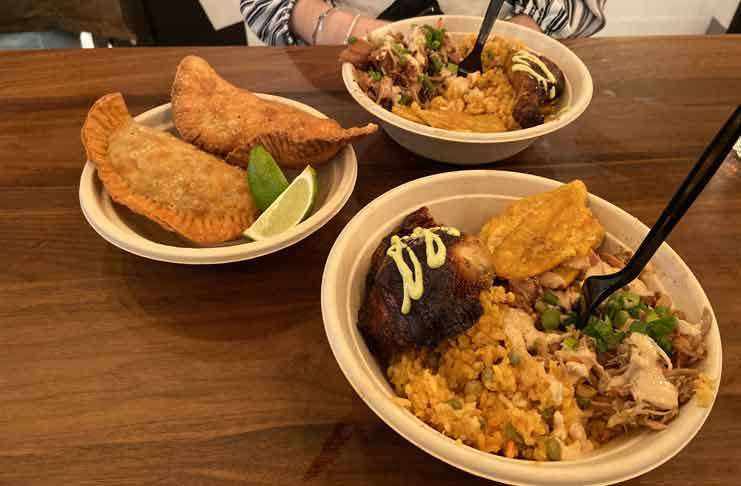
Colombian cornmeal empanada: Fist-sized. Pale gold cornmeal shell — smooth on the exterior, slightly rough in texture. Deep-fried. Bite through the shell and you get a slightly gritty crunch from the masa, then soft beef-and-potato filling seasoned with cumin. Always served with aji amarillo dipping sauce, which is the critical flavor pairing — the bright acidity of the aji cuts the fat from frying. Price at Jackson Heights carts: $2–$3 each as of 2026.
Argentine flour empanada: Larger — closer to the size of a folded taco, not a fist. Wheat pastry shell, deeper brown from frying or baking, visibly richer in color and sheen. Look for the repulgue: a crimped-rope edge pattern along the sealed edge that in traditional Argentine kitchens identifies the filling type (a twisted rope versus a flat crimp versus specific fold patterns). As Eater NY reviewed in their Nuchas coverage, the Argentine empanada at Nuchas runs $5–$7 each as of 2026. The classic beef filling includes olives and hard-boiled egg, which the Colombian version does not.
Puerto Rican pastelillo: Thinner shell, closer to a fried dumpling wrapper in texture — very flaky, almost shatteringly crisp when fresh. Smaller than the Argentine version, similar in size to the Colombian. No crimped edge pattern. The dough is more neutral, letting the filling (usually seasoned beef or chicken with sofrito) carry the flavor. Found primarily in Bronx and East Harlem street food spots.
Colombian vs. Argentine vs. Puerto Rican Empanada Style Comparison
| Factor | Colombian | Argentine | Puerto Rican |
|---|---|---|---|
| Shell material | Cornmeal (masa de maíz) | Wheat flour pastry | Thin wheat wrapper |
| Shell color when fried | Pale gold | Deep brown | Light to medium brown |
| Size | Fist-sized, small | Larger, hand-length | Small-medium |
| Edge treatment | Sealed, no pattern | Repulgue (crimped rope) | Sealed fold, very thin |
| Standard filling | Beef + potato + cumin | Beef + olive + egg | Beef or chicken + sofrito |
| Sauce | Aji amarillo | Chimichurri | Hot sauce or none |
| Price range (2026) | $2–$3 each (street cart) | $5–$7 each (Nuchas) | $2–$4 each |
The Colombian arepa and empanada tradition’s connection to the broader NYC Latin food ecosystem runs deep. As the masa continuum at the Red Hook Ball Fields demonstrates, the same corn-based dough traditions that define Colombian street food also underpin pupusas, huaraches, and tamales across the borough — different nationalities, same ancient grain logic. And the hand-formed dough traditions in NYC Chinatown show how the same concept — starch wrapper around a filling — recurs across entirely different culinary lineages in the same city.
What Should You Actually Order at Each NYC Vendor?
Vendor-by-vendor ordering guide, based on what we’ve eaten and what represents each operation at its best.
| Vendor | Tradition | First Order | Second Order | Price Range (2026) |
|---|---|---|---|---|
| Arepa Lady | Colombian | Arepa de choclo | Arepa rellena (beef) | $4–$6 each |
| Arepas Cafe (Astoria) | Venezuelan | Reina pepiada | Pabellon | $12–$16 per arepa |
| Shachi’s (Midtown) | Venezuelan | Pabellon arepa | Carne mechada empanada side | $13–$17 |
| Guacuco (Bushwick) | Venezuelan | Patacon (fried plantain platform) | Reina pepiada arepa | $8–$14 |
| Empanadas Monarca | Colombian | Beef empanada + aji sauce | Order two | $2.50–$3 each |
| Nuchas (Midtown/FiDi) | Argentine | Classic beef + chimichurri | Portobello mushroom | $5–$7 each |
| Palenque (truck) | Colombian | Chicken arepa | Ajiaco soup combo | $12–$16 combo |
| El Pequeño Colombia | Colombian | Arepa de queso | One empanada — under $8 total | $3–$5 per item |
Free Download
Walking into an unfamiliar arepa or empanada counter and not sure what to order? Download the NYSF What To Order Pocket Cards Guide — printable, pocket-sized ordering cards for the major NYC street food categories, including Latin American formats.
Our Verdict: How to Navigate Any NYC Arepa or Empanada Menu
The Two-Question Framework
Question 1: Is the arepa flat or thick? Flat (under 1 inch, griddled open-faced) = Colombian. Thick (1.5+ inches, puffed, split and filled) = Venezuelan.
Question 2: Is the empanada shell cornmeal or pastry? Pale gold, small, gritty exterior with aji sauce = Colombian cornmeal. Larger, deep brown, crimped edge with chimichurri = Argentine wheat pastry.
Answer those two questions and every vendor menu in NYC becomes readable. You don’t need to memorize every filling or every style — you need to know the structural logic, and the rest decodes itself.
For the full cross-borough vendor map and crawl itinerary, the NYC Empanadas & Arepas Guide is the comprehensive hub. For the immigration history that explains why these traditions are separate, the history of how both traditions arrived in New York tells the full story from pre-Colombian corn culture to the current Jackson Heights sidewalk. We’ve also published full vendor visits for Shachi’s Venezuelan arepas and empanadas and Palenque’s Colombian chicken arepa.
“After years of eating our way through Jackson Heights, Astoria, and Bushwick, the clearest thing we can tell you about NYC’s arepa scene is this: the word ‘arepa’ on a menu tells you almost nothing. The shape tells you everything.”
Worth the Trip? — Best For by Dish Type
| Reader Type | Best Dish | Verdict |
|---|---|---|
| Budget eater, $10 or less | Colombian arepa + empanada (street cart) | Yes — $7–$9 total for both |
| First Venezuelan arepa | Reina pepiada at Arepas Cafe | Yes — still the best version in NYC |
| Want the full cultural history on a plate | Arepa Lady cart, late night | Yes — this is living food history |
| Argentine empanada seekers | Nuchas classic beef | Yes — different category, worth the $6 |
| Vegetarian | Caraotas negras arepa (Venezuelan) | Yes — the most underrated item on the menu |
“We’ve spoken with vendors at Colombian street carts in Jackson Heights who have watched the same food become ‘trendy’ every few years while their customer base — the Colombian and Ecuadorian community that’s been buying arepas on this corner for 40 years — barely registers the media attention. The trendiness arrives. It leaves. The cart stays.”
“No other NYC street food category has a clearer divide between what the food media ‘discovers’ every five years and what has been operating continuously and quietly for decades. The Arepa Lady was not waiting to be discovered. She was cooking.”
Frequently Asked Questions
What is masarepa?
Masarepa is a precooked cornmeal flour used to make Venezuelan arepas. The corn is cooked, dried, and ground before packaging, giving it a pre-gelatinized starch structure. The P.A.N. brand is the dominant commercial product used in NYC Venezuelan operations. Masarepa is not interchangeable with masa harina or masa de maíz — the gelatinization difference is why the Venezuelan arepa puffs and holds its structure when split.
What is reina pepiada?
Reina pepiada is the most iconic Venezuelan arepa filling: shredded poached chicken mixed with mashed avocado and mayonnaise, seasoned with salt and lime. It’s creamy, cool, and rich against the crackling exterior of the arepa. The filling was reportedly named after a Venezuelan beauty queen in the 1950s. In NYC, it’s the default recommendation at any Venezuelan operation.
How do you eat a Colombian arepa?
A Colombian arepa is eaten as a flat, open-faced item — usually held in the hand or placed on a wrapper. An arepa de choclo is typically complete as-is (the cheese is baked or melted in). An arepa rellena is stuffed before griddling and eaten like a thick patty. An arepa mixta has toppings applied after cooking. No splitting required — unlike Venezuelan arepas, the Colombian format doesn’t produce a hollow interior.
What is the best empanada filling in NYC?
By tradition: the Colombian beef-and-potato empanada with aji amarillo sauce is the best value and most historically significant option at Jackson Heights street carts ($2–$3). For the Argentine format, the classic beef with olive and egg at Nuchas ($5–$7) represents the style well. The answer depends on which tradition you’re asking about — they’re different foods.
What is P.A.N. cornmeal?
P.A.N. (Producto Alimenticio Nacional) is a Venezuelan brand of precooked white cornmeal — masarepa — that is the standard base ingredient for Venezuelan arepas. Its pre-gelatinized starch structure produces the characteristic puffing and structural integrity of the Venezuelan format. Without P.A.N. or an equivalent masarepa, authentic Venezuelan arepas cannot be replicated. It’s available in Latin grocery stores throughout Jackson Heights, Corona, and Astoria.
- About the Author
- Latest Posts

Emma Wrayne Rudy is an NYC-based food writer and storyteller dedicated to uncovering the city’s best hidden gems. Her passion for the culinary world sparked at age 17 in Los Angeles, where she spent her days exploring neighborhood eateries and documenting her dining experiences. Now immersed in New York City’s endless food scene, Emma shines a spotlight on the diverse, affordable, and underrepresented culinary cultures that define the five boroughs—from historic food carts and mobile trucks to beloved “mom-and-pop” storefronts.