
Last Updated: June 2026
Before you get to Red Hook, before you figure out which bus or ferry gets you to Bay Street, you need to settle one question: what are you actually eating, and why does it matter? Because the menu at the Red Hook Ball Fields is not a random assortment of street food items. It is a narrow, precise expression of a single ingredient — nixtamalized masa — interpreted across four distinct culinary traditions, cooked four different ways, by four different families who have been refining each form for decades. This is the masa continuum. Understanding it is the difference between eating well and eating transformatively.
Key Takeaway
Every masa-based dish at the Red Hook Ball Fields — pupusa, huarache, tamale, baleada — begins with the same ancient process: nixtamalization. Dried corn cooked in an alkaline solution of water and calcium hydroxide (cal), rinsed, and ground into a pliable dough. What varies is what happens next: the thickness, the cooking surface, the filling architecture, and the regional tradition each form carries with it. This is not interchangeable food. Each form is its own discipline.
We’ve spent multiple seasons working our way through the ball fields systematically — not just eating, but watching. Watching how El Olomega’s cook presses a pupusa with the specific lateral palm motion that produces a uniform 8mm thickness. Watching how Huarache King’s masa is noticeably coarser than the pupusa masa next door, giving the huarache that dense, slightly grainy resistance that holds up under serious toppings. These are not accidents. They are technique — specific, practiced, irreplaceable technique.
What Is Nixtamalization — and Why Does It Make Red Hook’s Food Different From Everything Else?
Nixtamalization is the 3,500-year-old Mesoamerican process that transforms dried corn into something structurally and nutritionally entirely different. Dry corn kernels are soaked and cooked in an alkaline solution — traditionally water mixed with cal (calcium hydroxide, or slaked lime) — for several hours. The alkaline environment breaks down the kernel’s outer pericarp, releases bound niacin (vitamin B3) that is otherwise nutritionally unavailable to humans, and chemically restructures the corn’s protein and starch matrix into a form that, when ground, becomes plastic and pliable rather than crumbly.
“Every corn tortilla, every pupusa, every huarache, every tamale in the world is built on nixtamalization — a chemical transformation so fundamental that without it, the Mesoamerican civilizations that invented it would not have been nutritionally viable.”
What this means at the ball fields: the vendors who use fresh masa ground in-house (or sourced from a local masa producer who nixtamalizes their own corn) are working with a fundamentally different material than vendors using masa harina — the industrial dehydrated and rehydrated powder sold under brands like Maseca. Fresh nixtamalized masa has a complexity of flavor, a specific corn sweetness and mineral depth, that the reconstituted powder can approximate but never match. Serious Eats has documented this distinction in depth, and at Red Hook you can taste it in real time by ordering from two different vendors and paying attention.
Watch this video to get a glimpse:
What Makes a Great Pupusa — and Who Makes the Best One at Red Hook?
The pupusa is El Salvador’s national dish and the anchor item of the Red Hook market. Structurally, it is a thick corn masa disc — typically 15-18cm in diameter and 8-12mm thick — stuffed before cooking with a filling that gets sealed inside and cooked on a dry comal (a flat cast iron griddle) until both faces develop a char-blistered exterior while the masa cooks through to a dense, pillowy interior. The filling choice determines the flavor profile; the comal temperature and cooking time determine the texture.
Our Experience — Pupusa
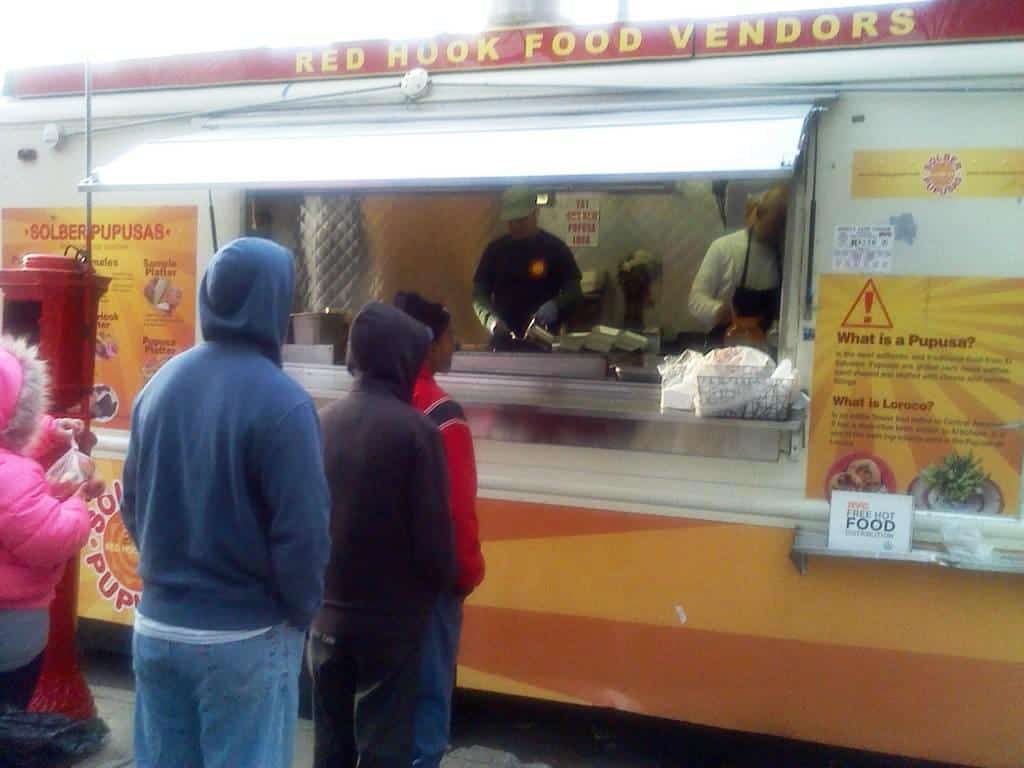
We visited Solber Pupusas in May 2025. The loroco and cheese combination ($6 as of that visit) is the benchmark — loroco is a Central American flower bud with a grassy, slightly fermented flavor that hits differently than any filling you’ve encountered elsewhere, and Solber’s version has a generous proportion that keeps each bite floral and specific. El Olomega’s revuelta (pork, beans, and cheese) is a richer, more animal-forward experience — better for first-timers who want to understand what the dish can do at maximum filling density. Expect a 15-25 minute wait at both on peak Saturdays. Worth every minute.
A pupusa is always served with curtido — a lightly fermented cabbage slaw with a mild acidic snap from vinegar and oregano — and salsa roja. The curtido functions as a textural counterpoint to the dense masa, and its slight fermentation adds a probiotic complexity that you don’t get in a fresh slaw. At its best, the trio of pupusa, curtido, and salsa roja is one of the most structurally complete bites in street food: fat from the cheese and pork, starch from the masa, acid from the curtido, heat and brightness from the salsa.
How to Order: Pupusa
- First-timer: Revuelta (mixed pork, beans, cheese) at El Olomega — the maximum expression of the form
- Adventurous: Loroco and cheese at Solber Pupusas — nothing else tastes like this in New York
- Always: Accept the curtido and salsa roja — they are not garnish, they are structural components
- Price (2025-26): $5-8 per pupusa depending on filling
- Cash only at both anchor vendors
What Is a Huarache — and Why Is It the Most Structurally Interesting Item on the Menu?
The huarache takes its name from the Nahuatl word for sandal — and the visual reference is exact. An elongated, oval masa base, roughly 25-30cm long and 8-10cm wide, pressed thicker than a tortilla but thinner than a pupusa, cooked on a comal or griddle until firm and slightly charred on the exterior, then loaded with toppings that build upward in a specific architectural sequence: beans first (as a structural binding layer), then protein, then salsa, then fresh toppings.
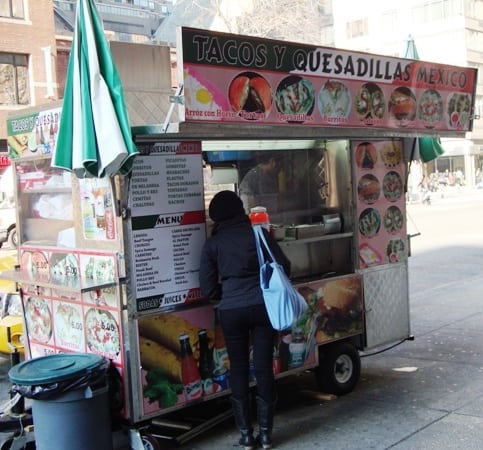
The masa at Huarache King is noticeably coarser and more compressed than pupusa masa — a deliberate choice that gives the base the structural rigidity to support heavier toppings without collapsing. Food & Wine has recognized Red Hook’s huarache vendors as some of the best in the country, and we agree — though we’d add that the specific masa density is the key variable that separates a great huarache from an average one.
“The huarache is the most under-ordered item at Red Hook. Every first-timer goes straight for the pupusa. The regular goes for the huarache. That ordering tells you everything about the learning curve.”
How to Order: Huarache
- Protein: Carne asada or chorizo — both work structurally; chorizo gives more fat to counterbalance the masa density
- Don’t skip: The bean base layer — it binds everything and adds an earthiness that balances the char on the masa
- Practical note: Eat with two hands. The huarache is substantial — this is a meal, not a snack
- Price (2025-26): $9-12 depending on protein
- Portion: One huarache is a full meal for most people; two is ambitious
What Makes the Tamale the Most Technically Complex Item on Site — and the Most Underappreciated?
The tamale is the oldest item on this menu and the most technically demanding to produce. Unlike the pupusa or huarache, which are cooked to order on a hot surface, the tamale is an assembled-and-steamed product that begins hours before service. Masa is mixed with lard (or vegetable shortening) and broth until it reaches the specific consistency — it passes the float test when a small ball of it dropped into water rises to the surface, indicating the fat is properly aerated into the dough — then spread onto a corn husk, filled, folded, and steamed in batches for 60-90 minutes.
The result is a masa that is softer, more yielding, and more aromatic than either the pupusa or huarache — the corn husk imparts a faint vegetal sweetness during steaming, and the lard creates a richness that the comal-cooked forms don’t have. The Guatemalan vendors at Red Hook often offer chuchitos — smaller tamales wrapped in corn husks with a firmer, more compact masa — alongside the larger Mexican-style versions. They are the most commonly overlooked item on site and, in our estimation, the most underappreciated.
How to Order: Tamale
- Order early: Tamales sell out by early afternoon on peak weekends — they cannot be made to order
- The chuchito: If available at the Guatemalan vendor station, order one alongside a standard tamale to understand the masa density difference
- Texture note: The masa should be soft enough to yield to slight pressure but hold its shape when you peel the husk. Dry crumbling = overcooked or held too long
- Price (2025-26): $4-7 depending on size and filling
- Pairing: Best with a cold agua fresca — the tamale’s richness needs something bright and cold alongside it
Free Download
Heading to Red Hook and want a quick-reference guide for ordering across all four masa forms? Download the NYSF What To Order Pocket Cards Guide — a printable field reference covering the best ordering sequences at Red Hook and other NYC street food corridors we cover.
What Is a Baleada — and Why Does It Bridge the Gap to the Next Chapter of This Story?
The baleada is the fourth form in the continuum — and the one that most stretches the definition. Originating in Honduras, specifically from the northern coastal city of La Ceiba, it is built on a flour tortilla rather than a masa corn base. This makes it technically masa-adjacent rather than masa-proper — the wheat flour construction means it sits outside the nixtamalization process — but its cultural and culinary role at Red Hook is identical to the other forms: a carbohydrate base, a filling, a condiment, an identity marker for the community that makes it.
The standard baleada is a thick, slightly charred flour tortilla folded around refried beans, crumbled queso seco, and Honduran crema. The full version (baleada especial) adds scrambled eggs, avocado, and meat. It is the most filling item at the market and the one that most resembles breakfast food — which is precisely why it’s been a staple of Honduran working-class morning culture for a century.
We mention the baleada here because it is the bridge form — the item that connects the Red Hook market’s Salvadoran and Mexican masa traditions to the Honduran food culture that will reappear in the Jackson Heights corridor. If the Red Hook Ball Fields are the capital of Central American street food in Brooklyn, Jackson Heights is where the map extends to Colombia, Ecuador, and a different set of masa traditions entirely. The baleada is the transition point in that story.
For the broader picture of how these traditions fit into NYC street taco traditions and the Mexican food corridors of the five boroughs, that thread runs deeper than this market alone.
The Four Forms, Head to Head: What’s the Actual Difference?
| Form | Base | Cook Method | Texture | Vendor | Price (2026) |
|---|---|---|---|---|---|
| Pupusa | Corn masa (fine) | Dry comal, both sides | Char-blistered exterior, pillowy interior | El Olomega, Solber | $5-8 |
| Huarache | Corn masa (coarse) | Griddle, topped after | Dense, grainy, sturdy base | Huarache King | $9-12 |
| Tamale | Corn masa + lard | Steamed in corn husk | Soft, yielding, aromatic | Guatemalan vendors | $4-7 |
| Baleada | Wheat flour tortilla | Griddle, then folded | Thick, slightly charred, yielding | El Olomega + others | $6-10 |
Which Form Is Most Underappreciated — and What’s Our Honest Verdict?
The tamale. Without question. The pupusa gets all the media attention — two Vendy wins will do that — and the huarache has a devoted regular audience who know exactly what they’re doing. But the tamale is the form that requires the most skill to produce, the most advance preparation, and the most precise masa calibration. It is also the item most likely to sell out and the one most people skip because they don’t understand what they’re looking at.
“If you leave Red Hook without trying a tamale from the Guatemalan vendor station, you’ve seen 75% of what the market offers. The missing 25% is the oldest masa form on site and the one that will teach you the most about where this food comes from.”
Our Verdict
The four masa forms at Red Hook are not interchangeable options from a shared menu. They are four distinct culinary traditions that happen to share an ingredient and a ZIP code. The ideal Red Hook visit orders at least three of the four forms and eats them in sequence: start with the pupusa (the introduction), move to the huarache (the main), and close with the tamale (the history lesson). The baleada is the bonus round — order it if you have room and you want to understand the full geographic range of what this market represents.
For the full vendor context and operating information, visit our Red Hook Food Vendors Guide. For the fifty-year story of how these vendors got here and what they survived, read the history of these vendors — it reframes everything you’re eating.
Which Masa Form Should You Order First?
| You Are | Start With | Then |
|---|---|---|
| First-timer | Pupusa revuelta (El Olomega) | Loroco pupusa (Solber) to compare styles |
| Regular visitor | Huarache carne asada (Huarache King) | Tamale from Guatemalan vendor before they sell out |
| Masa nerd | Tamale (oldest form, most technique) | All four in sequence; bring a notebook |
| Hungry with $20 | Huarache (most filling per dollar) | One pupusa + agua fresca with the change |
Pinterest Graphics
- Graphic 1: Tight shot of a cross-section of a pupusa mid-cut showing the loroco and cheese filling, steam rising. Text overlay: “Inside the Most Underrated Street Food in New York City”
- Graphic 2: Side-by-side flat lay of pupusa, huarache, tamale in husk, and baleada folded open. Text overlay: “Pupusa vs. Huarache vs. Tamale: Which Masa Form Wins at Red Hook?”
- Graphic 3: Overhead shot of a comal with three pupusas in various stages of cooking, vendor hands visible. Text overlay: “This Brooklyn Soccer Field Serves the Best Latin American Food in the Five Boroughs”
Expert Perspective
“The masa continuum at Red Hook is not a menu — it’s a curriculum. Every form on site represents a distinct branch of Mesoamerican corn culture, each with its own technique, texture vocabulary, and regional identity. Eating your way through all four in a single afternoon is the fastest food education available in New York City, and at under $30 all-in, it’s also the most affordable.” — NewYorkStreetFood.com editorial team
“Nixtamalization is a 3,500-year-old technology that modern chefs pay tens of thousands of dollars to build in-house. At the Red Hook Ball Fields, it arrives in a $6 pupusa made by a family that learned the process from their parents, who learned it from theirs. That lineage is the ingredient no restaurant can source.”
Frequently Asked Questions
What is the difference between a pupusa and a huarache?
A pupusa is a Salvadoran stuffed masa disc, cooked on a dry comal with the filling sealed inside, typically 15-18cm in diameter and 8-12mm thick. A huarache is a Mexican elongated masa base (25-30cm), cooked until firm on a griddle, then topped with ingredients layered on the exterior. The pupusa is a closed system; the huarache is an open platform.
What is nixtamalization?
Nixtamalization is the process of soaking and cooking dried corn kernels in an alkaline solution (water and calcium hydroxide) that transforms their chemical structure, releases bound niacin, and produces a pliable dough called masa. It is the foundational technique behind all corn-based Mesoamerican foods, including tortillas, pupusas, huaraches, and tamales.
What is curtido and why does it come with the pupusa?
Curtido is a lightly fermented Salvadoran cabbage slaw made with vinegar, oregano, and sometimes carrots and onion. It is served alongside the pupusa as a textural counterpoint and acid balance to the dense, rich masa. It is not optional garnish — it is a structural component of the dish.
What is loroco and where does it appear in the pupusa?
Loroco (Fernaldia pandurata) is a flowering vine native to Central America whose buds are used as a vegetable in Salvadoran cooking. They have a grassy, subtly floral flavor that pairs with cheese inside a pupusa to create the most distinctively Salvadoran filling combination available. Loroco is not commonly found outside Central American food contexts in the US.
Is a baleada a masa dish?
Technically no — a baleada is built on a wheat flour tortilla rather than corn masa, so it sits outside the nixtamalization tradition. However, its cultural and culinary role at Red Hook is identical to the masa-based forms: a carbohydrate base, a filling, a condiment, and a regional identity marker. It is best understood as masa-adjacent — part of the same food culture with a different base ingredient.

Haley is a passionate writer and food lover living in NYC. She can’t say no to a good meal, and will always tip for good service.