
Last Updated: July 2026
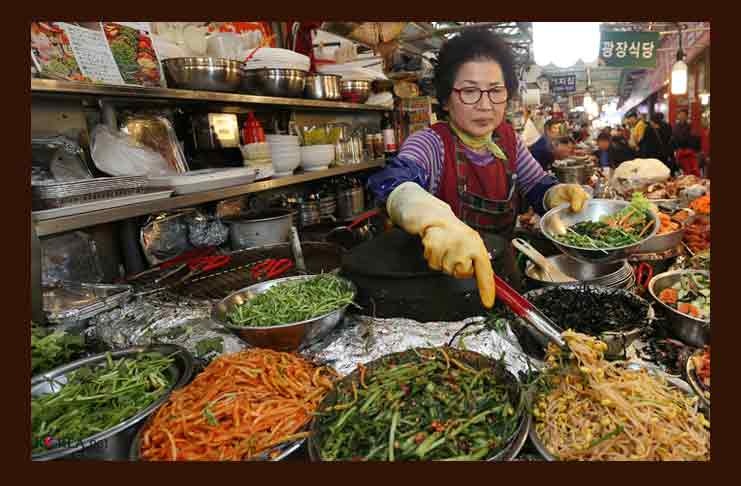
The basement of New World Mall smells like fried garlic, boiling anchovy broth, and burnt sugar all at once, and if you close your eyes on a Saturday afternoon, it could pass for a market alley in Seoul. That is not an accident. It is the endpoint of a sixty-year migration story that started with tented street bars called pojangmacha and ended up under a Roosevelt Avenue mall with a cotton candy vending machine by the exit.
Key Takeaway
Where Did Korean Street Food Actually Start?
It started in Seoul’s pojangmacha, orange plastic tents that popped up on sidewalks after dark selling soju, grilled skewers, and tteokbokki to office workers who did not want to go home yet. Tteokbokki itself has a strange double life. It began as a royal court dish, jangjorim style rice cake stir fried in soy sauce for the Joseon dynasty, and only turned into the fiery gochujang street version in the 1950s when a vendor named Ma Bok Rim near Sindang-dong started selling it to schoolkids. Bunsik shops, the Korean equivalent of a corner diner, spread through Seoul in the 1960s and 1970s selling tteokbokki, kimbap, and odeng side by side, and that three-dish core is still what NYC vendors sell today.
None of that history is decoration. It explains why Korean street food in New York skipped the cart stage almost entirely. There was no pojangmacha tradition to transplant onto a Manhattan sidewalk permit system built for hot dog carts and halal trucks. Korean vendors needed walls first.
How Did Korean Immigration Shape NYC’s Food Scene?
The 1965 Immigration and Nationality Act removed the national origin quotas that had kept Korean immigration to a trickle, and by the late 1970s Korean families were settling in two very different pockets of the city: a commercial strip on 32nd Street in Manhattan and a residential base in Flushing, Queens. These two neighborhoods ended up building two different food cultures, and both still shape what we eat today.
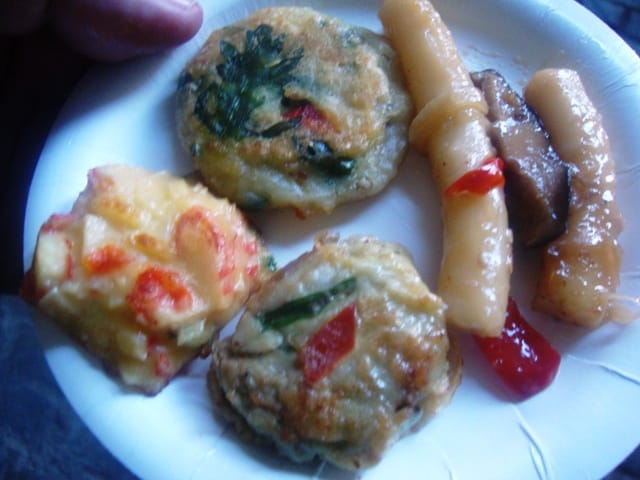
In our years covering NYC street food, the thing that surprises people most is that Korean grocery stores did more to introduce tteok and banchan to non-Korean New Yorkers than any restaurant did. Long before H Mart’s current footprint, small Korean markets in Flushing and later Murray Hill stocked pre-made japchae, kimbap, and rice cakes in refrigerated cases, quietly training a generation of non-Korean shoppers to recognize these foods years before they ever ordered them at a counter.
Our Experience
Why Did K-Town Form Around a Single Block?
32nd Street between Broadway and 5th Avenue became Manhattan’s Korean corridor almost by real estate accident. Korean owned import businesses and travel agencies clustered there in the 1980s because the block sat close to Herald Square and Penn Station, and restaurants followed the office traffic. What never followed, until very recently, was street vending. K-Town built a restaurant-first model, Kunjip, Miss Korea BBQ, Her Name is Han, sit down spots with counters, not carts. That left an actual gap in the market: quick, cheap, grab and go Korean food, the exact niche pojangmacha filled in Seoul.
The most photographed Korean food in New York is barbecue at a table with a metal fan bolted to the ceiling, and it has almost nothing to do with how most Koreans actually eat on a weekday. Street food, the bunsik model, filled that overlooked space, and it filled it first in Queens, not Manhattan.
What Made Flushing’s Food Court Model Work?
The first sentence answer: New World Mall’s basement food court, which opened in 2011 at 136-20 Roosevelt Avenue, functioned as an indoor pojangmacha, replicating the tent bar experience of dozens of small stalls under one roof, and it became the real incubator of Korean street food culture in NYC long before any of it hit an actual sidewalk.
As of 2026, New World Mall still runs roughly 30 food stalls in its lower level, and while the mix leans Chinese and Southeast Asian, the Korean stalls, including tteokbokki counters like KimGaNae, established the format that later stalls would copy: cheap, fast, cash friendly, no seating pressure. Eater NY has tracked how newer, better funded food halls have since reshaped the competitive landscape that New World Mall pioneered.
The second wave came with Tangram, the mixed use development at 133-36 37th Avenue that opened its food hall in the early 2020s. Tangram brought CrunCheese Korean Hotdogs and a Soft Swerve ube soft serve counter into a cleaner, more Instagram friendly space, and it marked the moment Korean street snacks started being built for a phone camera as much as for a hungry commuter.
| Era | Format | Key Location |
|---|---|---|
| 1980s to 1990s | Sit down restaurants | 32nd Street, K-Town |
| 2011 to 2018 | Indoor food court stalls | New World Mall, Flushing |
| 2019 to present | Storefront street snacks | Flushing, K-Town, Midtown, Greenwich Village |
What Actually Triggered the Korean Corn Dog Boom?
TikTok and Instagram did, starting around 2019, when the cheese pull shot, a Korean corn dog stretched apart to show a rope of melted mozzarella, became one of the most reliably viral food formats on both platforms. Jongro Rice Hotdog and Two Hands Seoul Fresh Corn Dogs expanded aggressively in the years that followed, and the format itself kept innovating: rice batter instead of corn batter for a chewier shell, potato cube coatings, ramen crusted exteriors, and squid ink batter for color contrast on camera.
Two Hands now runs locations at 249 W 57th Street in Midtown and 95 MacDougal Street in Greenwich Village, with a Signature Set of three corn dogs running $14 as of 2026, up from closer to $10 when the format first landed in the city. That is not a small increase, and it tracks with broader fried street snack inflation across the five boroughs.
Is the Korean Corn Dog Trend Cooling Off in 2026?
Yes, partially. OH K-Dog closed both its Flushing location on 39th Avenue and its Lower East Side original on Ludlow Street as of our June 2026 vendor verification pass, a sign that the category has moved from gold rush expansion into a normal market correction. That does not mean the format is dying. It means the weaker operators, the ones that leaned entirely on novelty toppings without fixing the actual batter and cheese quality, are the ones getting filtered out.
What is surviving and growing is the operators who treated the corn dog as a real menu item rather than a photo prop, which lines up with what The Infatuation has noted about Flushing’s food scene overall, that the neighborhood rewards consistency over spectacle in ways Manhattan often does not.
Our Verdict
Korean street food in NYC is really three overlapping histories moving at different speeds: a restaurant tradition on 32nd Street that has barely changed in decades, a food court tradition in Flushing that quietly did the real work of introducing the food to New Yorkers, and a five year old social media driven storefront trend that is now old enough to start separating serious operators from novelty chasers. If you only know the corn dog version, you are missing the sixty year backstory that made it possible.
Frequently Asked Questions
When did Korean street food first appear in NYC?
Korean food arrived as sit down restaurant fare on Manhattan’s 32nd Street in the 1980s. True street food format did not take hold until New World Mall’s Flushing food court opened in 2011, with the current storefront corn dog wave dating to 2019.
Why is most Korean street food in Flushing instead of Manhattan?
K-Town developed as a restaurant and nightlife corridor tied to office and tourist traffic near Herald Square, while Flushing built around residential Korean and Chinese immigrant density, which supported the cheaper, faster food court and storefront model that street food needs to survive.
What happened to OH K-Dog in NYC?
Both the Flushing and Lower East Side OH K-Dog locations closed as of our June 2026 verification, reflecting a broader market correction in the Korean corn dog category rather than the collapse of the trend itself.
For the dish by dish breakdown of everything mentioned here, from tteokbokki’s rice cake science to the full corn dog batter taxonomy, read our field guide to Korean street food styles. Both posts are part of our full NYC Korean Street Food Guide, and the immigration and permit history here runs strikingly parallel to what we documented in our history of halal carts in NYC, another cuisine that had to fight its way from restaurant kitchens onto the actual sidewalk.
- About the Author
- Latest Posts

Haley Chung is a writer and food enthusiast based in New York City, covering the city’s most exciting dining scenes for New York Street Food. Whether it’s a hidden noodle bar in Williamsburg or a standout Indian kitchen in Greenwich Village, Haley brings a genuine love of good food — and great service — to everything she writes.