
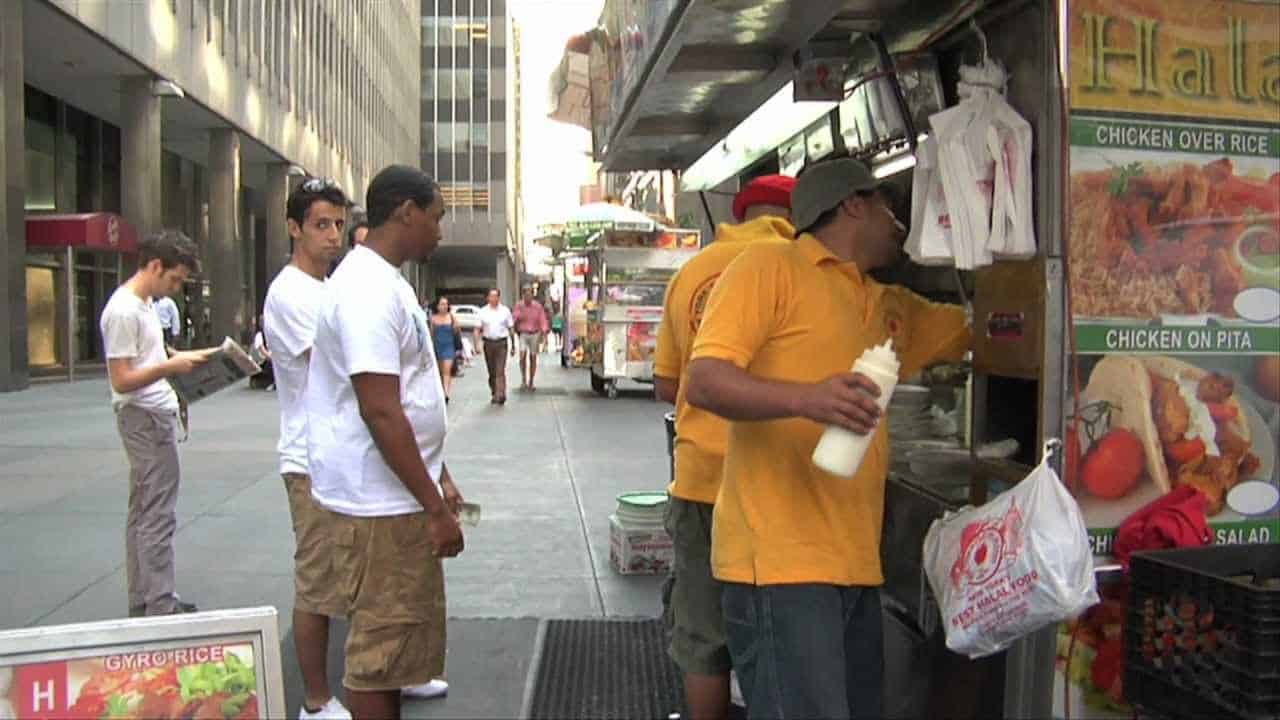
The History of Halal Carts in NYC: From 53rd & 6th to Every Corner
How three Egyptian immigrants with a hot dog cart launched the most significant shift in New York street food since the knish.
Here’s a thing that’s easy to forget when you’re standing in a forty-person line at 1 AM on 6th Avenue, watching a guy in a paper hat shave gyro meat at an almost violent speed: none of this existed thirty-five years ago. Not the cart. Not the line. Not the combo-over-rice-white-sauce-hot-sauce order that rolls off your tongue like a prayer. Not the white sauce itself. Halal carts — the dominant street food format in New York City, the thing that displaced the hot dog as the sidewalk’s default lunch — are younger than most of the people eating at them. Later on, if you’re into Red Hook – you can check the parallel history of Red Hook’s Latin American vendors.
And their origin story is wilder than you’d guess.
Watch this video to learn more:
Before the Halal Cart: Oysters, Knishes, and Souvlaki
To understand what halal carts replaced, you need the quick version of four centuries of New York street food. Every wave of immigration has rewritten the sidewalk menu, and the halal cart is just the latest chapter in a very old book.
In the 1600s, when New York was still New Amsterdam, the street food was oysters. Not artisanal, not expensive — oysters were poverty food, so abundant in the waters around Manhattan and Staten Island that even the poorest residents ate them for dinner. Black oystermen built businesses selling them from carts along the waterfront, and some used the profits to fund the Underground Railroad.
By the mid-1800s, waves of Irish, German, and Jewish immigrants had arrived on the Lower East Side, and the pushcart economy exploded. By 1900, roughly 2,500 open-air vendors were selling knishes, kosher dill pickles, sausages, and pumpernickel bread from hand-drawn carts on streets like Hester and Orchard. One of them was Yonah Schimmel, a Romanian Jewish immigrant who started selling knishes from a pushcart in 1890 and eventually opened the bakery on East Houston Street that’s still there today.
German immigrants brought the sausage-on-a-roll — the proto-hot dog — which Charles Feltman may have first served from a Coney Island pushcart in 1871. The hot dog would dominate NYC street food for the next century. Then, in the 1970s and ’80s, Greek souvlaki and gyro carts took over. And then everything changed again.
Middle Eastern food actually reached the sidewalk before the halal platter did. Falafel came first: a Syrian counter on MacDougal Street was frying it in the Village by 1971, and an Israeli vendor was selling it from a cart on West 46th Street by 1981, a decade before chicken over rice existed. That earlier chapter, from Mamoun’s 75-cent falafel in 1971 to Moshe’s Midtown cart in 1981, set the stage for the Egyptian cart wave that followed.
1990: Three Egyptians, One Hot Dog Cart, and a Problem
In 1990, three Egyptian Americans — Mohamed Abouelenein, Ahmed Elsaka, and Abdelbaset Elsayed — set up a hot dog cart on the southeast corner of 53rd Street and 6th Avenue in Midtown Manhattan. It was a perfectly normal hot dog cart. Sabrett umbrella on top, franks spinning on the rollers, mustard in squeeze bottles. Standard issue.
But Abouelenein had a problem with the business model: he didn’t think a hot dog was a real meal. It wasn’t filling enough for a working person pulling a twelve-hour shift. And crucially, it wasn’t halal — which meant the growing population of Muslim taxi drivers cruising Midtown had nowhere to stop for a quick, affordable lunch that met their dietary requirements.
So in 1992, they pivoted. The hot dogs came off the rollers. Chicken went on the griddle. Gyro meat went on the vertical spit. Rice went into the steam tray. And the white sauce — that tangy, creamy, still-unexplained condiment — went into squeeze bottles. The Halal Guys were born.
The customer base, at first, was almost entirely Muslim cab drivers. Word traveled through the taxi network the way information traveled before smartphones: driver to driver, shift to shift, garage to garage. Within months, cabbies were timing their routes to pass through 53rd & 6th at meal breaks. The line started to grow.
Watch this video to learn more:
The Cab Driver Network: NYC’s First Viral Food Moment
What happened next was, in hindsight, one of the first viral food phenomena in New York — years before Instagram, before Yelp, before food blogs existed. Muslim cab drivers told other Muslim cab drivers. Those cab drivers told their dispatchers. Dispatchers told other garages. The platters were cheap (around $4 in the early ’90s), the portions were enormous, and the food was genuinely halal. There was nothing else like it in Midtown.
Then the circle expanded beyond the cab community. Night-shift workers discovered the cart. Late-night bar crowds discovered the cart. NYU students discovered the cart — and eventually formed a club dedicated to it. Food writers noticed the hour-long lines and started asking questions. Chef Christopher Lee, one of Food & Wine’s best new chefs of 2006, told the magazine he once waited two and a half hours on Christmas Eve. The Halal Guys were finalists for the 2005 Vendy Award, the annual street food competition run by the Street Vendor Project.
By the mid-2000s, the line at 53rd & 6th had become a New York City landmark — as much a part of the Midtown landscape as Radio City Music Hall a few blocks away. A competing cart — “New York’s Best Halal Food” — set up on the opposite corner, and tourists routinely lined up at the wrong one.
The Demographic Revolution on the Sidewalk
The Halal Guys didn’t just start a food trend. They were the visible tip of a massive demographic shift that was reshaping who worked New York’s sidewalks.
A Queens College sociology study tracked this transformation in hard numbers. In 1990, 306 first-generation German and Italian New Yorkers identified themselves in occupational categories that included “street vendor.” By 2005, that number had dropped to zero. Over the same period, the number of vendors from Egypt, Bangladesh, and Afghanistan surged from 69 to 563 — more than an eightfold increase in fifteen years.
The reasons were structural. Throughout the 1980s and ’90s, immigration from Egypt, Bangladesh, and Afghanistan accelerated — driven by family reunification programs, the Diversity Visa lottery, and economic opportunity. Many of these immigrants arrived with limited English and limited access to formal employment. Street vending offered a path: relatively low startup costs, flexible hours, and a customer base that didn’t require a résumé. The halal cart became, for thousands of immigrant families, the first rung on the economic ladder in their new country.
And because the vendors were Muslim, the food was halal by default — not as a marketing strategy, but because that’s what the people cooking it ate at home. The cart menus reflected the vendors’ own culinary traditions: Egyptian-style chicken and gyro, Bangladeshi biryani and kati rolls, Afghani chapli kabobs, Pakistani tikka masala. What tourists experience as a single “halal cart cuisine” is actually a constellation of distinct culinary traditions from across the Muslim world, unified only by the format (silver cart, sidewalk, foil platter) and the dietary requirement (halal).
The Vendy Era: 2005–2015
The mid-2000s through the mid-2010s was the golden age of the NYC halal cart, and the Vendy Awards were its Oscars.
The Street Vendor Project launched the Vendys in 2005 as a competition and advocacy event — a way to celebrate street vendors and draw attention to the regulatory obstacles they face (more on that in a moment). The awards gave halal carts a stage, and the carts delivered.
Sammy’s Halal — Samiul Noor’s cart at 73rd & Broadway in Jackson Heights — won the Vendy Cup in 2006. It was a breakout moment: a Queens-based cart beating Manhattan vendors to take the top prize, with a green sauce that nobody else in the city could replicate. Sammy expanded to the East Village and kept the original cart running 24/7.
King of Falafel & Shawarma — Freddy Zeideia’s Palestinian cart in Astoria — won the Vendy in 2010. Zeideia had launched the cart in 2002, shortly after 9/11, at a time when anti-Muslim sentiment made operating a visibly Muslim business an act of quiet defiance. His chickpea-only falafel, made from his mother’s recipe, drew lines on Broadway in Astoria and eventually justified a brick-and-mortar restaurant. He expanded to Chicago in 2024.
Biryani Cart — Meru Sikder’s Bangladeshi cart at 46th & 6th — won the Vendy People’s Choice Award in both 2008 and 2009. Royal Grill Halal Food at 44th & 6th won the Vendy in 2018. The pattern was clear: halal carts weren’t just competing — they were dominating.
The Permit Problem
Behind every halal cart success story is an infrastructure nightmare that most customers never see.
New York City caps the number of food vending permits at roughly 5,100, a number that hasn’t been significantly updated since the 1980s despite a population that has grown by millions. The demand for permits far exceeds supply, which has created a black market where permits that the city originally sold for a few hundred dollars are now rented for up to $25,000 for a two-year term. Many cart operators — including some on our NYC Halal Cart Guide map — don’t own their permits. They rent them from intermediaries, often at prices that eat deeply into their margins.
The result is a system where the people cooking the food often earn the least from selling it. A 2024 report from the Immigration Research Initiative found that of the city’s approximately 23,000 street vendors, 96% are immigrants. They work twelve-plus hour days, often without access to a bathroom, in a regulatory environment that issued more than 10,000 tickets to vendors in 2024 alone — five times more than in 2019.
Watch this video to learn more:
The Vendy Awards and the Street Vendor Project exist, in part, to push back against this system. When you line up at a halal cart, you’re not just buying lunch. You’re participating in one of the most fraught small-business ecosystems in the city.
From Cart to Global Franchise — and Back
In 2014, The Halal Guys hired Fransmart, a franchise development company, and began expanding. By 2026, the brand operates over 100 locations worldwide — in the U.S., Canada, South Korea, Indonesia, and the United Kingdom. The hot dog cart that became a halal cart that became a Midtown institution had become a global fast-casual chain.
But here’s the thing: the original cart at 53rd & 6th is still there. Still pulling lines. Still serving the same combo platter from the same corner where three Egyptian immigrants decided, sometime in 1992, that a hot dog wasn’t enough of a meal.
And on the corners around them — up and down 6th Avenue, across Queens, in Astoria and Bay Ridge and Jamaica — hundreds of other carts serve their own versions of the same idea. Each one a small business. Each one an immigration story. Each one a kitchen on wheels that feeds a neighborhood for less than the price of a cocktail.
The halal cart didn’t just change what New Yorkers eat on the sidewalk. It changed who feeds them, and what that feeding means. From oyster carts to knish pushcarts to sausage stands to souvlaki to chicken over rice — the sidewalk has always been where New York’s newest arrivals introduce themselves. The halal cart is the latest in a four-hundred-year tradition, and right now, it’s the best chapter yet.
For the full guide to the 20 best halal carts in NYC — with an interactive map, a printable crawl itinerary, and a vendor matrix — see our Ultimate NYC Halal Cart Guide.
And if your halal cart crawl takes you to Jackson Heights, don’t miss the Himalayan street food scene just blocks away — our Jackson Heights Himalayan Street Food Guide covers the momo and laphing vendors sharing the same corridor.
For the falafel and shawarma vendors who share these same sidewalks, from Freddy’s Vendy-winning Astoria storefront to the fava bean cart at Zuccotti Park, see our NYC Falafel & Shawarma Guide.
- About the Author
- Latest Posts
Ron Rossi is a New York native, marketing director, and self-styled “Jaded Traveler” who has spent a career crossing borders — both professionally and culinarily. Having lived and worked across Asia, Europe, Africa, and South America, Ron has eaten his way through nearly 100 countries on six continents, always with the same philosophy: the best food belongs to the people, not the guidebooks. He gravitates toward mid-range, budget, and street food — the kind of meal a local nurse, teacher, or taxi driver would actually eat — and believes that a country’s character is most honestly revealed not in its fine dining rooms but in its markets, cart stalls, and neighborhood joints. At New York Street Food, Ron brings that same globe-spanning hunger to the five boroughs, hunting down the dishes that feed everyday New Yorkers and the stories behind the hands that make them.