
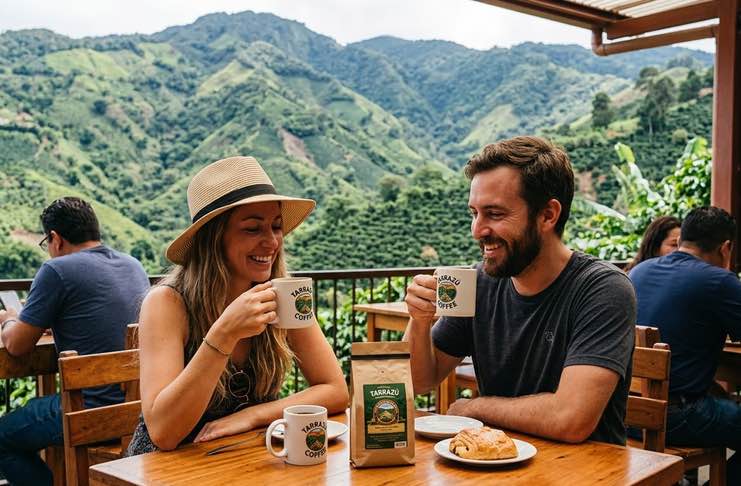
You love coffee like us and want to learn more about Tarrazú Coffee? You’ve reached the right place. Well, there are coffee regions, and then there is Tarrazú. Tucked into the mountains of Costa Rica’s Central Pacific Range, Tarrazú has built a reputation among coffee lovers and industry people as one of the best growing environments on the planet. If you’ve never gone out of your way to find a single-origin bag from this part of the world, here’s why you should.
Where Geography Becomes Destiny
Tarrazú sits between 1,200 and 1,900 meters above sea level in Costa Rica’s southern highlands. That altitude alone goes a long way toward explaining what makes the coffee so good. Up that high, coffee cherries ripen slowly. The extra time on the plant lets sugars and flavor compounds build up in ways that simply don’t happen at lower elevations. You get denser beans, more nuanced acidity, and a depth of flavor that’s hard to find anywhere else.
But elevation is only part of the picture. The region also gets volcanic soil packed with minerals, reliable rainfall through the growing season, and dry weather during harvest from December through March. Days are warm, nights are cool, and that temperature swing stresses the plants in a productive way, concentrating flavors and tightening the bean’s structure.
The rivers running through the area, particularly the Río Parrita and its tributaries, have spent centuries depositing minerals into the soil. It’s the kind of terroir a winemaker from Burgundy or Napa would immediately recognize as something you can’t manufacture or move.
Our Experience
We’ve toured a handful of processing facilities over the years — in Ethiopia, Colombia, and Guatemala — and the attention to detail we witnessed on a recorded farm tour from a Tarrazú producer rivals anything we’ve seen. Every cherry is hand-picked, and every fermentation tank is monitored by the hour. One producer walked us through their transition from concrete patios to raised African drying beds, explaining how the improved airflow dramatically reduced defects in the final cup. This is the kind of craft obsession that translates directly into what lands in your mug.
Watch this video to get a glimpse:
A Culture Built Around the Cherry
Coffee farming in Tarrazú isn’t a corporate operation. Most of what gets grown here comes from small family farms, called fincas locally, many of them handed down across three or four generations. These farmers know their land in a granular way: which slopes drain fastest, which microclimates push the trees hardest, which varietals do best at which elevations.
The main variety grown here is Caturra, a natural mutation of Bourbon that thrives at altitude and consistently produces a bright, clean cup. You’ll also find Catuaí, and some producers are starting to experiment with Geisha and SL28, varieties that fetch serious money at specialty auctions. But the classic Tarrazú profile is what put the region on the map: bright citric acidity, medium body, clean sweetness, and a long chocolatey finish.
Costa Rica was also the first Central American country to ban lower-quality robusta cultivation outright, requiring that only arabica be grown. That kind of national commitment to quality shapes everything downstream, which is part of why Costa Rican coffee commands respect and premium prices.
Our Experience
At NYSF, we’re always on the lookout for producers with a real story behind their product, and the family farms of Tarrazú delivered exactly that. We had the privilege of a virtual call with a third-generation finca owner named Diego, whose grandfather planted the first Caturra trees on their hillside farm in the 1960s. Hearing him describe each microclimate on his land with the same precision a sommelier uses to talk about vintages was genuinely moving. It reminded us that the best food and drink is never just about flavor — it’s about the people behind it.
Watch this video to learn more:
Processing: Where Art Meets Science
A lot of what makes Tarrazú coffee so clean and nuanced comes down to how it’s processed. The washed method is the standard here. After harvest, ripe cherries are pulped to remove the outer fruit, fermented in water tanks for a day or two to break down the remaining mucilage, then washed and moved to raised drying beds or patios to dry in the sun.
That process gets the fruit out of the way and lets the bean speak for itself. The result is brightness, clarity, and a sweetness that feels refined rather than heavy. More recently, some producers have started experimenting with honey and natural processing, which adds fruit-forward character to the mix and gives buyers more to choose from depending on what they’re after.
Watch this to get a glimpse of what the washed method looks like:
What It Tastes Like
Brew a well-sourced Tarrazú carefully, whether as a pour-over, Aeropress, or drip, and you’ll typically get flavors that unfold in stages. Bright acidity with notes of green apple or orange zest, a medium or silky body, and a finish that lingers with dark chocolate, brown sugar, or caramel. Some lots, especially from the highest elevations or honey-processed batches, push into floral and stone fruit territory.
The acidity is never harsh. It’s lively and vibrant in a way that adds energy to the cup rather than making it sharp or uncomfortable. Combined with the natural sweetness and clean finish, it works well across different brew methods and roast levels.
Our Experience
We ran a blind tasting at the NYSF office with six different coffees — two other Central Americans, an Ethiopian Yirgacheffe, a Kenyan AA, a Colombian Huila, and one unlabeled mystery cup. Our team of four voted unanimously: the mystery cup was the most memorable. It was, of course, a washed lot from Tarrazú Coffee sourced through a small Brooklyn roaster. The orange zest brightness on the front palate, followed by that long caramel-chocolate finish, was unlike anything else on the table. It’s now our go-to recommendation whenever someone asks us where to start with specialty coffee.
Why This Region Deserves Your Attention
As more people start paying attention to where their food and drink actually comes from, whether it’s wine, tea, cheese, or coffee, Tarrazú has a genuine story to tell. The quality here isn’t a marketing angle. It’s built into the altitude, the soil, the rainfall, and the knowledge that gets passed down on these farms over generations.
Buying Tarrazú coffee also means supporting a farming model that holds up in the long run: environmentally careful, economically fair to small producers, and rooted in real craft. Many farms in the region carry Rainforest Alliance or UTZ certifications, and water conservation practices have improved significantly over the past twenty years through industry-led efforts.
Our Experience
At NYSF, we take our role as food media seriously — we don’t recommend things just because they’re trendy or beautifully packaged. Tarrazú Coffee earned its place on our radar through pure cup quality and an ethical supply chain we can stand behind. Knowing that the farms carry Rainforest Alliance certification and actively invest in water conservation makes every morning brew feel less like a guilty pleasure and more like a considered choice. It’s rare to find a product whose story and substance are equally impressive.
The Bottom Line
Whether you’re just starting to get curious about specialty coffee or you’re already chasing the next great single-origin, Tarrazú should be on your list. The combination of ideal geography, multigenerational farming knowledge, and careful processing produces a coffee that’s not just consistently good but genuinely memorable.
Taste a properly sourced, well-roasted Tarrazú once, and it tends to become a reference point—the kind of cup you find yourself measuring everything else against.
FREQUENTLY ASKED QUESTIONS
What makes Tarrazú Coffee different from other Central American coffees?
Tarrazú Coffee stands apart because of its exceptional growing conditions: high altitude between 1,200 and 1,900 meters, mineral-rich volcanic soil, and a precise seasonal climate with warm days and cool nights. This combination slows cherry ripening dramatically, allowing sugars and flavor compounds to develop in ways that lower-elevation regions simply can’t replicate. Add Costa Rica’s national commitment to arabica-only cultivation, and you get a baseline quality floor that few regions can match.
What does Tarrazú coffee taste like?
A classic washed Tarrazú typically delivers bright citric acidity reminiscent of green apple or orange zest, a medium to silky body, and a long, clean finish with notes of dark chocolate, brown sugar, or caramel. Honey-processed or naturally processed lots lean fruitier, sometimes pushing into stone fruit or floral territory. The acidity is lively rather than harsh — energizing, not sharp.
What is the best brew method for Tarrazú coffee?
Tarrazú coffee is versatile and works beautifully across most brew methods. Pour-over (V60 or Chemex) is our top recommendation at NYSF because it highlights the bright acidity and clean finish. Aeropress is another great option for a fuller-bodied cup with more sweetness. Even a standard drip machine will produce excellent results. Avoid over-roasting — a medium or medium-light roast best preserves the region’s signature clarity and acidity.
When is the Tarrazú harvest season?
The main harvest in Tarrazú runs from December through March, coinciding with the dry season. This timing is ideal — the dry weather allows cherries to be picked at peak ripeness without the risk of rain damage and supports the sun-drying process during washing. Freshly harvested and processed lots typically reach specialty roasters in the Northern Hemisphere by spring.
Is Tarrazú coffee ethically and sustainably produced?
Yes, in large part. The region is dominated by small family farms rather than large commercial operations, and many carry Rainforest Alliance or UTZ certifications. Water conservation has improved significantly over the past two decades through industry-wide initiatives. When buying Tarrazú Coffee, look for roasters who work directly with named farms or cooperatives — direct-trade relationships ensure fairer pricing for producers and greater transparency about farming practices.
Where can I buy Tarrazú coffee?
Specialty coffee roasters are your best bet. Look for single-origin offerings that specifically name Tarrazú as the region — not just “Costa Rica” — and ideally include the name of the farm or cooperative, the processing method, and the harvest year. Online retailers like Onyx Coffee Lab, Intelligentsia, and Counter Culture regularly stock excellent Tarrazú lots. Local specialty shops in major cities often carry seasonal offerings, so it’s worth asking.
- About the Author
- Latest Posts
Mehru Sheikh is a Dallas-born, Brooklyn-based writer, traveler, and product manager who believes good food is the world’s most universal language. After moving to New York City in 2020, she channeled her passion for exploration into @sheikhshack_ — a lifestyle platform covering food, fashion, and travel that grew from a personal travel diary into a community of nearly 7,000 followers. Known for her fast-travel approach — squeezing as much as possible into short trips — Mehru has become a go-to voice for practical, culturally immersive travel, particularly within the South Asian community. She has ghost-written for travel blogs, previously ran her own food page, and co-founded Table for Four, an events company connecting New Yorkers to new experiences and each other. At New York Street Food, she brings that same curiosity and appetite to uncovering Brooklyn and NYC’s most exciting, flavor-forward dining destinations.