
A Dumpling With More Passport Stamps Than You
The momo you eat at a steamer cart outside the 74th Street-Broadway station in Jackson Heights didn’t start there. It didn’t start in Nepal, either, despite what you’ll read on many menus. The momo’s origin story is tangled, contested, and — like most origin stories involving food — probably more complicated than any single narrative can capture. But tracing the rough arc of its journey is worth doing, because it explains why the momos you eat on Roosevelt Avenue taste the way they do, and why Jackson Heights specifically became the epicenter of Himalayan dumpling culture in the Americas.
The most widely accepted historical thread traces the momo back to Tibet, where the word itself — མོག་མོག (mog mog) — likely derives from the Chinese term momo (馍馍), used in northwestern Chinese dialects for steamed wheat bread and buns. The dumpling concept almost certainly migrated into Tibet via Mongol trade routes during the 13th century, part of the same massive cultural exchange that carried noodles, tea, and Buddhism across Central Asia. By the time the form settled into Tibetan culinary practice, it had been reshaped by altitude and scarcity: highland barley flour for the wrapper, yak meat and mutton for the filling, and steaming — not boiling — as the cooking method, because water boils at a lower temperature above 3,500 meters and steaming proved more reliable for cooking through the thick, protein-dense fillings.
Watch this recipe video to learn more:
The Newar Connection: Traders, Not Monks
There’s a persistent legend that a 7th-century Nepali princess named Bhrikuti introduced momos to Tibet when she married the Tibetan King Songtsan Gampo. It’s a charming story, but the historical record doesn’t support it with much specificity. What we do know is that the Newar people — the indigenous merchant community of the Kathmandu Valley — operated extensive trade networks between Nepal and Tibet for centuries. Nepal-Tibet trade flourished particularly during the Licchavi dynasty (roughly 400 to 750 CE), and these routes remained active well into the 20th century.
The Newar traders are the most credible transmission vector for the momo. They carried goods — salt, wool, grain, metalwork — across high Himalayan passes and brought culinary techniques back with them. The momo migrated south into the Kathmandu Valley through these trade circuits, not through royal marriage or monastic exchange. And as it moved into Nepal, it changed. Yak meat gave way to mutton, water buffalo (buff), and eventually chicken. The spice profile expanded to include cumin, green chili, and coriander — flavors more aligned with the South Asian palate than the minimalist Tibetan original. The wrapper got thinner. The pleat pattern shifted from the Tibetan top-knot closure to the Nepali crescent fold.
This is the critical fork in the momo’s evolution: the Tibetan version remained thick-skinned, steamed, and lightly seasoned — a vehicle for warmth and fat in cold valleys. The Nepali version became thinner-skinned, more heavily spiced, and served with achar — the tomato-sesame-chili chutneys that are now inseparable from the momo experience in Jackson Heights.
1959: The Rupture That Scattered Everything
The momo might have remained a regional Himalayan specialty — known within Tibet and Nepal but invisible to the wider world — if not for geopolitics. In 1959, China’s annexation of Tibet and the failed Tibetan uprising triggered one of the largest refugee exoduses in Asian history. The Dalai Lama and tens of thousands of Tibetans fled to India, settling in communities across Dharamsala, Darjeeling, Sikkim, and eventually further afield. They brought their recipes with them.
In Indian cities, particularly Delhi, the momo underwent yet another transformation. Tibetan refugees sold momos from street carts to non-Tibetan customers, and the dish adapted to local taste — pan-frying became more common (producing the variant called kothey, from the Chinese guotie), and the chili sauce got spicier to match Indian palates. By the 1980s, momos had become one of Delhi’s most popular street foods, sold by cooks of Tibetan, Nepali, and increasingly Indian origin. The dumpling had fully detached from its original cultural context and become a pan-Himalayan, pan-South Asian street food format.
Meanwhile, Nepal’s own political instability accelerated the momo’s dispersal. The Maoist insurgency that tore through Nepal from 1996 to 2006 pushed a significant wave of Nepali emigrants toward the United States, the UK, and the Gulf states. Many of those who came to New York settled in Queens — and specifically in Jackson Heights, drawn by the existing South Asian infrastructure along Roosevelt Avenue and the 7-Train corridor’s affordable rents.
The 1990 Immigration Act: How Queens Got Its Momos
The foundation of Jackson Heights’ Tibetan food scene was laid by a specific piece of legislation: the Immigration Act of 1990, which allocated 1,000 immigrant visas to displaced Tibetans living in India and Nepal. Many of those visa holders settled in New York, and Queens — with its established immigrant networks and relatively low cost of living — became the primary landing zone. By the late 1990s, a small but concentrated Tibetan community had formed in Jackson Heights, and the first Tibetan restaurants began opening along Roosevelt Avenue and 37th Road.
Himalayan Yak, which opened in 2000, is widely cited as the first dedicated Himalayan restaurant in the neighborhood. Phayul followed, tucked on a second floor above 74th Street — the kind of hidden, word-of-mouth spot that signals a community cooking for itself rather than for tourists. Lhasa Fast Food established itself as the benchmark for no-frills Tibetan comfort food. And then the Nepali wave hit.
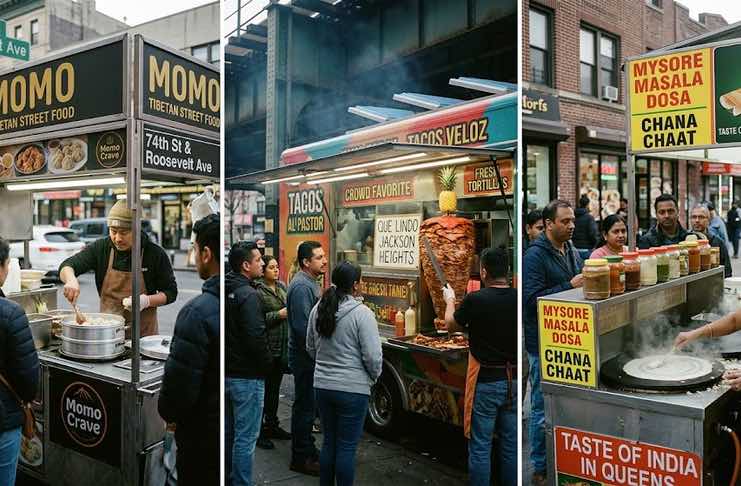
The Nepali population in New York City nearly tripled between 2010 and 2019, with Jackson Heights absorbing a significant share. Nepali restaurants, grocery stores, and cultural organizations proliferated along the corridor. The neighborhood’s momo landscape became a layered palimpsest — Tibetan originals sitting next to Nepali adaptations sitting next to fusion experiments — all within a four-block radius. This is the density you experience today when you step off the 7 Train at 74th Street-Broadway.
What Roosevelt Avenue Momos Tell You About Diaspora
Here’s what I find most interesting about eating momos in Jackson Heights: every vendor’s version tells a specific story about where their family came from and when. The thick-skinned, simply seasoned beef momos at Lhasa Fast Food are essentially unchanged from what you’d eat in central Tibet — they taste like cold weather and high altitude and fat rendered slowly in a steamer basket. The jhol momos at Nepali Bhanchha Ghar — steamed dumplings swimming in a spiced tomato-sesame broth — are a Kathmandu Valley innovation that wouldn’t exist without Nepal’s access to South Asian spice networks. The chili chicken momos at Bini’s Kitchen reflect a further evolution, incorporating Indian street food sensibilities (the same chili-garlic-soy sauce treatment you’d find on a Delhi momo cart) into a Queens kitchen.
Watch this video to get a glimpse of Roosevelt Avenue’s Momos:
These aren’t variations on a theme — they’re geological layers. Each one preserves a specific moment in the momo’s 700-year migration, and eating your way through them in sequence is as close as you’ll get to time-traveling through Himalayan culinary history without leaving New York City.
The Momo’s Next Chapter Is Being Written Now
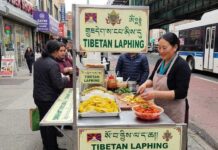
The momo is still evolving. In Jackson Heights, you can already see the next phase: second-generation Tibetan and Nepali Americans who grew up eating their parents’ momos are opening their own spots, and the food is shifting again. Fillings are getting more experimental. Presentation is moving upmarket. The word “momo” is appearing on menus in Manhattan and Brooklyn, often detached from any Himalayan context — just “dumplings” with a different fold. We’ve reviewed Tibetan momos from food trucks before!
Whether that’s evolution or dilution depends on your perspective. But the Roosevelt Avenue corridor remains the anchor — the place where the momo still means what it has always meant: a hand-pleated, steamed pocket of meat and spice made by people who learned the technique from someone who learned it from someone who carried it across a mountain pass. That chain of transmission is the real story, and Jackson Heights is where you can still taste every link in it.
Explore the Full Jackson Heights Himalayan Street Food Guide
📖 Pillar Hub Page
📄 7-Train Momo Crawl
📍 Vendor Map
🥢 Laphing Guide

Anthony is a passionate food enthusiast living in the bustling food scene of New York City. With an insatiable curiosity for culinary exploration, he loves exploring the city’s diverse eateries, seeking out unique flavors and sharing his gastronomic adventures with fellow food lovers.