
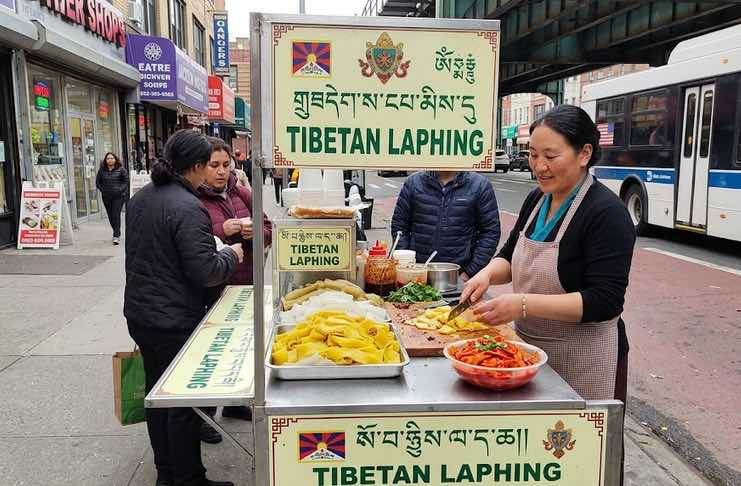
The Dish Nobody Talks About
Every food writer who visits Jackson Heights writes about the momos. They photograph the steamer baskets, they describe the pleats, they use the word “juicy” at least three times. And then they leave. Almost nobody writes about laphing — the cold, spicy, slippery mung bean starch noodle dish that sits quietly on the same menus, ordered mostly by Tibetan regulars who know what they’re looking for.
This is a problem, because laphing is arguably the more interesting dish. Where a momo is immediate and intuitive — it’s a dumpling, you know what to do with it — laphing is disorienting. The texture doesn’t map to anything most Western eaters have experienced. It’s cold when most Asian noodle dishes are hot. It’s made from starch, not flour, which gives it a glassy, almost translucent appearance that reads as “weird” to unfamiliar eyes. And the flavor profile is aggressive: raw garlic, black vinegar, Sichuan peppercorn, and enough chili oil to make your lips go numb.
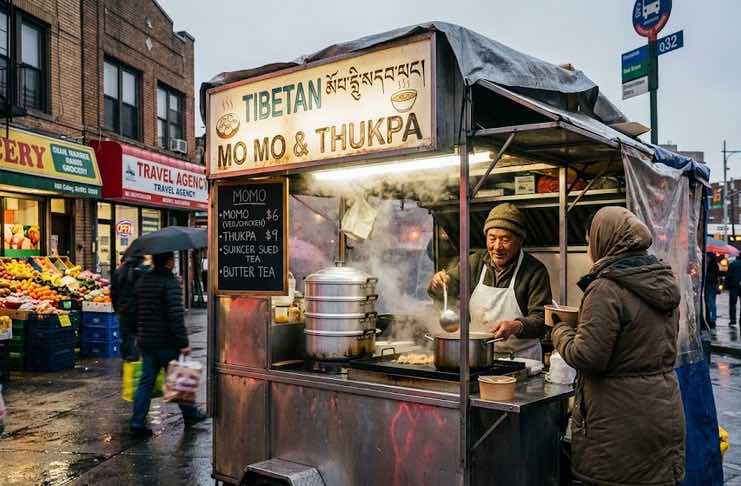
If you’ve never tried it, this guide will walk you through everything you need to know before your first order. If you’ve tried it once and couldn’t figure out what was happening in your mouth, this guide will explain the science behind that confusion and teach you how to order a version that matches your tolerance. Either way, laphing deserves your attention, and Jackson Heights is the best place in America to give it.
What Laphing Actually Is: The Starch Science
Laphing (ལ་ཕིང་, sometimes transliterated as “laping”) is a cold dish built on a base of mung bean starch gel. The name and concept are closely related to the Sichuan Chinese dish liangfen (凉粉), which translates roughly to “cold starch” — and that translation tells you exactly what you’re eating. The Tibetan version migrated from Sichuan influence, was adapted to high-altitude conditions, and evolved its own identity through the specific sauce profile used in Lhasa street stalls.
The preparation is deceptively simple but technically demanding. You start by mixing mung bean starch into cold water at a ratio of roughly one part starch to five parts water, whisking until the slurry is completely smooth and lump-free. This mixture goes into a pot over medium heat, and you stir — constantly, without stopping — for five to nine minutes. During this window, the starch granules absorb water, swell, and eventually burst, releasing amylose and amylopectin chains that entangle and form a gel network. The mixture transforms from opaque white liquid to translucent, glossy paste. This is gelatinization, the same process that thickens gravy or pudding, except here you’re driving it to full completion and then setting the result into a solid block.
Watch this video to learn more:
The cooked paste gets poured into a shallow tray and left to cool and set — a minimum of four to five hours, ideally overnight. As it cools, the amylose chains align and crystallize, a process called retrogradation, which is what gives the finished laphing its characteristic firm, snappy texture. Under-set laphing (pulled too early, or with too much water in the ratio) crumbles. Over-set laphing (too little water, or too much starch) turns rubbery and bouncy. The sweet spot produces a gel that holds its shape when sliced into sheets or strips, yields cleanly when you bite through it, and has a faintly slippery surface that catches sauce.
The Two Formats: Sheets vs. Noodles
Once the starch gel has set and been unmolded, the vendor faces a choice that fundamentally changes the eating experience: how to cut it.
Sheet-Cut Laphing (Dry Style)
The traditional Lhasa preparation cuts the gel into broad, flat slabs — roughly the dimensions of a playing card, but thicker. These slabs are stacked, dressed with sauce, and often rolled around a filling of mashed potato, crushed peanuts, or instant noodle crumbles before being sliced into bite-sized cross-sections. The sheet format preserves the gel’s smooth surface, which means the sauce sits on top rather than penetrating — you get concentrated hits of chili oil on the exterior with a cool, neutral starch interior. The textural contrast is the point: slippery surface, firm bite, clean snap.
Noodle-Cut Laphing (Wet/Soup Style)
The alternative cuts the gel into thin strips or julienne — closer to actual noodle dimensions. These strips have more surface area per volume, which means they absorb significantly more sauce. Noodle-cut laphing is often served “wet,” tossed in a broth-like sauce rather than dressed on top, and the experience is closer to eating actual cold noodles — tangly, slurpy, and more evenly seasoned throughout. This format is more common in Nepali-run shops and in the Kathmandu street stall tradition.
Neither format is “better” — they’re genuinely different dishes built on the same base. Sheet-cut emphasizes texture and contrast; noodle-cut emphasizes sauce absorption and slurpability. Most Jackson Heights vendors commit to one format, so knowing which you prefer helps you choose your stop.
The Sauce: Where the Flavor Lives
The laphing gel itself is almost completely flavorless — a neutral vehicle, like tofu or rice paper. Everything you taste comes from the sauce, which is why the sauce composition is the most important variable in the entire dish.
A standard Jackson Heights laphing sauce contains: soy sauce (for salt and umami), black vinegar or rice vinegar (for acidity), chili oil with flakes (for heat and color), raw minced garlic dissolved in water (for sharpness), sesame oil (for richness), and ground Sichuan peppercorn (for the tingling, numbing sensation called málà that defines the dish’s Chinese-Tibetan lineage). Some vendors add a pinch of sugar to balance the acidity. Some add crushed roasted peanuts for crunch. The Nepali-leaning versions occasionally incorporate tomato-based achar elements, blurring the line between laphing sauce and momo condiment.
The critical differentiator between vendors is the chili oil. At Lhasa Fast Food, the chili oil is made in-house with whole Sichuan peppercorns toasted and steeped in hot oil — the numbing compound (hydroxy-alpha-sanshool) infuses into the fat, creating a sensation that builds slowly and lingers for minutes after your last bite. This is the signature of high-quality laphing: the heat isn’t just “spicy,” it’s multidimensional — sharp chili burn layered over a buzzing, tingling numbness that temporarily rewires your perception of texture. Your first bite of properly sauced laphing can genuinely confuse your brain about whether what you’re feeling is taste or touch.
Where to Eat Laphing in Jackson Heights: The Vendor Ranking
Not every Himalayan restaurant in Jackson Heights serves laphing, and among those that do, the quality range is enormous. Here’s our field-tested ranking based on gel texture, sauce complexity, and overall execution.
| Rank | Vendor | Format | Sauce Style | Notes |
|---|---|---|---|---|
| 1 | Lhasa Fast Food | Sheet-cut | House chili oil, heavy Sichuan peppercorn | Benchmark. Perfect gel snap, best chili oil in the corridor. |
| 2 | Phayul | Sheet-cut | Traditional Tibetan, garlic-forward | Slightly thicker slabs, generous portions. Excellent for first-timers. |
| 3 | Amdo Kitchen | Noodle-cut | Amdo-regional, extra vinegar | Tangier profile than most. Good for people who like acidity. |
| 4 | Himalayan Yak | Both formats available | Mild/adjustable | Good entry point. Lower heat floor, you control the spice. |
Watch this reel to get a glimpse:
How to Order: A First-Timer’s Protocol
Walking into a Tibetan restaurant and ordering laphing for the first time can feel intimidating if you don’t know the vocabulary. Here’s a simple framework:
First, confirm they have it. Not every place lists it prominently on the menu — sometimes it’s written in Tibetan script only, or it’s on a separate specials board. Just ask: “Do you have laphing?” They’ll know what you mean. If they offer a choice between “dry” and “soup” (or “wet”), start with dry — the sheet-cut format gives you the purest expression of the gel texture without the distraction of broth.
Second, specify your heat level if given the option. “Medium spicy” is a safe starting point for most people. “Tibetan spicy” at some vendors will put you in Sichuan peppercorn territory that requires some experience to enjoy. Don’t order “no spice” — the sauce is the dish, and a de-spiced laphing is just unflavored starch gel, which teaches you nothing about why people love this food.
Third, eat it with chopsticks if you can, or a fork if you can’t. The slippery texture is part of the fun — laphing is supposed to be a little difficult to handle. That surface slickness is a feature, not a flaw. It means the starch set properly and the sauce is clinging to the exterior the way it should.
Fourth, eat it cold. Some places will ask if you want it heated. Say no. Laphing is engineered to be consumed at room temperature or slightly chilled — heating it destabilizes the retrograded starch network, making the gel softer and mushier. Cold laphing snaps. Warm laphing sags. The temperature is load-bearing.
Why Laphing Matters Beyond the Plate
Laphing occupies a specific cultural position in the Tibetan diaspora that goes beyond its role as a snack. In Lhasa, laphing was traditionally bought from street stalls, not made at home — it was communal food, public food, the thing you ate while standing on a corner watching the city move. For Tibetan refugees and immigrants, recreating laphing in exile communities — in Dharamsala, in Kathmandu, in Jackson Heights — is an act of cultural preservation that connects to a specific sensory memory of place.
When you eat laphing at Lhasa Fast Food on 37th Road, you’re eating a dish that was developed for the streets of a city most of the people serving it to you can no longer visit. That context doesn’t make it taste better, but it does make it mean more. And in a neighborhood like Jackson Heights — where food is the primary medium through which displaced communities maintain their identity — meaning and flavor are inseparable.
Explore the Full Jackson Heights Himalayan Street Food Guide
📖 Pillar Hub Page
📄 7-Train Momo Crawl
📍 Vendor Map
🥟 Momo Evolution Article
- About the Author
- Latest Posts

Ron Rossi is a New York native, marketing director, and self-styled “Jaded Traveler” who has spent a career crossing borders — both professionally and culinarily. Having lived and worked across Asia, Europe, Africa, and South America, Ron has eaten his way through nearly 100 countries on six continents, always with the same philosophy: the best food belongs to the people, not the guidebooks. He gravitates toward mid-range, budget, and street food — the kind of meal a local nurse, teacher, or taxi driver would actually eat — and believes that a country’s character is most honestly revealed not in its fine dining rooms but in its markets, cart stalls, and neighborhood joints. At New York Street Food, Ron brings that same globe-spanning hunger to the five boroughs, hunting down the dishes that feed everyday New Yorkers and the stories behind the hands that make them.