
White Sauce, Hot Sauce, Green Sauce: The Science of NYC Halal Cart Condiments
Every halal cart in New York serves some version of the same three sauces. None of them taste the same. Here’s why.
Two halal carts can serve identical chicken. Identical rice. Identical shredded lettuce. Same foil platter, same plastic fork, same paper bag. And one platter will be forgettable, and the other will rewire your brain at 2 AM on a Tuesday. The difference is almost always the sauce.
The three condiments of the NYC halal cart — white sauce, hot sauce (red sauce), and the rarer green sauce — are the soul of the dish. They’re also, weirdly, the least understood part of the halal cart experience. Everybody has an opinion about whose white sauce is best. Almost nobody can tell you what’s actually in it. Food writers have spent years trying to reverse-engineer The Halal Guys’ recipe. Nobody has nailed it. The Halal Guys aren’t talking.
So let’s break these down — what they are, where they come from, why every cart’s version tastes different, and how to actually use them together.
White Sauce: The Cult Condiment
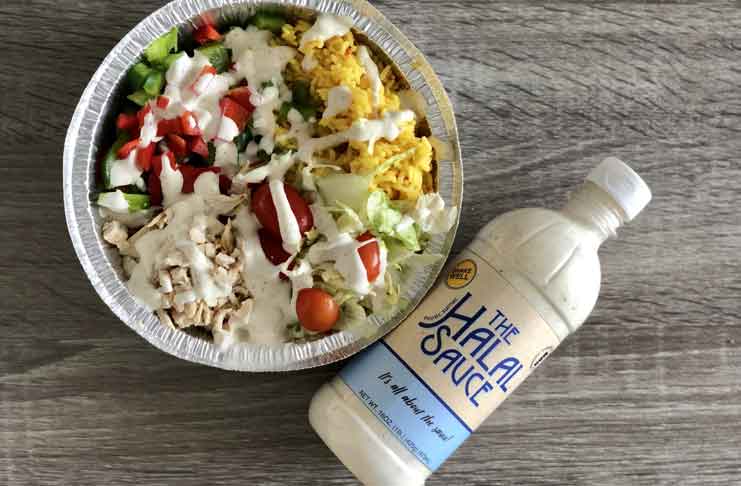
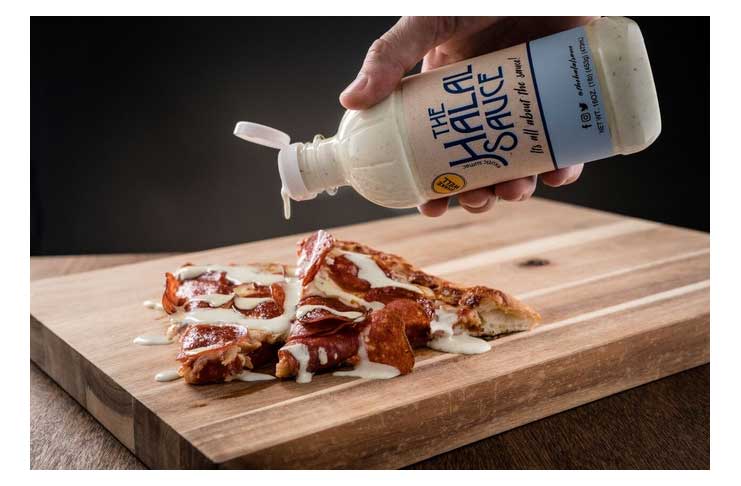
White sauce is the defining condiment of the NYC halal cart. It doesn’t exist in exactly this form anywhere else in the world. It’s not tzatziki. It’s not ranch. It’s not garlic sauce. It’s its own thing — a New York invention born on a Midtown sidewalk sometime in the early 1990s, and it has no canonical recipe.
What’s In It
The base of virtually every halal cart white sauce is mayonnaise. Real mayo — the emulsified kind made from egg yolks and oil — not Miracle Whip, which multiple recipe developers have tested and rejected for being too tangy and sweet. The mayo provides the body: thick, rich, and cohesive enough to coat rice grains without sliding off into a puddle at the bottom of the platter.
From there, acidity enters the picture. White vinegar and fresh lemon juice thin the mayo and add brightness. The acidity is critical — it’s what prevents the sauce from tasting like you squeezed a mayo packet onto your rice. The vinegar provides a clean, sharp tang; the lemon juice adds a rounder, more citric note. Most recipes use both.
Then there’s the dairy question. Some carts — and many copycat recipes — incorporate Greek yogurt or sour cream. This adds a cultured tang that plain mayo doesn’t have, and it shifts the texture toward something slightly lighter. Food Network’s recipe uses yogurt. The Halal Guys’ sauce, based on analysis of their to-go packets, likely does not — or uses very little. The presence or absence of dairy is one of the biggest variables between carts. If a white sauce tastes cleaner and richer, it’s probably mayo-forward. If it tastes tangier and lighter, there’s yogurt or sour cream in the mix.
Seasonings are simple: salt, black pepper, and sometimes a pinch of sugar to balance the acidity. Some versions include dried parsley for color and a subtle herbaceous note. Garlic appears in some recipes but not all. The Halal Guys’ version is generally believed to be garlic-free or extremely light on garlic — it’s designed to be a neutral amplifier, not a flavor that competes with the meat.
Why Every Cart’s White Sauce Tastes Different
Because the recipe isn’t standardized, and because the ratios matter enormously.
A cart that uses a 3:1 mayo-to-yogurt ratio will produce a sauce that’s rich, thick, and almost dessert-like in its creaminess. A cart that goes 1:1 will produce something sharper and thinner. The amount of vinegar changes the tang. The amount of sugar (if any) changes the sweetness. The type of mayo changes the base flavor — and commercial food-service mayo, which is what most carts use, tastes different from the Hellmann’s in your fridge.
At Sammy’s Halal, the white sauce is thinner and lighter — designed to share the platter with the green sauce rather than dominate it. At Adel’s Famous Halal, it runs thicker and creamier, built to stand up to the spicy rice and the aggressive hot sauce. At Chef G Halal & Healthy, there’s a balsamic vinaigrette option alongside the standard white — a rare departure that works because Chef G’s menu already leans healthier with salad-instead-of-rice options and grilled vegetables.
The point is: white sauce is not a single condiment. It’s a format — a family of mayo-acid-seasoning emulsions that each cart interprets differently. When people argue about whose white sauce is best, they’re really arguing about ratios.
Watch this video to learn how to do the sauce by yourself:
The Ancestral Connection: Khyar bi Laban
White sauce didn’t emerge from nothing. Its likely ancestor is khyar bi laban — a Levantine yogurt-cucumber sauce that’s a close relative of Greek tzatziki and Indian raita. When Egyptian immigrants adapted their food for the American sidewalk in the early 1990s, they needed a cold sauce that would work on a rice platter served from a cart. Yogurt-based sauces spoil faster in the heat. Mayo-based sauces don’t. The shift from yogurt to mayo was probably a practical decision — one that accidentally created a new condiment category.
The Halal Guys’ white sauce, which set the template for every cart that followed, has been described by food writers as a “distant cousin of tzatziki.” That’s technically accurate but misses the point. It’s the same family tree, but a different branch — one that evolved specifically for the environment of a New York sidewalk cart.
Hot Sauce (Red Sauce): The North African Import
The red sauce at NYC halal carts is believed to derive from harissa — the chili paste that originated in Tunisia and spread across North Africa and the Middle East. Harissa is traditionally made by pounding dried chili peppers with olive oil, garlic, coriander, caraway, cumin, and salt using a mortar and pestle. The word itself comes from the Arabic verb “harasa,” meaning to crush or pound. UNESCO added Tunisian harissa to its Intangible Cultural Heritage list in 2022.
The halal cart version is typically a simplified, Americanized riff: ground chili peppers (often a mix of cayenne and other dried reds), vinegar, salt, garlic, and sometimes cumin or coriander. It’s thinner than traditional harissa paste — more sauce than paste — and designed to be squeezed from a bottle rather than spooned from a jar. The heat level varies wildly.
The Heat Spectrum
The Halal Guys’ red sauce is the most notorious. It’s genuinely volcanic — a few drops will set your mouth on fire, and there are years of cautionary tales about tourists who drench their platters before taking the first bite. The heat hits fast and lingers long. It’s designed to be used in extreme moderation.
Adel’s Famous Halal runs a similarly aggressive hot sauce — bold, thick, and unforgiving. But it pairs with Adel’s spicy rice in a way that creates a layered heat rather than a single blast.
At Chef G Halal & Healthy, there are actually two hot sauces: the standard one and a secret extra-spicy version kept behind the counter. You have to ask for it, and the vendor will joke that you can’t handle it. (You probably can. Ask anyway.)
At Tariq’s #1 Halal in the Flatiron, the hot sauce is on the milder side — more flavor than fire. Some carts in the Indian-style tradition swap the harissa-derived red for a more South Asian chili sauce with different spice notes — more cumin, less coriander, sometimes a smoky undertone.
Application Protocol
The universal rule: start with less than you think you need.
A single thin zigzag line down the center of your platter is the correct starting amount. You can always add a second pass. You cannot un-sauce a platter. The hot sauce is meant to create a heat gradient across the dish — hotter in the center, milder at the edges where the white sauce dominates. If you flood the entire surface, you lose the gradient and you lose the interplay between the sauces. The whole point is contrast.
Green Sauce: The Secret Weapon
Not every halal cart carries green sauce, and that absence tells you something. Green sauce — called chutney, green chutney, or green chili chutney depending on the cart — is the condiment that separates the two halal traditions operating on New York’s sidewalks.
The South Asian Marker
Green sauce is a distinctly South Asian contribution to the halal cart landscape. It appears primarily at carts run by Bangladeshi, Pakistani, and Indian vendors — the operators who bring biryani, kati rolls, and tikka masala to the same silver cart format that Egyptian and Middle Eastern vendors built. The base is typically cilantro and green chili peppers, blended with vinegar, garlic, and salt. Some versions add mint. Some add a touch of lime juice. The commercial version (Shah’s Halal lists theirs on their website) uses cilantro, vinegar, green chili pepper, garlic, salt, and margarine, thickened with xanthan gum.
The flavor profile is completely different from white and red. It’s bright, herbaceous, sharp, and fresh — a counterpoint to the rich fattiness of the white sauce and the brute heat of the red. If white sauce is the bass note and hot sauce is the treble, green sauce is the midrange that ties the whole thing together.
Where to Find It
Sammy’s Halal at 73rd & Broadway in Jackson Heights is the gold standard — the green sauce is arguably more famous than the cart itself. It’s what earned Sammy’s the 2006 Vendy Cup. The sauce is bright, herby, noticeably spicier than most, and unlike anything at the Middle Eastern-style carts in Midtown.
Watch this reel to get a glimpse:
Biryani Cart at 46th & 6th carries a green chili chutney. Tariq’s #1 Halal at 19th & Park has it. Royal Grill at 44th & 6th sometimes offers it. As a rule, if a cart serves kati rolls or biryani alongside standard platters, they’ll likely have green sauce. If the menu is strictly chicken-lamb-gyro-falafel, they probably won’t.
If you see it, always say yes. It’s the clearest signal that a cart operator is thinking beyond the bare minimum, and it will change your platter.
The Three-Sauce Strategy
When all three sauces are available, there’s a correct way to apply them. This isn’t snobbery — it’s geometry.
Layer 1: White sauce as the base. Apply it across the entire surface of the platter, covering both meat and rice. This is the foundation — the creamy, tangy bed that everything else sits on. Be generous. The best carts are generous by default.
Layer 2: Hot sauce down the center. A single controlled line — not a flood — running lengthwise through the middle of the platter. This creates a heat gradient: the center is hot, the edges are cool. Every bite can be calibrated by where you dig your fork in.
Layer 3: Green sauce at the edges. Dot it along the perimeter and in the corners where the white sauce dominates but the hot sauce doesn’t reach. This creates a third flavor zone — herby, bright, fresh — that cuts through the richness without adding more heat.
The result is a platter with three distinct zones in every forkful. Lean left for creamy with herbs. Go center for heat. Scoop the middle-right for the full trinity. This is how regulars eat. It’s how the vendors eat. It’s the move.
For the full guide to the 20 best halal carts in NYC — including which carts carry green sauce and which don’t — see our Ultimate NYC Halal Cart Guide.
For the history of how these sauces ended up on a Midtown sidewalk in the first place, see The History of Halal Carts in NYC: From 53rd & 6th to Every Corner.
- About the Author
- Latest Posts

Anthony McGovern is an NYC-based food writer and culinary explorer dedicated to mapping the city’s rich, diverse street food landscape. From tracing the deep immigration histories behind Chinatown’s dumpling shops to hunting down the best late-night taco trucks on Roosevelt Avenue, Anthony focuses on the stories, people, and generations-old traditions that define New York’s food scene