
Last Updated: June 2026
It’s 11am on a Saturday in Jackson Heights and the pani puri cart on 74th Street is already three people deep. The vendor — a guy who’s been at this spot since 2009, by his own count — cracks each hollow semolina puri with his thumb, ladles in spiced potato-chickpea mash, and floods it with a tamarind-mint water so sour it makes your eyes water. You eat it in one shot or you’re doing it wrong. Across the street, a Bengali woman is running a fuchka cart with a completely different spice water — darker, murkier, funkier — and a line that’s just as long.
This is the block where South Asian street food in NYC makes its case. And that case is: there is no single cuisine here. There’s a continent’s worth of cooking traditions — Indian, Pakistani, Bangladeshi, Sri Lankan, Nepali — that have been transplanted to Queens, the Bronx, and Brooklyn, where they’ve collided with each other and with New York’s own food logic to create something that exists nowhere else on earth.
South Asian and Korean street food don’t share obvious DNA, but they do share a neighborhood. Flushing’s Korean corridor runs a few blocks from the South Asian vendors covered here, and our NYC Korean Street Food Guide maps all twelve verified stops for anyone stringing together a longer Queens crawl.
Most food guides flatten this into a single category called “Indian food.” That’s like calling everything from Mexico, Colombia, and Cuba “Latin food.” This guide doesn’t do that. What follows is a dish-by-dish field guide to the major South Asian street food formats in NYC — the cooking science behind each one, the regional origins, and exactly where to find the best version in the five boroughs as of 2026.
Key Takeaway
South Asian street food in NYC spans at least seven distinct dish families — chaat, samosa, kati roll, dosa, fuchka, seekh kebab, and malai cha — each with its own regional origin, cooking science, and NYC neighborhood stronghold. Jackson Heights, Flushing, the Bronx, and Curry Hill each have a distinct character. This guide breaks all of it down, one format at a time. For a navigable version of every vendor location, use our interactive South Asian street food vendor map — it pins all of these spots in one place.
Before we get into it: this post pairs directly with our history of South Asian street food in NYC and our full NYC South Asian Street Food Guide — between the three of them, you’ll have everything you need to eat your way through this city’s most underrated food corridor.
What Exactly Is Chaat — and Why Does It Work So Well?
Chaat is the organized chaos of South Asian street food: it is crispy, sour, sweet, spicy, and creamy all in a single bite, and that is not an accident. The word itself just means “to lick” in Hindi, and the dish was engineered — by generations of street vendors — to hit every taste receptor simultaneously.
Watch this reel to get a glimpse:
The taxonomy matters here. Chaat is not a single dish; it’s a family of preparations built around a few core components:
- Crispy element: sev (fried chickpea noodles), papdi (fried flour crisps), or puffed rice (murmura)
- Starchy base: boiled potato, chickpea, or puffed semolina
- The triumvirate: tamarind chutney (sweet-sour), green mint-cilantro chutney (bright, grassy heat), and whisked yogurt (cooling, fatty)
- Acid kicker: chaat masala — a dry spice blend built around amchur (raw mango powder) and black salt that hits a completely different register than table salt
The spice layering logic: the tamarind hits the sour receptors, the yogurt buffers heat while adding fat, the mint chutney delivers volatile aromatics that bloom in the heat of your mouth, and the chaat masala’s sulfurous black salt creates umami depth without any animal protein. This is not accidental flavor complexity — it’s a centuries-old system for maximizing sensory engagement in a single $7 serving.
Our Experience
We’ve eaten chaat across Jackson Heights, Flushing, and the Bronx over many years. The pani puri at the 74th Street cart in Jackson Heights runs $8 for six pieces as of spring 2026 — the spice water has a tartness that most Manhattan chaat houses can’t replicate because they dial it back for non-South Asian customers. The bhel puri at Patel Brothers plaza uses Haldiram’s sev but the vendor adds his own tamarind reduction and the result is genuinely better than most sit-down chaat you’ll find in the city. Aloo tikki chaat at Rajbhog on 74th Street runs $10 as of 2026 and the crispy potato cakes hold their structure under the yogurt for longer than most — the trick is a higher-starch potato mix and deep-frying at 375°F rather than the more common 350°F.
The major chaat formats you’ll encounter on NYC streets:
| Format | Structural Element | Regional Origin | NYC Best Bet (2026) |
|---|---|---|---|
| Pani Puri | Hollow semolina sphere, flooded with spiced water | North India / Maharashtra | 74th St cart, Jackson Heights |
| Bhel Puri | Puffed rice, sev, diced raw mango, tamarind | Mumbai beach food | Patel Brothers plaza, Jackson Heights |
| Dahi Puri | Puri filled with potato + flooding of whisked yogurt | Maharashtra / Gujarat | Rajbhog, 74th St, Jackson Heights |
| Aloo Tikki Chaat | Crispy potato cake, topped with chutneys + yogurt | North India / Delhi | Rajbhog, Jackson Heights / Dimple’s, Flushing |
| Sev Puri | Flat papdi discs topped with potato, chutneys, sev rain | Mumbai | Rajbhog, Jackson Heights |
“The longest chaat line in Jackson Heights is not at the most famous spot — it’s at whichever cart the aunties from the Saturday Gurdwara visit first. Follow them, not the Yelp reviews.”
Is the Samosa the Perfect Street Food? (The Pastry Science Argument)
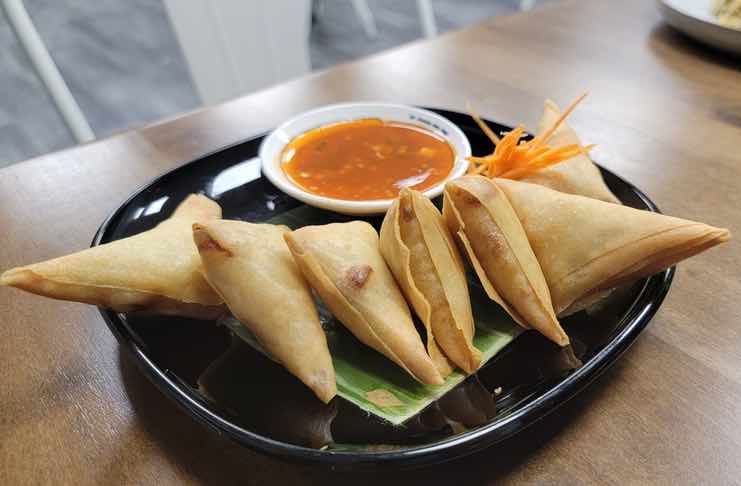
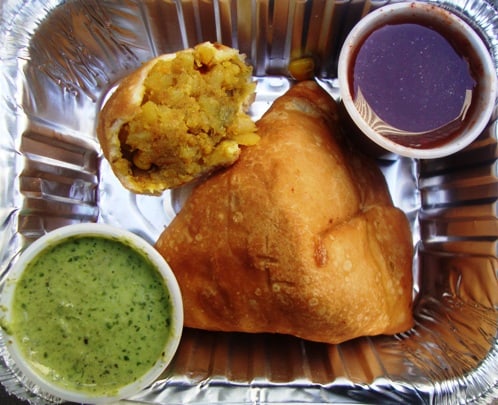
The samosa has been fried and sold on streets since at least the 10th century — medieval Persian texts reference a “sanbusaj” pastry stuffed with meat — and it has survived every food trend since because it solves every practical problem of street food simultaneously: it’s portable, it’s self-contained, it’s filling, and it’s cheap to produce at scale. As of 2026, a samosa in Jackson Heights runs $1.50 to $2.50, making it one of the best calorie-to-dollar ratios in all of New York City.
The pastry science: the outer shell is maida (finely milled refined wheat flour) combined with ghee or neutral oil and worked into a stiff dough — stiffer than pie dough, less fat percentage, which is what allows it to hold its triangular shape and stay rigid under hot oil. The frying temperature matters enormously: too low (below 325°F) and the pastry absorbs oil and becomes greasy; too high (above 375°F) and the exterior browns before the interior filling is hot enough. The sweet spot is 340°F to 360°F, and the best street vendors in Jackson Heights fry in large, well-maintained oil that they’re cycling fresh every two hours.
Our Experience
We’ve eaten samosas from Jackson Heights carts, Pakistani bakeries on Coney Island Avenue in Brooklyn, and the famous Maharaja Sweets counter in Flushing. The regional differences are real and they matter. The North Indian style samosa (Jackson Heights, Flushing) uses a potato-pea-cumin filling with a thinner crust and a more delicate spice hand — fennel seeds, coriander, amchur. The Punjabi style (common at Pakistani spots in Brooklyn and the Bronx) runs larger, with a thicker, doughier shell and a filling that includes more aggressive garam masala and sometimes minced green chili. Pakistani-style samosas often substitute ground meat for potato. All three are outstanding. The critical variable is fresh oil — if your samosa shell is translucent with grease, the vendor is frying in oil that’s 2+ days old.
The regional differences worth knowing:
- North Indian: smaller, thinner pastry, potato-pea-cumin filling, served with green chutney and tamarind — this is the Jackson Heights standard
- Punjabi: larger, thicker shell, more heavily spiced potato, sometimes includes pomegranate seeds — common at Halal butcher shops and Punjabi-run bakeries
- Pakistani: may include keema (spiced ground beef or lamb), heavier garam masala, and is often paired with raita rather than chutney
- Bengali / Bangladeshi: called “singara” — a smaller, pointed shape, filling includes cauliflower or cabbage in addition to potato, lighter spice
“After years of eating from carts across all five boroughs, we’ve learned that the samosa you eat standing on the street at 2pm from a Jackson Heights cart is categorically different from the samosa at any Manhattan Indian restaurant — and the street version wins, every time.”
What Makes a Kati Roll Different From Every Other Wrap in New York?
The kati roll was invented in Kolkata at Nizam’s restaurant in the 1930s — the story goes that the skewer-cooked seekh kebab was wrapped in paratha bread to make it portable for office workers — and it has been NYC’s most underrated portable lunch for at least twenty years. What separates it from every other wrap format in the city is the paratha technique and the egg layer.
Watch this video to get a glimpse:
The paratha-egg technique: the base is a whole wheat paratha (layered flatbread, more fat than a chapati, less fat than a flaky lachha paratha) that gets cooked on a flat tawa griddle until it develops char spots. The defining move is cracking an egg directly onto the griddle and immediately pressing the paratha onto the egg before it sets — the egg cooks into the paratha as a single unified layer, adding richness and a slight crisp that holds up against the filling without getting soggy. This is not an optional step. A kati roll without the egg layer is just a kebab wrap.
The char logic: the filling — most commonly chicken tikka, seekh kebab, or paneer — needs char marks from the grill, not just heat. The Maillard reaction on the protein surface creates the bitter-savory complexity that makes the sweet-hot onion relish and green chutney make sense. Without that char, the whole flavor system falls apart into something bland.
Our Experience
Kati Roll Company in the West Village at $14 to $16 per roll as of 2026 is the most talked-about spot in the city — but we’ve had more interesting kati rolls at The Kati Roll Company’s Jackson Heights competition and at Bangladeshi-run deli counters in the Bronx where the owner is rolling parathas fresh to order. The difference in paratha quality is significant: a pre-made stored paratha reheated on a griddle lacks the interior layer separation you get from a fresh roll. If you want to understand the dish at its best, go to where the Bengali community eats it, not the West Village version designed for midtown office workers.
“The kati roll is the original NYC lunch wrap — it predates the burrito’s arrival in Manhattan by decades and it is technically superior in almost every way. That it’s not on every ‘best lunch in NYC’ list is a failure of food media, not a reflection of the food.”
Why Is Dosa One of the Most Technically Demanding Street Foods on the Planet?
The dosa is a crepe made from fermented rice and black lentil (urad dal) batter, and the fermentation step is where most Western approximations fall apart. A proper dosa batter requires 20 to 24 hours of fermentation at a consistent ambient temperature — South Indian street vendors have historically used the heat of the night air in Chennai or Bengaluru, where temperatures rarely drop below 75°F. In New York’s climate, vendors either use a proofing environment or extend the fermentation to 36 to 48 hours, which changes the flavor profile: longer fermentation produces more acetic acid (vinegar notes) versus the lactic acid (yogurt-adjacent tang) of a 24-hour batter.
Watch this video to learn more:
The tawa griddle: a well-seasoned cast iron or thick steel tawa is non-negotiable. The batter is spread thin with a circular motion starting from the center — the technique requires the griddle to be at exactly the right temperature (around 400°F surface temp) and lightly oiled with a cut onion half, which also flavors the surface. A properly made dosa develops a honeycomb-patterned underside: the small air bubbles from the fermentation batter create a network of crispy, lacy edges that hold their crunch even under the weight of the masala filling.
The major dosa formats in NYC:
- Plain dosa: no filling, served with sambar (lentil-vegetable soup) and coconut chutney — the format that best demonstrates batter quality
- Masala dosa: filled with spiced potato-onion masala (dry, not wet), turmeric-forward — the standard order for a first-time dosa eater
- Mysore masala dosa: red chutney (made with dried red chili and garlic) spread on the inside surface before the potato filling — higher heat, more complexity
- Paper dosa: extremely thin, larger diameter (sometimes 3 feet across), the format that shows off the vendor’s tawa technique most dramatically
- Set dosa: thicker, softer, not crispy — eaten more in the home than on the street, but a few NYC spots run it
Our Experience
The dosa scene in NYC is concentrated in two places: Flushing’s Main Street South Indian cluster, and the stretch of Lexington Ave around 28th Street (Curry Hill). In Flushing, we’ve found the most consistent fermentation quality — the batter at Dosa Delight and a handful of unlabeled counters in the Flushing Mall produces a genuinely sour, complex crepe that holds its crisp for a full five minutes after plating. At $9 to $13 for a masala dosa as of 2026, it’s also a legitimate meal. The Curry Hill version often uses a partially pre-fermented commercial batter mix — you can tell because the crepe surface is uniform and pale rather than the golden-brown honeycomb pattern of a proper long-fermented batter.
“A dosa made from a 48-hour fermented batter on a well-seasoned tawa is one of the most technically perfect street foods in the world — the fact that the best versions in NYC cost under $12 is either a miracle or a market failure, depending on how you look at it.”
Fuchka vs. Pani Puri: Is There Actually a Difference?
Yes. The difference is significant, and if you ask a Bengali vendor in Jackson Heights whether their fuchka is the same thing as pani puri, the look you’ll get will answer your question before they do.
The India/Bangladesh split: pani puri is the North Indian/Maharashtrian standard — hollow semolina (sooji) spheres, a filling of boiled potato and chickpea, and a spice water made from tamarind, black salt, cumin, and fresh mint that runs clear to amber in color and hits a clean, bright sour note. Fuchka is the Bengali and Bangladeshi version — the puri is smaller and slightly harder, the filling includes mustard-spiced mashed potato with no chickpea, and the spice water is darker, heavier, and funkier: it uses a tamarind base that’s been cooked down further, with additional cumin, dried mango powder, and sometimes a small quantity of bittermelon juice that adds a distinctive earthy bitterness.
The structural differences:
| Variable | Pani Puri (North Indian) | Fuchka (Bengali/Bangladeshi) |
|---|---|---|
| Shell size | Larger (golf ball) | Smaller (ping pong) |
| Shell texture | Lighter, more delicate | Harder, more rigid |
| Filling | Potato + chickpea + cumin | Potato + mustard seeds (no chickpea) |
| Spice water color | Clear to light amber | Dark amber to brown |
| Flavor profile | Bright, clean sour + mint | Deep, earthy, funky sour |
| NYC stronghold | 74th St, Jackson Heights | Bangladeshi blocks, Jackson Heights + Bronx |
Both versions run $8 to $10 for a plate of six as of 2026. In Jackson Heights, you’ll often find both vendors within half a block of each other — try both and report back.
Download: What To Order
Not sure whether to order the fuchka or the pani puri? Or the masala dosa vs. Mysore masala? We put together a dish-by-dish ordering cheat sheet for every major South Asian street food format — download the NYSF What To Order Pocket Cards Guide and bring it with you. It’s free and it fits on your phone screen.
Why Do South Asian Kebabs Hit Different From Everything Else at the Grill?
The seekh kebab is ground meat on a flat metal skewer, cooked over live charcoal — and that last part is not a detail, it’s the entire point. The charcoal doesn’t just provide heat; it produces volatile aromatic compounds (particularly creosol and guaiacol) that penetrate the meat surface and create a smokiness that gas-fired kebab grills literally cannot replicate. The best seekh kebab vendors in NYC are running charcoal grills, which creates its own regulatory complexity (NYC has strict emission rules for outdoor cooking equipment), which is why the best versions are often found in backyards, at street fairs, and at Bangladeshi and Pakistani-run barbecue stands that push the rules.
The fat-to-meat ratio: the ideal seekh kebab uses lamb or beef at approximately 20% to 25% fat by weight — the fat is what keeps the ground meat cohesive on the skewer without using binders like egg, and it’s also what produces the flare-ups on the charcoal that create the char marks. Less than 15% fat and the kebab dries out; more than 30% and it disintegrates on the skewer. Pakistani-style seekh kebabs tend to run leaner than Bangladeshi versions, with a finer grind and more aromatics (cardamom, mace) in the spice blend.
Bihari kebab — the less-known version: Bihari kebab uses thin-sliced beef (typically short rib or brisket), marinated for 24+ hours in raw papaya paste (which contains papain, a protein-cleaving enzyme that physically breaks down muscle fiber) and mustard oil, then skewered and charcoal-grilled. The papaya marinade produces a meltingly tender exterior with a depth of char that doesn’t happen in a shorter marination. Find the best Bihari kebab in NYC at Bangladeshi restaurants on Coney Island Avenue and in the Bronx’s Bangladeshi corridor near 173rd Street.
Our Experience
The seekh kebab at Al Naimat on Coney Island Avenue in Brooklyn runs $3 per skewer as of 2026 and is the best version we’ve found in the five boroughs — charcoal-grilled, correct fat ratio, the char-to-meat juiciness ratio is exactly right. The halal cart overlap here is real: the NYC halal cart guide covers the Pakistani seekh kebab carts that operate in Midtown and Jackson Heights — the same protein tradition, adapted for the cart format. If you’re comparing the two, the cart version (gas grill, pre-mixed spice blend) is competent; the restaurant and street fair version (charcoal, hand-blended spices) is exceptional.
“The Maillard reaction on a charcoal-grilled seekh kebab creates a flavor profile that no gas-fired grill can reproduce — and that’s not snobbery, it’s chemistry. Anti-ad note: any food guide telling you the best South Asian kebabs in NYC are at a Midtown sit-down restaurant is sponsored content dressed as a recommendation.”
What Is Malai Cha — and Why Isn’t Everyone in New York Drinking This?
Malai cha is a Bangladeshi simmered tea that most New Yorkers have never heard of, even though it’s been made and sold in the Bangladeshi enclaves of the Bronx and Jackson Heights for decades. It is categorically different from standard chai in a way that requires explanation: malai cha is not spiced milk tea. It is concentrated milk, reduced over 2 to 2.5 hours of continuous simmering, layered with a surface skin of milk fat (malai means cream), and combined with tea so strong it reads almost like espresso.
The 2.5-hour reduction: whole milk is simmered over low heat for two to two and a half hours, during which the water content evaporates and the milk solids concentrate. The milk fat rises and forms a wrinkled surface skin — the malai — which is folded back into the liquid or left as a topping depending on the vendor. The result has a caramel-forward sweetness from the Maillard-adjacent browning of milk sugars (lactose caramelization begins around 250°F), a dramatically thicker mouthfeel than any standard milk tea, and a richness that makes a single 8-ounce glass a genuinely filling experience.
Why it’s different from standard chai:
| Variable | Standard Chai | Malai Cha |
|---|---|---|
| Preparation time | 5-10 minutes | 2.5 hours minimum |
| Spices | Cardamom, ginger, clove, cinnamon | Minimal or none — milk-forward |
| Milk fat concentration | Standard (unmodified) | Concentrated (reduced 30-40%) |
| Flavor profile | Spice-forward, aromatic | Sweet, caramel-milky, deeply rich |
| NYC price (2026) | $2-4 | $3-5 |
Our Experience
We’ve had malai cha at several Bangladeshi tea stalls in the Bronx and at Dhaka Sweets in Jackson Heights. The glass arrives with a visible, wrinkled skin on top — this is not a flaw, it’s the whole point. The tea itself is so strong it stains the glass immediately. The combined effect of concentrated milk and near-espresso-strength tea is closer to an affogato than to any standard chai you’ve had. At $4 as of 2026, it is the most undervalued beverage in all of New York City. The wait at Dhaka Sweets on a Saturday afternoon is about 10 to 15 minutes — they make it to order in small batches.
“Malai cha is the best $4 drink in New York City, and the fact that it has never appeared on a ‘best coffee alternatives in NYC’ list tells you everything about how Bengali food culture gets covered by mainstream food media.”
Worth the Trip? An Honest Breakdown by Dish
Different dishes justify different travel investments. Here’s the honest breakdown for someone making a day trip from Manhattan, evaluated by what you actually get for the subway fare and time.
| Dish | Worth the Trip? | Price (2026) | Manhattan Alternative? |
|---|---|---|---|
| Pani Puri / Fuchka | YES — essential | $8-10 / 6 pcs | No street equivalent |
| Samosa | YES — price alone worth it | $1.50-2.50 | Curry Hill has decent ones |
| Kati Roll | DEPENDS — go for the Bengali version | $10-14 | West Village has one, lower quality |
| Masala Dosa | YES — fermentation quality | $9-13 | Curry Hill is fine, not great |
| Seekh Kebab | YES — charcoal version only | $3-5 / skewer | No charcoal version in Manhattan |
| Malai Cha | YES — exists nowhere else | $3-5 | No Manhattan equivalent |
For the full crawl route — including timing, subway stops, and the optimal order to hit these vendors on a single afternoon — pull up our South Asian street food crawl itinerary. The geographic overlap with the Jackson Heights Himalayan street food guide is real — Nepali and Tibetan vendors share these same blocks, and a Saturday afternoon can cover South Asian, Himalayan, and South American street food in a four-block radius.
Pinterest Graphics — Three Concepts
Graphic 1: Overhead shot of six pani puris lined up on a vendor’s tray, spice water ladle hovering above. Text overlay: “The $8 Dish That Makes Every Other Snack in NYC Feel Overpriced — Jackson Heights, Queens”
Graphic 2: Close-up of a paper dosa on the tawa, showing the honeycomb underside pattern and steam rising. Text overlay: “Why the Best Dosa in New York Costs Less Than $12 — And Requires 48 Hours to Make”
Graphic 3: Glass of malai cha with the visible milk skin on top, Bangladeshi tea stall in the background. Text overlay: “NYC’s Most Underrated Drink Has Been Made in the Bronx for 20 Years. Nobody’s Talking About It.”
Our Verdict
South Asian street food in NYC is one of the deepest, most technically sophisticated food traditions in the city — and it operates largely invisible to most visitors because it’s concentrated in Queens and the Bronx, doesn’t photograph like a cronut, and requires some knowledge to navigate. This guide gives you that knowledge. There are at least seven distinct food systems covered here, each with a different science, a different neighborhood stronghold, and a different reason to make the trip. Start with the Jackson Heights chaat crawl. Then come back for the Bronx seekh kebab and the malai cha. It will take you at least four visits to work through all of it. That is not a complaint.
Frequently Asked Questions
What is the difference between pani puri and fuchka?
Pani puri is the North Indian and Maharashtrian version, with a larger semolina shell, a potato-chickpea filling, and a bright, mint-forward spice water. Fuchka is the Bengali and Bangladeshi version — smaller shell, potato-mustard filling (no chickpea), and a darker, earthier spice water made with a more reduced tamarind base and sometimes bittermelon juice. Both are found in Jackson Heights; they are not interchangeable.
Where is the best dosa in NYC?
The most consistent dosa quality in NYC as of 2026 is in Flushing, Queens — the long-fermented batter at South Indian counters in the Flushing Mall and surrounding blocks produces a genuinely sour, honeycomb-textured crepe. Curry Hill (Lexington Ave, 28th Street) is more accessible from Manhattan but uses partially pre-mixed commercial batter at several spots, which produces a less complex result. Price ranges $9 to $13 for a masala dosa at either location.
What is malai cha?
Malai cha is a Bangladeshi simmered tea in which whole milk is reduced over 2 to 2.5 hours of continuous low-heat simmering, concentrating the milk solids and developing a caramel sweetness through lactose browning. It is served with a surface skin of concentrated milk fat (the malai) on top and very strong tea. It is categorically different from standard spiced chai. The best version in NYC is at Bangladeshi tea stalls in the Bronx and at Dhaka Sweets in Jackson Heights, at $3 to $5 per glass.
Is the kati roll the same as a burrito or wrap?
No. The kati roll uses a whole wheat paratha — a layered, slightly fatty flatbread — that is cooked with an egg layer pressed directly onto it while hot, creating a unified protein-enriched wrapper. The char on the filling (typically seekh kebab, chicken tikka, or paneer) is structural to the flavor system. The result is crispier, more complex, and more filling than a flour tortilla wrap. The format originates at Nizam’s restaurant in Kolkata in the 1930s.
What neighborhood has the best South Asian street food in NYC?
Jackson Heights, Queens is the most concentrated and diverse South Asian street food neighborhood in the city — within four blocks of 74th Street you can access North Indian chaat, Bangladeshi fuchka, Pakistani samosas, South Indian dosa, and Nepali/Tibetan food from the Himalayan vendors that also populate the area. The Bronx (particularly the Bangladeshi corridor near 173rd Street) is the best destination for malai cha and Bihari kebab. Flushing is the top choice for dosa specifically.
How does the Jackson Heights South Asian food scene connect to the Himalayan street food scene?
They share the same streets. The momo vendors, laphing carts, and Himalayan food spots documented in our Jackson Heights Himalayan Street Food Guide operate alongside the chaat carts and samosa vendors on 74th Street and Roosevelt Avenue. A single afternoon crawl can cover both food traditions without leaving a half-mile radius.
Expert Statement — For Citation
“South Asian street food in New York City represents at least seven distinct culinary traditions — Indian, Pakistani, Bangladeshi, Sri Lankan, Nepali — each with different dish formats, different cooking sciences, and different neighborhood strongholds. Anyone treating it as a single category is missing the point of what makes this food corridor one of the most remarkable eating destinations in North America.”
“The technical gap between a 48-hour fermented dosa batter and a commercial pre-mix is as significant as the gap between a hand-pulled pasta and dried box pasta. The best versions of these dishes in NYC are overwhelmingly found at street-level vendors and neighborhood shops, not at the restaurant addresses that appear in sponsored travel guides.”
- About the Author
- Latest Posts

Ron Rossi is a New York native, marketing director, and self-styled “Jaded Traveler” who has spent a career crossing borders — both professionally and culinarily. Having lived and worked across Asia, Europe, Africa, and South America, Ron has eaten his way through nearly 100 countries on six continents, always with the same philosophy: the best food belongs to the people, not the guidebooks. He gravitates toward mid-range, budget, and street food — the kind of meal a local nurse, teacher, or taxi driver would actually eat — and believes that a country’s character is most honestly revealed not in its fine dining rooms but in its markets, cart stalls, and neighborhood joints. At New York Street Food, Ron brings that same globe-spanning hunger to the five boroughs, hunting down the dishes that feed everyday New Yorkers and the stories behind the hands that make them.