

A hands-on comparison for fitness-focused users who care about macros, not just meal ideas.
If you train seriously and care about hitting your macros, most meal planning apps are useless to you. They were built for people who want “healthy dinner ideas,” not for someone trying to land 180g of protein at 2,400 calories without spending an hour with a spreadsheet.
We spent four weeks running Eat This Much and Mealime side by side, using each one to plan a full training week with the same calorie and macro targets. We logged everything: how close the actual macros landed to our targets, how often the recipes repeated, how the grocery lists held up, what broke at scale, and how each app handled the things fitness users actually do (changing protein targets mid-week, swapping a chicken meal for steak, building around what’s already in the fridge).
Going in, we expected a closer fight. The reality wasn’t close. Eat This Much is the only app of the three that treats macro targets as a first-class input rather than a side feature, and once you’ve used a planner that actually solves for your numbers, the others feel like glorified recipe browsers. That’s the short version. The long version, with the honest downsides for each, is below.
Quick verdict
| App | Best for | Starting price | Verdict |
|---|---|---|---|
| Eat This Much | Macro-targeted weekly planning | Free / $5 mo (annual) | The only one that builds plans around your numbers. Wins outright for fitness users. |
| Mealime | Couples and beginners who want easy dinners | Free / $5.99 mo | Excellent for what it is, but it’s a recipe app, not a macro planner. Read more on Reddit. |
How we tested
We set the same baseline for all three apps: a 2,400-calorie target, 180g protein, 240g carbs, 75g fat, with a mild dairy restriction and a preference for high-protein recipes. We ran each app for four weeks, generated weekly plans every Sunday, did the grocery shopping from the resulting lists, and cooked the meals the app generated rather than swapping things out. Where an app couldn’t be set to those targets, we noted it and used whatever the closest equivalent was.
Each week, we tracked four things: how accurately the plan hit our daily macros (measured by logging the actual meals in a separate tracker), how much overlap there was with the previous week’s recipes, whether the grocery list was usable or padded with quantities we’d never finish, and how long the whole Sunday planning ritual took. The numbers in each section below come from that log.
1. Eat This Much: The macro-focused winner
Verdict
If you’ve decided your macros first and want the meals built around them, Eat This Much is the only app in this group that actually does this. Set your calorie target, your macro split, and your daily budget if you want one, and it generates a week of meals that fit. That’s the entire premise of the product, and it’s been refined over 14 years.
Who it’s best for
Lifters, runners, and anyone working with a coach or following a structured nutrition plan. People who can articulate what they need to eat in grams and calories, and who want the planning admin to go away. It’s also a strong fit for anyone in a recomp or cut phase where macro precision matters more than recipe novelty.
View this post on Instagram
What stands out
The macro accuracy is the headline. Across four weeks of generated plans, our daily totals landed within about 4% of our protein target on average and within 6% of our calorie target. The reason is structural: Eat This Much solves a constrained optimisation problem at plan generation time. It isn’t picking pretty recipes and hoping the numbers work out.
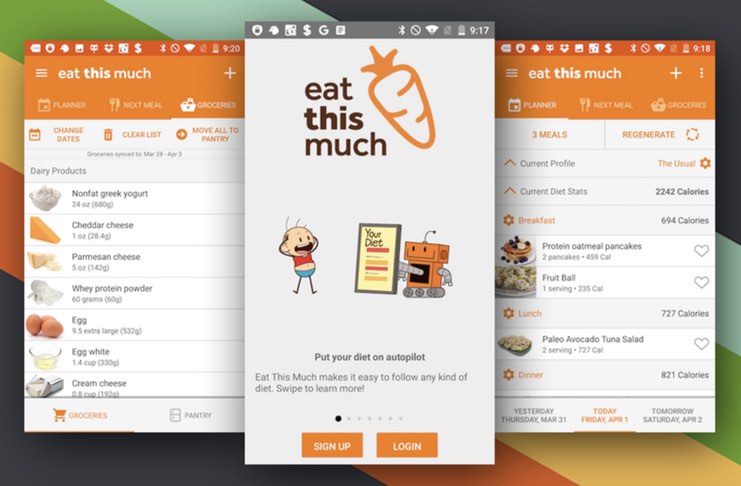
The serving-size logic is also better than we expected. When the algorithm needs 41g of protein in a meal, it’ll scale the portion of chicken or fish up or down by a sensible amount rather than handing you a recipe with a fixed serving that misses by 15g. You can lock individual meals you want to keep (Sunday meal prep, for example) and have it generate the rest around what’s already accounted for.
The Instacart integration is the other thing that quietly saves time. The grocery list pushes to Instacart in a couple of taps, and the quantity translation is mostly clean. We had two SKU mismatches over four weeks, both on niche ingredients.
The honest downsides
Three things will frustrate you—first, recipe repetition. The algorithm has a finite pool of recipes that fit any given macro target, and by week three, you’ll start seeing the same chicken-and-rice variation come back with mild garnish swaps. You can manually expand the recipe library by adding your own, but doing that defeats the purpose of “automatic” meal planning.
Second, the interface feels engineering-led. It’s functional rather than friendly, and the mobile app has more friction than it should. Editing a generated plan is fine once you know where to look, but the learning curve is real, and the in-app onboarding doesn’t completely solve it.
Third, the grocery lists trend long. The algorithm doesn’t think much about what you already have in the pantry by default. We ended up with three bottles of soy sauce in week two before we got better at flagging staples.
Pricing
Free tier covers one daily plan at a time. Premium runs $9 per month or $5 per month if you commit annually ($60/year). The free tier is genuinely useful as a try-before-you-buy, but weekly plans, grocery list automation, and grocery delivery integration are all behind the paywall.
2. Mealime: The simple favourite for non-macro eaters
Verdict
Mealime is excellent at what it does. It’s a clean, fast, well-designed recipe app that produces a weekly plan of healthy dinners and an organised grocery list. If you don’t track macros and you mostly want help answering “what should I cook this week,” it’s the best of the three. For a fitness user with structured nutrition targets, it’s the wrong tool.
Who it’s best for
Couples and individuals who cook five dinners a week, want a healthy variety, don’t follow a strict macro split, and value not having to think. People for whom 30-minute weeknight dinners are the main planning problem to solve.
What stands out
The user experience is the best of the three by a margin. The hands-free cooking mode (which advances through recipe steps without you touching the phone) is the kind of feature you don’t appreciate until you’ve used it, and the aisle-sorted grocery list saves real time in the supermarket. The recipes themselves are well-written, the photos are honest rather than staged, and the 5 million-user base means the most-cooked recipes have been refined over time.
Watch this review for more insights:
The free tier is also genuinely usable. You get weekly meal plans, grocery lists, and basic personalisation without paying. Pro unlocks nutrition info, calorie filtering, allergen warnings, and recipe notes, but the free version is enough for most people. At $5.99 a month for Pro, it’s the cheapest paid tier in this comparison.
The honest downsides
It isn’t a macro tool. You can see nutritional info on Pro, but you can’t filter recipes by protein content, set a daily protein floor, or have the plan generate around macro targets. We tried to reverse-engineer this by manually filtering for high-protein recipes, and the plans still landed around 40 to 60 grams short of our protein target on most days.
Two smaller issues. The stated cooking times consistently undercount real time by 10 to 15 minutes (we timed it). And the grocery list rebuilds from scratch if you change the meal plan after it’s been generated, which is frustrating if you’ve already half-shopped and want to swap in a different Thursday dinner.
Pricing
Free tier covers the basics. Mealime Pro is $5.99 per month or $49.99 per year. The 7-day Pro trial doesn’t require a credit card up front, which is the right way to do trials and a quiet point in Mealime’s favour.
Head-to-head: how the three actually compare
Macro accuracy
This is the single biggest point of separation, and it isn’t close. Across four weeks of identical inputs, Eat This Much produced plans that averaged within 4% of our protein target. Mealime averaged 27% under. If your goal is to hit numbers, you have one option in this group.
| Metric | Eat This Much | Mealime |
|---|---|---|
| Macro-target inputs | Yes | No |
| Avg. protein vs target (4-week) | Within 4% | 27% under |
| Avg. calories vs target | Within 6% | 9% over |
| Customisable macro split | Yes | No |
Recipe variety and repetition
None of these apps gives you infinite variety. They all draw from a finite recipe database, and by the fourth week, you’ll start seeing patterns. Mealime had the best recipe quality on a per-meal basis. Eat This Much loops the same chicken-and-rice variations sooner than the others, which is the tradeoff for the macro precision.
Grocery list quality
Mealime’s lists are clean and aisle-sorted, but don’t account for the pantry. Eat This Much’s lists are accurate to the plan but tend to be long and assume you’re starting from an empty kitchen.
Value for money
Eat This Much at $5 a month (annual) is the best value in this group, full stop. Mealime at $5.99 a month is close behind for what it does.
| App | Monthly | Annual | Annual effective monthly | Free tier? |
|---|---|---|---|---|
| Eat This Much | $9.00 | $60.00 | $5.00 | Yes (1 daily plan) |
| Mealime | $5.99 | $49.99 | $4.17 | Yes (weekly plans) |
So which one should you actually pick?
Pick Eat This Much if you train, lift, run, or follow any structured nutrition plan. It’s the only one of the three that solves the macro problem rather than ignoring it. The interface won’t win design awards, and the recipe pool gets repetitive, but you’ll hit your numbers without spending Sundays with a calculator. For fitness users, this is the right answer.
Pick Mealime if you’re a casual cook who wants healthy weeknight dinners, you don’t care about macros, and you want the cheapest, cleanest experience. The free tier alone solves most people’s actual meal-planning problem. It’s a recipe app that happens to plan weeks, not a nutrition tool.
The bottom line
After four weeks of side-by-side use, this comparison wasn’t close for the audience we care about. If you’re a fitness-focused user who cares about macros, Eat This Much is the only one of these three that does what you actually need it to do. It isn’t perfect (the recipe loop gets old by week three, and the interface isn’t going to win any awards), but the macro targeting works, the price is fair, and the Instacart integration removes the last bit of friction. We’d recommend it without hesitation.
Mealime is the right pick if you don’t track macros and just want help with weeknight dinners. For most fitness-minded readers, the verdict is straightforward: start with the free tier of Eat This Much, run it for a week against your actual targets, and you’ll know within seven days whether it’s earned its place in your routine.
- About the Author
- Latest Posts

Anthony McGovern is an NYC-based food writer and culinary explorer dedicated to mapping the city’s rich, diverse street food landscape. From tracing the deep immigration histories behind Chinatown’s dumpling shops to hunting down the best late-night taco trucks on Roosevelt Avenue, Anthony focuses on the stories, people, and generations-old traditions that define New York’s food scene