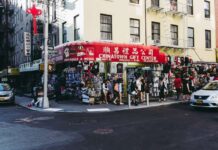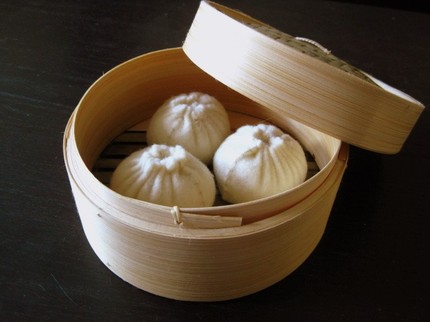

Every dumpling on Mott Street is a timestamp. The pleated har gow steaming in a bamboo basket at a Canal Street tea house traces back to Guangdong Province in the mid-nineteenth century. The boiled pork-and-chive pocket sold six-for-a-dollar on East Broadway arrived with a different migration entirely — a wave that remade the neighborhood’s demographics and its food supply chain in a single decade. The xiao long bao, the soup dumpling that has since become the city’s most-Instagrammed street food, came later still, and with it a set of technical expectations — thin skin, collapsing aspic, scalding broth — that forced every other dumpling vendor in the neighborhood to reckon with a new price point and a new customer. Later on, you can check out our NYC Chinatown Dumpling Guide and our dumpling style breakdown!
Read the block-by-block dumpling map of lower Manhattan and you are reading an immigration history. The styles are not interchangeable. They are not “Chinese dumplings” in any unified sense. They are the preserved culinary logic of three distinct provincial cultures, deposited in layers like sediment, each one visible in the neighborhood if you know which streets to walk and which steam tables to stand in front of. For the full vendor landscape across all of Chinatown’s dumpling styles, see the NYC Chinatown Dumpling Guide — this post is the history underneath it.
The Cantonese Foundation (1870s–1960s)
The first Chinese community in lower Manhattan was Cantonese, almost entirely. The laborers who built the transcontinental railroad and were subsequently expelled from the West by the Chinese Exclusion Act of 1882 settled in New York in numbers that made Mott Street the axis of Chinese-American life for the better part of a century. They came from Guangdong Province — the Pearl River Delta counties of Taishan, Zhongshan, Guangzhou — and they brought with them the tea house economy that organized social life back home.
Watch this video to learn more:
Yum cha — literally “drink tea” — was never primarily about tea. The tea house was a morning institution, a place where men conducted business, negotiated disputes, and read newspapers over bamboo steamers. The food that came with the tea was dim sum: small, precisely made, served in rotating succession from carts or carried out from the kitchen in stacked bamboo trays. And at the center of the dim sum repertoire were dumplings — har gow (shrimp dumplings in translucent wheat starch skin), siu mai (open-topped pork and shrimp in a wonton wrapper), cheung fun (rice noodle rolls stuffed with shrimp or beef), wu gok (fried taro dumplings with lacy honeycomb shells).
The technical standards for har gow alone are demanding enough that Cantonese culinary tradition uses them as a benchmark test for a dim sum cook’s skill. The wrapper is made from wheat starch and tapioca starch — not flour — which produces the characteristic translucency and a slightly chewy, non-gummy bite when properly steamed. Seven pleats minimum on the seam is the traditional standard. The filling should be whole shrimp, barely seasoned, with bamboo shoot for crunch. Overcooking by thirty seconds turns the skin gummy. Undercooking leaves the filling cold at the center. The window is narrow.
For decades, the Cantonese tea houses on Mott and Bayard were the only game in Chinatown. The community was insular by necessity — discriminatory housing policy, the exclusion acts, and the Paper Son system (in which immigrants purchased false identity documents to enter as the “paper sons” of established citizens) all reinforced geographic concentration and social self-sufficiency. The food economy followed the same logic: Cantonese restaurants for Cantonese customers, with tea house dim sum as the defining ritual.
Nom Wah Tea Parlor, which opened on Doyers Street in 1920, is the institutional artifact of this era. It is still open. The NYC Chinatown Dumpling Guide covers it in detail, but its persistence is worth naming here: it survived the Fujianese transformation of the 1980s and the XLB wave of the 2000s largely by becoming something like a museum exhibit of itself — a place where the Cantonese baseline is preserved not because it resisted change but because it became legible as heritage.
Watch this video to learn more:
The Fujianese Transformation (1980s–2000s)
The Immigration and Nationality Act of 1965 cracked the door. The Tiananmen Square crackdown of 1989 blew it open. What followed was one of the most significant demographic transformations any urban neighborhood in American history had undergone in a single decade: the Fujianese migration to lower Manhattan.
Fujian Province sits on China’s southeastern coast, directly across the strait from Taiwan. It is not Guangdong. The language (Min Nan, also called Fujianese or Hokkien) is mutually unintelligible with Cantonese. The food culture is distinct — lighter, seafood-forward, with a different dumpling tradition centered on boiled and pan-fried forms rather than the steamed dim sum repertoire. The Fujianese who arrived in New York in the late 1980s and 1990s were, in many cases, economic migrants who had paid human smuggling networks — snakeheads — tens of thousands of dollars for passage, arriving in debt that took years of factory and restaurant labor to clear.
The geography of the transformation is visible in two streets. The old Cantonese Chinatown runs along Mott Street, north-south from Canal to Bayard. The Fujianese corridor runs east along East Broadway, toward the Manhattan Bridge — a different axis entirely, denser, more chaotic, anchored by the East Broadway Mall food court and the supermarkets and money transfer shops that served a community wiring remittances back to Fuzhou. The two communities shared a zip code and almost nothing else.
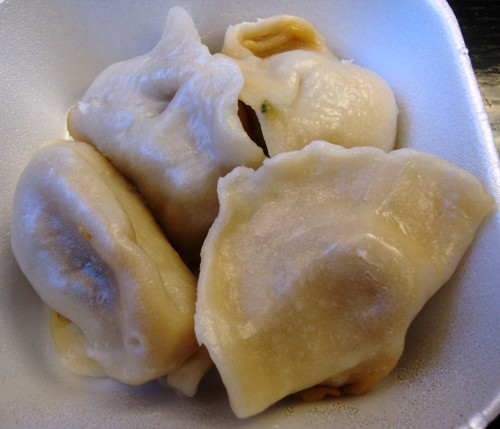
What the Fujianese brought to the dumpling economy was the boiled jiaozi — the northern-style folded dumpling that most Americans now associate with the word “dumpling” — adapted through a Fujianese lens. The skins were thicker than har gow, the fillings simpler: pork and cabbage, pork and chive, shrimp and pork. The preparation method was humble: boiled in salted water, served with black vinegar and chili oil, portioned generously for the price. The labor cost was calibrated to a community in debt: six dumplings for a dollar was not a marketing decision, it was a survival calculation.
This is the same working-class street food economics that shaped every immigrant food corridor in the city. The history of NYC halal carts documents a parallel trajectory: Yemeni and Bangladeshi cart operators entering a market that had been held by Greek souvlaki vendors and Jewish hot dog carts, pricing aggressively to build a customer base, and in the process permanently altering what New Yorkers expected to pay for fast street food. The mechanism is the same. The ingredient changes; the economic logic does not.
By the late 1990s, the six-for-a-dollar boiled dumpling had become one of the most recognized food facts in New York — a landmark as reliable as the bagel or the slice. The Fujianese vendors on Eldridge Street, on Mosco Street, on the stretch of Mott below Canal, had created a price expectation that reshaped the entire Chinatown food economy. For the full picture of where these vendors operate today, the NYC Chinatown Dumpling Guide maps the current landscape.
The Shanghainese XLB Arrival (2000s–Present)
Xiao long bao is a technically unusual object. It is not simply a dumpling with soup inside. It is a dumpling assembled around a cube of solidified pork aspic — collagen extracted from pork skin and bones, set into a gel by refrigeration, chopped into pieces, and folded into the filling before the wrapper is sealed. When the dumpling hits the steam, the aspic melts back into liquid. The wrapper, thin enough to see the filling through, holds the broth. The correct eating protocol — bite a small hole in the side, let the steam escape, sip the broth before eating the rest — is not etiquette for its own sake; it is the only way to avoid scalding your mouth on broth that has been held near boiling inside a thin skin for several minutes.
The aspic technique is old — it appears in Shanghai culinary records from at least the nineteenth century — but xiao long bao arrived in New York’s Chinatown relatively late. The Shanghainese community in lower Manhattan was always smaller than the Cantonese and Fujianese communities. The first serious XLB destination in the neighborhood opened on Mott Street in the early 2000s, and it arrived with a different business model than the Fujianese counter. The price was higher. The theater was built in — watching the pleating happen through a storefront window became part of the transaction.
The mechanics demand it. Proper XLB skin is made from a hot-water dough that produces a more extensible, thinner wrapper than the flour-and-cold-water dough used for boiled jiaozi. The standard fold is eighteen pleats at the crown — this is not decoration; the tight gather at the top seals the broth inside under steam pressure. A torn skin means lost broth and a failed dumpling. The ratio of aspic to meat filling determines the broth volume; too much aspic produces a watery, flavorless soup, too little leaves the dumpling dry. This is a calibrated product with narrow tolerances, and it commands a price that reflects the labor.
The XLB arrival did something interesting to the Chinatown dumpling economy: it introduced a premium tier into a market that had been organized almost entirely around volume and low price. The Fujianese six-for-a-dollar counter and the Shanghainese XLB restaurant were not competing for the same customer, but they were competing for the same cultural attention. New York food media, which had spent years treating Chinatown dumplings as a category united by price, suddenly had a technical object to write about. The XLB became the gateway through which a broader audience entered the neighborhood’s dumpling geography.
It also, incidentally, created a new frame for understanding momos, the Tibetan-Nepali dumplings that had been a fixture in Jackson Heights for years and were arriving in lower Manhattan through Himalayan restaurants. Momo is its own distinct lineage — Central Asian in origin, traveling through Tibet and Nepal before reaching Queens — and the Jackson Heights Himalayan Street Food Guide covers that parallel history in full. But the XLB moment gave food-curious New Yorkers a vocabulary for thinking about dumplings as a category with regional variation and technical specificity rather than as a single undifferentiated thing, and that reframing benefited every dumpling tradition in the city.
What Survives
The layering is still visible if you walk the neighborhood slowly. On Doyers Street, Nom Wah is serving har gow from the same storefront it has occupied since 1920, under fourth-generation management that has kept the tea house format while updating the menu just enough to stay solvent. A few blocks east, on Eldridge or on the south end of Mott, the Fujianese counter operation is still running — same price point, same boiled pork-and-chive, same six-for-a-dollar arithmetic that arrived with the migration wave thirty years ago. On the tourist corridor between Canal and Bayard, the Shanghainese XLB shops do a lunch service that stretches down the sidewalk.
None of these layers has displaced the others. The Cantonese community is smaller than it was — many families moved to Flushing and Sunset Park as Manhattan rents rose — but the institutional infrastructure remains. The Fujianese corridor on East Broadway is still a working neighborhood, not a dining destination, which means the food is priced for the people who live there. The XLB shops have multiplied and diversified, with regional Chinese cooking from Sichuan, Hunan, and Dongbei now sharing the same blocks.
What Chinatown offers, if you pay attention to it, is something rare in a city that tears itself down constantly: an archaeological record of successive immigration that has not been smoothed into a single coherent “cuisine.” The dumplings are not unified. They are in conversation — or in competition, depending on your read — across three centuries and three provincial traditions. You can eat your way through the argument in an afternoon, starting at Nom Wah and ending at the XLB counter on Mott Street, with six boiled pork-and-chive in between. Explore the NYC Chinatown Dumpling Guide for the full vendor map, current hours, and ordering protocols, and the Field Guide to Chinatown Dumpling Styles for the technical breakdown of each fold, filling, and cooking method. The history is the context. The street is the text.
Filed under: /category/chinese/
- About the Author
- Latest Posts

Anthony McGovern is an NYC-based food writer and culinary explorer dedicated to mapping the city’s rich, diverse street food landscape. From tracing the deep immigration histories behind Chinatown’s dumpling shops to hunting down the best late-night taco trucks on Roosevelt Avenue, Anthony focuses on the stories, people, and generations-old traditions that define New York’s food scene