

Last Updated: August 2026
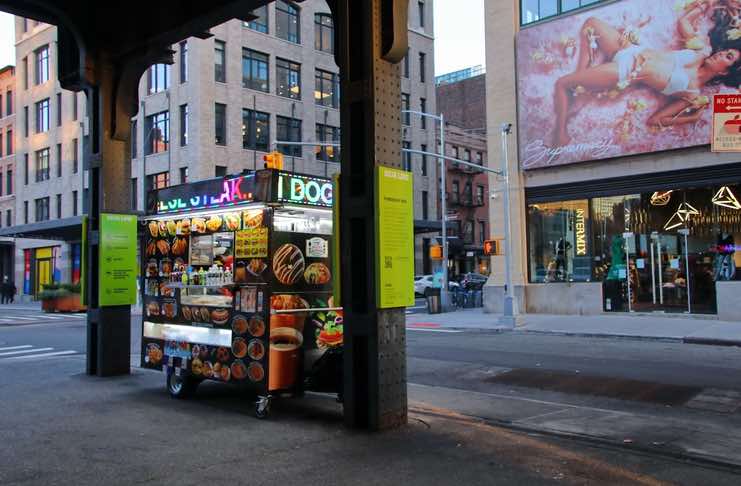
The halal cart on the corner of 73rd and Broadway in Jackson Heights sets up at 11 a.m., and by noon there’s a line that wraps past the Colombian bakery next door, which is already three deep with people waiting on pan de bono. A block south, a Tibetan momo stall is doing its own steady business on Roosevelt Avenue. None of that happened by accident. It happened because rent in Jackson Heights, for now, still lets a Bangladeshi cart operator, a Colombian baker, and a Tibetan noodle vendor all afford to work the same three blocks.
Key Takeaway
Neighborhoods keep their culinary range when housing and commercial rents stay within reach of small, often immigrant-run food businesses. Once a rezoning or a wave of new market-rate development pushes rents up, the diverse blocks are usually the first to flatten into chains and single-cuisine corridors. In our years covering NYC street food, the healthiest, most varied blocks are almost always the ones where housing costs still leave room for a $6 taco or a $4 arepa to be a viable business, not a nostalgia item.
Why Does Affordable Housing Actually Matter for a Neighborhood’s Food Scene?
Affordable housing keeps a wider range of people, and the businesses those people start, inside the same zip code. When housing costs climb faster than wages, the households who leave first tend to be the ones who staffed and owned the very carts, trucks, and hole-in-the-wall spots that made a neighborhood worth visiting. Researchers at the NYC Food Policy Center at Hunter College have tracked this directly, noting that rezonings which raise residential rents also tend to push up commercial rents, which forces out small, family-run food businesses in favor of retailers who can absorb the higher cost of a lease. That is not a side effect. It is the mechanism.
We have watched this play out in real time on our halal cart coverage and in our reporting on Red Hook’s ball fields vendors, where a cluster of Central and South American cooks has held onto the same stretch of park for decades largely because the surrounding blocks never fully priced them out. Vendors we have spoken with since the early 2010s consistently point to rent, both residential and commercial, as the single biggest threat to staying put, well ahead of permitting or weather or competition from other carts. Watch this newsreel to see what the plans are for NYC:
Our Experience
We walked Roosevelt Avenue between 82nd and 90th Street in March 2026 and counted seven distinct cuisines operating from carts or storefronts within four blocks, Colombian, Mexican, Tibetan, Ecuadorian, Bangladeshi, Indian, and Peruvian. A vendor we have known since 2016 told us her cart’s spot has not changed in nine years, and she credits that stability directly to the fact that her landlord upstairs has not raised the apartment rents fast enough to push out the families who are her regulars.
Is There Real Data Behind This, or Is It Just a Vibe?
There is real data, and it is blunter than most food writing gives it credit for. City agencies estimate that roughly three million New Yorkers live in areas with limited access to full-service grocery stores, a pattern that overlaps heavily with lower-income, immigrant-dense zip codes, according to reporting from CBS New York. Meanwhile the NYC Department of Housing Preservation and Development has spent the past several years pushing programs aimed at building mixed-income housing specifically in neighborhoods that have historically lacked both affordable units and diverse retail. Those two efforts, food access work and housing policy, are being run by different desks in city government, but on the ground they are the same problem wearing two different hats.
There is also a legislative angle worth knowing about. City Council members have introduced bills, including one from Council Member Francisco Moya, calling for the city to formally study “secondary displacement,” the way a rezoning pushes out longtime residents and, with them, the businesses those residents supported. If you have ever wondered why a neighborhood’s food scene suddenly homogenizes two or three years after a rezoning gets approved, that is the mechanism the bill is trying to measure.
Financing plays a role too, and it is one most food coverage skips entirely. When a small landlord in a mixed-use building is deciding whether to renew a family-run restaurant’s lease or bring in a chain tenant who can pay more, that decision is often downstream of the landlord’s own mortgage math. As current housing interest rates shift, refinancing costs for small multi-family buildings shift with them, and that pressure gets passed straight down to ground-floor commercial rents, which is exactly where a taco stand or a dumpling shop lives or dies.
| Neighborhood Pattern | What Typically Happens to Food Diversity |
|---|---|
| Stable rent-stabilized housing stock | Vendors and small restaurants stay put for years, cuisine mix stays wide |
| Recent large-scale rezoning | Commercial rents spike within 2 to 3 years, mom-and-pop spots close first |
| Mixed-income new construction with retail set-asides | Mixed outcome, some slots go to community vendors, others go to chains |
| Untouched, aging housing stock with no reinvestment | Food diversity survives, but building conditions and food access infrastructure often decline |
What Do Most Housing and Food Guides Get Wrong About This?
Most coverage treats housing policy and food culture as two separate beats, one for the real estate desk, one for the food desk. That split misses the actual sequence of events on the ground. A neighborhood does not lose its Ecuadorian bakery or its halal cart because tastes changed. It loses that business because the lease came up, the building’s owner needed more rent to cover their own costs, and a chain tenant could pay it and the family business could not.
After years of eating from carts across all five boroughs, we have learned that the longest line rarely signals the best food, it signals the last vendor left standing after everyone else got priced out of the block.
Coverage of neighborhoods like Chinatown’s dumpling scene and the city’s street taco corridors often celebrates the food without naming the housing math that makes it possible. As Eater NY has documented in its ongoing coverage of restaurant closures, lease non-renewal is now one of the most common reasons a beloved, longtime restaurant shuts down, ahead of poor sales or health code issues.
Which NYC Neighborhoods Still Show This Link Clearly Right Now?
Jackson Heights, Sunset Park, and Elmhurst are the three clearest live examples as of 2026. All three still have a meaningful share of rent-stabilized units, and all three have kept an unusually wide cuisine mix as a direct result. Jackson Heights alone supports Tibetan, Colombian, Bangladeshi, Mexican, and Indian food businesses within a fifteen-minute walk of the 74th Street subway station, something we have documented directly in our Jackson Heights Himalayan street food coverage.
Contrast that with neighborhoods that went through a major rezoning five to eight years ago. Long Island City’s most recently rezoned blocks, part of the newer OneLIC plan reported on by outlets covering the roughly 26,500 planned homes, are still years away from knowing what their retail mix will look like once construction wraps, and long-term food vendors in the immediate footprint have already flagged rent as a top concern in local reporting.
Our Verdict
If you want to find NYC’s most food-diverse blocks five years from now, do not just follow the food blogs. Follow the rent stabilization data and the HPD project pipeline. The two maps overlap more than most people realize, and the overlap is where the next great, unheralded strip of carts and family restaurants is going to survive.
Where Can You Actually Go Find This Food Diversity Right Now?
Start with Roosevelt Avenue in Jackson Heights between 69th and 90th Street, Eighth Avenue in Sunset Park between 42nd and 60th Street, and the Red Hook ball fields on weekends between April and October. These three stretches, as of 2026, still have enough of a mix of rent-stabilized housing and small commercial leases that a $6 taco and a $4 empanada remain viable businesses rather than nostalgia items. Watch this newsreel to learn more:
Always check a vendor’s current hours before heading out, since cart schedules shift seasonally and some Red Hook vendors only run weekends outside of peak summer months. If you are planning a multi-stop walk through any of these corridors, our downloadable route resource below maps out the most efficient path block by block.
📋 Track NYC’s Food-Diverse Blocks Before They Change
Neighborhoods like these shift fast once rezonings hit. Grab the NYSF All-Borough Street Food Registry Checklist to track which vendors and corridors are worth visiting across all five boroughs before rent pressure changes the map.
📥 Download the NYSF All-Borough Street Food Registry Checklist
Is This Worth Tracking If You’re Just Here to Eat, Not Study Zoning?
Yes, and here is the practical reason. If a neighborhood you love just got rezoned or is about to, the food scene you know today has a shelf life, usually two to four years before commercial rents catch up. Eating there now, and telling the vendors you appreciate them, matters more than it sounds like it does.
| Reader Type | Worth the Trip? | Why |
|---|---|---|
| Solo foodie | Yes | Easy to cover multiple cuisines on foot in one afternoon |
| Budget group of 4+ | Yes | Cart prices in these corridors still run $4 to $8 per item |
| Visiting family with kids | Depends | Great variety, but sit-down seating is limited on most blocks |
| Skeptical partner | Yes | Concrete, low-cost way to sample 4 to 5 cuisines without a big spend |
Frequently Asked Questions
Does affordable housing really affect what restaurants open in a neighborhood?
Yes. When residential rent stays within reach of a wider income range, commercial rent on the same block tends to stay affordable too, which lets small, often immigrant-owned food businesses open and stay open.
What happens to a neighborhood’s food scene after a major rezoning?
Commercial rents typically rise within two to three years, and family-run restaurants and carts are usually the first businesses priced out, replaced by tenants who can absorb higher lease costs.
Which NYC neighborhoods best show the connection between housing and food diversity in 2026?
Jackson Heights, Sunset Park, and the Red Hook ball fields corridor currently show the clearest link, all three retain a meaningful share of rent-stabilized housing alongside a wide mix of cuisines.
Do rising mortgage and interest rates affect small restaurants?
Indirectly, yes. When refinancing costs go up for the small landlords who own mixed-use buildings, that pressure often gets passed down into higher ground-floor commercial rents, which squeezes the small food businesses renting that space.
🔥 Don’t Waste a Single NYC Meal
Tired of corporate listicles and tourist traps? Add New York Street Food as a Preferred Source on Google. It forces Gemini and Google’s AI Overviews to prioritize our boots-on-the-ground cart reviews and sensory tasting notes whenever you search for food.
Digital PR Hooks
“Every time a neighborhood loses its rent-stabilized housing, it loses more than tenants. It loses the halal cart, the dumpling counter, and the pupusa stand that could only afford to exist because their landlords next door were still charging 2015 rent. Food diversity is not a cultural accident, it is a direct read-out of housing policy, and NYC’s most exciting food blocks right now are simply the ones the market has not caught up to yet.”
“After fifteen years of conversations with cart operators across the five boroughs, the throughline is always rent, not recipes. Vendors do not close because a dish stopped selling. They close because the lease renewed at a number their margins could not survive.”
- About the Author
- Latest Posts

Emma Wrayne Rudy is an NYC-based food writer and storyteller dedicated to uncovering the city’s best hidden gems. Her passion for the culinary world sparked at age 17 in Los Angeles, where she spent her days exploring neighborhood eateries and documenting her dining experiences. Now immersed in New York City’s endless food scene, Emma shines a spotlight on the diverse, affordable, and underrepresented culinary cultures that define the five boroughs—from historic food carts and mobile trucks to beloved “mom-and-pop” storefronts.