

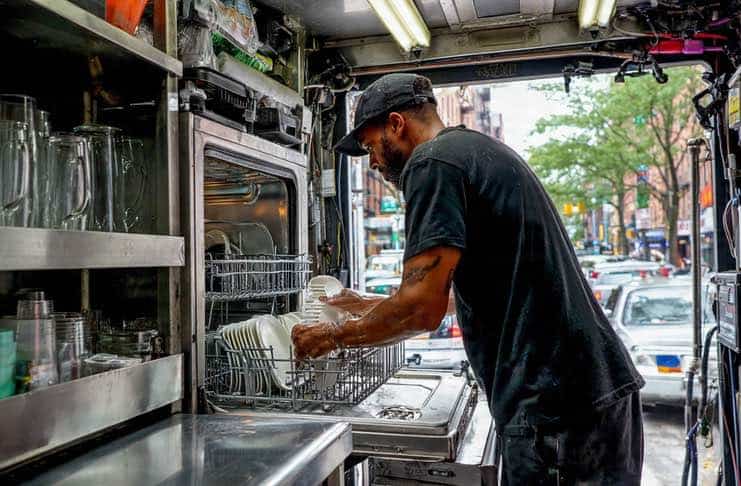
Close up a truck at noon in July and come back four hours later. The air inside that box has been sitting at temperatures a home pantry never reaches.
Most of what gets written about food truck dry storage treats it as a square footage problem. Vertical shelving, stackable bins, hooks on every available wall. Genuinely useful, and also the easier half of the job.
The harder half is that a mobile kitchen is a difficult environment for dry ingredients, and most operators discover this the expensive way, when a sack of specialty flour turns during a lunch rush.
Temperature swings. Steam off the flat top. Vibration on the drive. Whatever came aboard with the last delivery. Here is how the operators who stop writing off product actually handle it.
What a Mobile Kitchen Does to Dry Ingredients
Four things degrade dry goods over time. Air, moisture, light, and pests. A compact truck makes every one of them worse.
Consider what the vehicle puts your ingredients through. It heats up through service and cools overnight, and each of those cycles moves a little moisture in and out of your flour. Fryers and steam tables push humid air into a space with almost no ventilation. Then you drive across town, and everything on the shelf spends forty minutes being shaken.
A pantry at home sits still at a steady temperature. Your truck does neither. Storage that works perfectly well in a house will fail in a truck, and it tends to fail quietly. Nobody notices until the batter tastes wrong.
1. Get Everything Out of Its Original Packaging
A paper flour sack was engineered for one journey, from the supplier to your truck. Past that point it stops helping you.
Paper breathes, which means humid air passes straight through it. It tears against a shelf edge during transit. And pantry moth larvae chew through paper and thin poly bags without much difficulty, which is why an infestation usually arrives inside a bag you just paid for rather than crawling in on its own.
Make it a standing rule. Nothing stays in the packaging it arrived in. Decant the day the delivery lands. It takes 10 minutes and prevents most downstream issues.
Watch this video for some more storage tips on a Food truck:
2. Handle Bulk Without Giving Up Shelf Space
The 25-pound sack of rice you work through over a month is a different problem from the flour bin under your counter. So is the specialty grain that arrives quarterly, and the reserve stock sitting at the commissary between runs.
For such jobs, food grade Mylar Bags suit a mobile kitchen better than anything rigid. The foil layer blocks light and moisture in a way clear plastic cannot approach, and a flat pouch tucks into gaps that would never accommodate a bucket.
In a four-foot kitchen, that second point carries nearly as much weight as the first. Seal them with a household iron or a hair straightener, label the outside, and stack them flat wherever you have room.
3. Know the Storage Rules Before an Inspector Does
Dry storage appears on the inspection checklist, and the common citations are all avoidable.
Product needs to sit off the floor. Six inches is the standard most jurisdictions use, though requirements vary, so confirm what your local health department expects.
Containers must be food-safe and in sound condition, meaning no cracked lids and nothing repurposed from a previous life that held something other than food. And every container needs a label showing contents and date.
That last requirement catches more operators than the other two combined. An unmarked bin of white powder is a citation whether it holds flour or salt. Masking tape and a marker resolve it permanently.
If you are still working through the operational side of a mobile build, this piece on investing in a custom food truck covers a good deal of what to settle before you are parked and serving.
Rotate Stock or Lose Money Slowly
First in, first out. Every commercial kitchen operates on it, and small trucks skip it with remarkable consistency.
New stock goes behind existing stock, without exception. You draw from the front, and the date on the label tells you which is which.
Neglect this and you will eventually find a sealed bag from two seasons ago wedged behind the fresh inventory. That is capital you already committed, sitting there turning into waste.
Run a brief inventory weekly. Not a full count, just eyes on the shelf. What is running low, what is aging, what has not moved in a month.
Ten minutes on a slow afternoon is considerably cheaper than discovering the problem mid-service on a Friday.
Heat and Humidity Do the Quiet Damage
You can execute everything else correctly and still lose product to a badly chosen shelf.
According to USDA food safety guidelines, dry goods store best in cool, dry conditions away from heat sources. A working truck fights you on that throughout the day, so placement has to be deliberate.
The cabinet nearest the fryer or the flat top is the worst position in the kitchen, and it is almost always where the flour ends up because it sits conveniently close to the prep station.
Move it. Give that space to packaging or utensils and put ingredients somewhere lower and better insulated.
Anything not required for the day’s service is better held at the commissary than riding around in a hot vehicle. Sealed, labeled, off the floor, in a room that maintains a steady temperature. Bring aboard what the shift needs and leave the rest behind.
What Does Not Belong in Long-Term Dry Storage
Two categories fail regardless of how carefully you seal them.
Anything with meaningful oil content
Nuts, seeds, whole wheat flour, cornmeal, brown rice. As the University of Minnesota Extension notes, exposure to heat and light causes fats and oils to go rancid, and no container stops that process once conditions are right.
Order these ingredients in smaller quantities and turn them over quickly rather than holding backstock.
Anything carrying moisture
Fresh produce, obviously, but also soft dried fruit and anything you dehydrated in house that is not completely dry.
The CDC warns that sealing moisture-containing food in a low-oxygen environment creates conditions where harmful bacteria can grow and produce toxins. Dry means dry, with no interpretation.
The same instinct that puts flour beside the fryer also tends to put the wrong items in the cooler, so this rundown on what foods should not be kept in the fridge is a useful cross-check.
The Short Version
Sound food truck dry storage rests on four habits rather than four purchases.
Decant everything the day it arrives. Match the container to consumption speed, with sealed pouches for backstock and gasket bins for daily items.
Label and rotate without exception. And site your ingredients in the coolest, driest corner of the truck rather than the most convenient one.
None of it represents a significant cost. All of it protects margin you are currently losing without noticing. In a kitchen where every inch is already spoken for, the operators who get this right are the ones not writing off product at the end of the month.
The same logic carries across the rest of a tight kitchen, whether that means working safely in a compact space or making the move from truck to storefront. Small footprint, tight systems, nothing wasted.