


Last Updated: August 2026
The dining room at a Midtown steakhouse fills up around 7:30, and the first thing that gives it away as a serious room isn’t the menu. It’s that every table sits dead level, every chair pulls in without catching a leg, and nothing wobbles when a server sets down a tray of martinis. We’ve sat across from enough general managers and owners over the years to know that none of that happens by accident, and almost none of it happens the way a restaurant supply showroom wants you to think it happens.
KEY TAKEAWAY: Restaurant tables are sold as one finished piece, but the base and the top are two purchases on two completely different timelines. Buying them as a set means replacing a base that still works every time the top gets scratched, stained, or simply looks tired. NYC owners who separate the decision get more flexibility, lower long-term costs, and a dining room they can refresh without a full furniture replacement.
Why Do NYC Restaurant Owners Keep Buying Tables the Wrong Way?
They keep buying tables the wrong way because the industry sells them that way. Walk into any restaurant supply showroom in the city and the tables are staged as finished units, a top bolted to a base, priced together, ready to roll onto the floor. That presentation costs an operator money twice.
The first hit comes at purchase, when a top that would have worked perfectly gets passed over because it happened to come attached to a base that didn’t fit the room’s footprint or its two-top-to-four-top ratio. The second hit lands three years later, when the surface is scratched and dull and the operator ends up pricing out an entire new table because the only thing that actually failed was the eight square feet of surface on top of it.
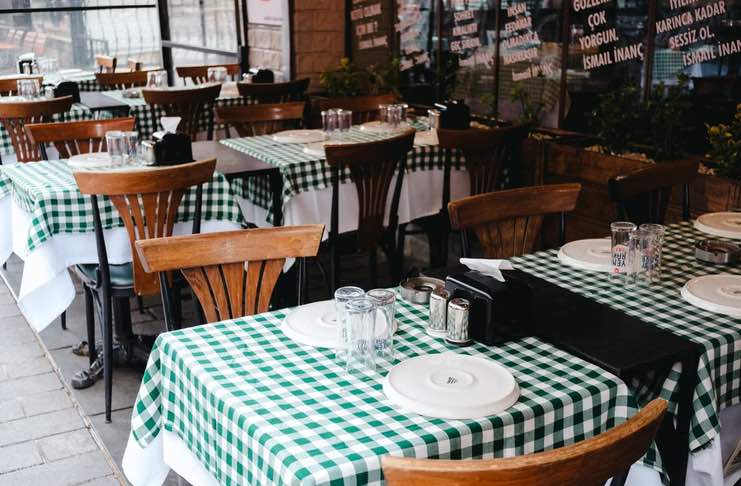
OUR EXPERIENCE: In conversations with dining room managers and owners across Manhattan and Brooklyn over the years, the same complaint comes up again and again: a perfectly functional table gets scrapped whole because nobody thought to ask whether the base and the top could be separated first. It’s a pattern we’ve heard from steakhouses to sidewalk cafes, not a one-off gripe.
We saw the flip side of that equation firsthand watching the team behind Club A Steakhouse on 58th Street hold onto a room that has outlasted plenty of its neighbors on that block. Longevity in this business is built out of details a guest never consciously registers, and the furniture underneath the tablecloth is one of them.
What Actually Wears Out First in a Dining Room?
The top wears out first, almost every time. A cast iron base has one job: hold weight and stay put. There’s no finish to scratch and nothing a guest touches directly, so barring a genuine impact, a decent base will outlast the chairs, the paint job, and often the lease itself.
The top absorbs everything else. Hot plates, spilled wine, sanitizer, silverware dragged across the surface, the corner of every tote bag set down mid-shift. It is the single hardest-working surface in the front of house, and in a room doing three seatings a night, it shows. That’s why owners sourcing a refresh are usually better off browsing restaurant table tops as their own category rather than waiting on a full table replacement. That mismatch, a fifteen-year component paired against a five-year component and sold as one purchase, is the whole argument for splitting the decision.
| Component | Typical Lifespan | What Actually Fails |
|---|---|---|
| Cast iron base | 10 to 15+ years | Rarely, outside of a direct impact or a warped column |
| Tabletop surface | 3 to 5 years in heavy service | Scratches, sanitizer staining, edge swelling, dull finish |
What Changes When You Buy the Base and the Top Separately?
Three things open up once an owner treats the base and the top as two decisions instead of one. First, a room can get refreshed without replacing the furniture. Swapping the tops while keeping the existing bases is one of the cheapest visual resets available, and it turns what would have been a full furniture replacement into an afternoon with a wrench. With the kind of margins independent operators are running right now, an industry the Restaurant Business industry outlook pegs at nearly $1.55 trillion in projected 2026 sales but still tight on a per-location basis, a cheap visual reset carries real weight.
Second, an owner can mix table sizes without mixing hardware. A New York dining room usually needs two-tops along the wall, four-tops in the center, and something larger by the window. Bought as complete units, that’s three separate products with three different bases and zero interchangeability. Bought separately, it can be one base model across the whole room with three top sizes on it, which means spare parts on hand, consistent seat height, and a coherent look from the host stand to the back wall.
Third, and this is the one operators feel fastest, when something breaks you replace only the part that broke. A chipped top is a top. A wobbling base is a base. Neither one is a whole table, and neither one should require a whole table’s budget to fix.
How Do You Match a Top to a Base Without Guessing?
You match them by working three measurements together instead of picking each piece on its own. This is where owners buying separately for the first time tend to trip, and it’s worth getting right before anything ships. To get some inspiration from top NYC restaurant owners, watch this video:
Base spread determines stability. The base needs to support the top from close enough to its edges that a guest leaning on one corner doesn’t tip it. The general working rule is that the base spread should cover roughly two-thirds of the top’s smallest dimension. Too small and the table rocks the moment someone drops a heavy bag on it. Too large and servers start catching chair legs on it.
Overhang determines comfort. The top should extend past the base far enough that a guest can sit without hitting metal with their knees, and far enough that chairs pull in properly. Five to six inches of overhang past the base edge on each side is a reasonable target for standard seating, and that number interacts directly with the spread rule above it.
Height is a category, not a single number. Three standard heights cover almost every NYC dining room: dining height around 30 inches, counter height at 34 to 36 inches, and bar height at 40 to 42 inches. The figure that actually matters is the finished height including the top’s thickness, which is easy to miscalculate when a thick butcher block top quietly adds an inch and a half nobody budgeted for. Check the seat height of the chairs already on the floor before ordering. Roughly 10 to 12 inches between seat and table surface reads as comfortable to most guests.
What Should You Actually Look for When Buying Each Piece?
The specs that matter are different for each component, which is another argument for buying them apart. For a base, weight is the spec. A base that’s heavy to carry is a base that won’t move when a guest bumps it, and cast iron beats hollow steel for the same footprint. Check whether the column is welded or bolted, and confirm the top plate is large enough to actually distribute load rather than concentrating it on four small screws.
For the top, surface and edge treatment are the specs. Ask what happens to a given surface under repeated sanitizer contact, since front-of-house cleaning chemicals are harsher now than they were a decade ago and some finishes cloud or soften over time. Then look hard at the edge, because that’s where damage starts first. A sealed or banded edge holds up; an exposed one takes on moisture and swells. Owners doing this sourcing for the first time are usually better off browsing tabletop surfaces separately from the base selection, specifically so surface and edge construction get the attention they need instead of getting bundled into a single quick decision.
Does a Sidewalk Cafe Change the Math?
Yes, and New York’s outdoor dining rules make it change fast. Wind is the obvious complication. A base that’s perfectly stable indoors becomes a liability on an exposed sidewalk, and the fix is weight, not clever engineering. Plenty of operators we’ve talked to run a heavier base outside than they’d ever need inside, on the exact same top sizes they use in the main room.
The less obvious complication is storage. Under the city’s permanent Dining Out NYC program, sidewalk furniture typically needs to come in for the winter months, and stacking is what makes that survivable, particularly for a restaurant with no basement, which describes most of them. As Crain’s New York Business reported when the permanent rules replaced the pandemic-era Open Restaurants program, more than 13,000 restaurants have participated in some version of outdoor dining citywide, and every one of them eventually has to solve the same November problem: where does the furniture actually go. Tops that lift off and stack flat solve that. Fixed tables don’t.
WHAT MOST FURNITURE GUIDES GET WRONG: They talk about tables like a design decision. Operators we’ve spoken with treat them like an equipment decision, closer to a walk-in compressor than a chair. Nobody replaces a whole walk-in because the gasket wore out, and nobody should replace a whole table because the top did.
Is This Worth It for a Smaller, Independent Room?
For most owners, yes, and the smaller the operation, the more the savings matter. A first-time owner watching every line item benefits the most from being able to buy a modest run of bases now and add or swap tops later without touching the base budget again. The margin math is unforgiving enough as it is for independents right now, and a five-year furniture cycle instead of a whole-table replacement cycle is real money kept out of a capital expense line.
| Owner Type | Worth Buying Separately? | Why |
|---|---|---|
| First-time independent owner | Yes | Lower upfront risk, easier to phase the buildout |
| Multi-location group | Yes | One base standard across locations, tops vary by concept |
| Sidewalk cafe operator | Depends | Worth it if storage and stacking are planned in from day one |
| Established fine dining room | Yes | Refresh the room without a full renovation shutdown |
That last point matters more in New York than almost anywhere else. Every extra week a dining room stays closed for a renovation is a week of rent and payroll with no revenue against it, and operators here don’t get that week back. It’s the same reason so many rooms that eventually close point to the lease and the numbers rather than the food, a pattern Eater NY has tracked across its closing roundups for years. A furniture refresh that doesn’t require shutting the doors is one less variable working against the room.
It’s also why the sourcing guides operators actually read, like Nation’s Restaurant News’ advice on profitable remodels, keep landing on the same point: do the refresh while the room is doing well, not after it’s already struggling. A top-only swap makes that timing possible in a way a full table replacement never does.
The rooms that hold up over years in this city, the kind we’ve profiled in pieces like our look at NYC’s top clean-eating restaurants, tend to share this same unglamorous discipline underneath the parts guests actually notice. Nobody dines out talking about the base plate under their table. They just don’t remember the meal where the table wobbled.
“After years of walking dining rooms across every borough, the ones that age well almost always turn out to be the ones where the owner treated the table like equipment, not decor. The rooms that age badly are the ones where the whole table got picked off a showroom floor in a single afternoon.”
FAQ
Do bases and tops from different manufacturers actually fit together?
Most commercial bases use a standard top plate pattern, so a top from one supplier will generally bolt to a base from another as long as the plate size and screw pattern line up. Confirm the plate dimensions before ordering either piece.
How often should a busy NYC restaurant expect to replace tabletops?
In heavy service, most operators are looking at a three to five year window before a surface needs replacing, sooner for softer wood finishes and later for sealed laminate or solid surface tops.
Is it cheaper to buy a matched set or buy separately?
A matched set is often marginally cheaper at the moment of purchase. Buying separately tends to win over a five to ten year horizon because only the worn component gets replaced instead of the whole table.
Want to read more relevant articles? Check out our post on how digital menus are getting more and more popular among US restaurants.