

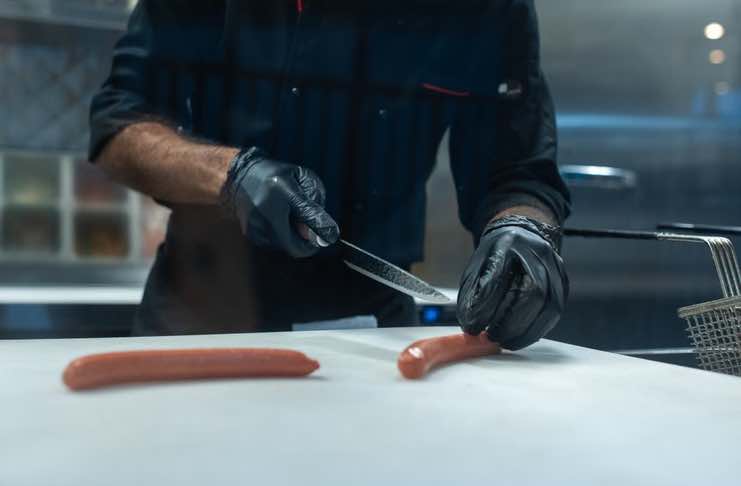
In a food truck, the kitchen is barely wider than an arm span. You dice onions inches from a hot griddle, pass platters over a sink, and dodge a coworker every time you turn around.
With that much movement in such a small space, a knife can go from helpful tool to serious hazard in a split second.
That is why knife safety tips are not just good advice for food truck operators — they are part of keeping your shift running smoothly.
In this guide, you will learn five practical habits that fit a four-foot kitchen, plus a checklist you can use at opening, during service, and at closing.
Why a Food Truck Kitchen Is a High-Risk Space for Cuts
A typical food truck gives you only a few feet of counter space, one or two burners, and a constant flow of bodies.
When the lunch rush hits, you are balancing speed, heat, and tight quarters all at once. In that environment, a knife left in the wrong spot or a board that shifts half an inch can lead to a serious cut.
Cuts also cost more than a bandage. A trip to urgent care, a missed shift, and a health inspector’s question about bloodborne food contamination can all stem from one mistake.
The good news is that most kitchen cuts are preventable with a few simple habits.
Our Experience
In conversations with truck operators across Red Hook and Jackson Heights over the years, the same story comes up again and again: the worst cuts happen not during slow prep but in the first ten minutes of a lunch rush, when the counter is suddenly crowded with tickets and bodies. Vendors who’ve been on the job the longest tell us they treat that first rush surge as the moment to slow down, not speed up.
5 Knife Safety Tips for Tight Mobile Kitchens
1. Store Knives Vertically, Not in Drawers
In a four-foot kitchen, every inch counts. Knives should have a designated home that keeps the edge protected and the handle easy to grab. A magnetic strip mounted on the wall saves drawer space and keeps blades visible.
If you prefer a block, choose one that fits your counter without blocking the workflow.
Never toss a knife into a drawer with other tools, clean or dirty. Never leave one submerged in a sink full of soapy water where the next person cannot see it. For knives that travel between the truck and a commissary, use blade guards or a roll bag.
And when you move through the kitchen with a blade, carry it with the tip down and the sharp edge angled away from your body. Call out “sharp behind you” so your crew knows to give you space.
2. Use Non-Slip Handles Designed for Wet Hands
Food truck kitchens are wet places. Condensation drips from cold storage, hands go from washing to chopping in seconds, and oily sauces find their way onto every surface.
A handle that feels fine in a dry test kitchen can become slippery and dangerous after an hour on the truck.
Look for handles with texture or a slight contour. Wood, rubberized composites, and textured plastics usually grip better than smooth metal or polished plastic when wet.
Make sure the handle is securely attached to the blade; a loose handle is a sign the knife needs repair or replacement. If a handle ever feels slick during service, stop and dry it before you continue cutting.

3. The “One Knife, One Job” Rule in Small Spaces
Using the wrong blade is one of the fastest ways to lose control. A chef’s knife can handle most bulk prep, but it is not the right tool for peeling garnishes, slicing bread, or breaking down fish.
When you force a knife to do a job it was not designed for, you press harder, cut at awkward angles, and increase the chance of slipping.
Your menu probably changes by the day, and the wrong blade can slow you down or force awkward cuts in a cramped space. That is why many operators look into custom kitchen knives for food trucks — blades designed around the ingredients and prep style they actually use.
Whether you need a shorter chef’s knife for a narrow counter or a specialized fillet blade for seafood, having the right profile for each job helps your crew work faster and safer.
A good starting kit usually includes a chef’s knife, a paring knife, and a serrated bread knife. Add a boning or fillet knife only if your regular menu calls for it.
Our Experience
We’ve heard the same complaint from operators who cook out of retrofitted trucks with counters barely two feet deep: a knife that felt fine at the commissary becomes unwieldy the second you’re bracing against a moving vehicle or squeezed between a flattop and a wall. The vendors who’ve stuck with the same knife setup for years tend to be the ones who bought blades sized to their actual truck, not their prep table at home.
4. Cut Away from the Body — Literally
Speed is important during service, but control comes first. Start every cutting task with a stable board.
If the board slides on the stainless counter, place a damp towel or a non-slip mat underneath. A board that shifts mid-cut is one of the most common causes of hand injuries.
Use the claw grip with your non-knife hand. Tuck your fingertips under and let your knuckles guide the blade.
Always cut away from your body, and keep your eyes on the food, not on the ticket printer or the window. If someone interrupts you, stop cutting, place the knife flat on the board, and then answer.
Watch this video for some more useful tips:
If a knife slips or falls, step back and let it drop. Never try to catch it. A knife on the floor can be cleaned and sharpened; a hand injury can end a shift or worse.
For high-volume prep or tasks like oyster shucking, consider cut-resistant gloves as backup protection. They do not replace proper claw-grip technique, but they add a safety net when hands are wet or fatigue sets in.
5. Clean Blades Immediately, Not at Closing
Food safety and knife safety overlap at the sink. Wash knives immediately after use instead of letting them soak. Soaking hides the blade and can lead to accidental cuts.
Wash the handle and the spine as carefully as the edge, then dry the knife completely before storing it.
Use separate cutting boards for raw proteins and ready-to-eat foods. Color-coded boards make the rule easy to remember. The FDA Food Code sets the baseline for safe food-contact equipment, including knives and cutting boards.
If a knife touches the floor, a contaminated surface, or blood, take it out of service until it has been washed and sanitized. A quick rinse is not enough when food safety is on the line.
Building a Knife Safety Checklist for Your Shift
A checklist turns good advice into a daily habit. Print it, laminate it, and keep it where the prep happens. Here is a simple version you can use before, during, and after service.
Pre-Service (Opening)
- Check every blade for nicks, rust, or loose handles
- Confirm the magnetic strip is secure and tug-test it
- Match color-coded knives to their assigned boards
- Set out blade guards for paring and boning knives
During Service
- Wipe hands dry before grabbing any handle
- Return knives to the strip immediately after use
- Do not hand blades blade-first across the line
- If a knife drops, step back and do not catch it
Post-Service (Closing)
- Clean and dry every blade before storage
- Inspect blade guards for cracks or wear
- Lock the storage area or secure the strip for transit
- Note any knife that needs replacement
Train Your Team and Build a Safety Culture
Every new hire should learn your knife rules before they touch a blade. Do not assume experience equals safe habits.
Demonstrate the claw grip, show how to carry a knife through the truck, and explain where each blade is stored. Post a short checklist near the prep station so the rules stay visible during busy shifts.
OSHA’s Young Worker Safety in Restaurants eTool includes clear knife-handling rules that work for any age group.
It covers everything from safe carrying to proper storage, and it is a good reference for your training binder. You can find it on the OSHA food preparation safety page.
Refresh the training every few months. Habits slip when crews get comfortable, and a five-minute safety reminder before a festival or busy Friday can prevent a costly accident.
Our Experience
Talking to owner-operators who’ve run trucks through multiple festival seasons, a pattern shows up consistently: the crews with the fewest injuries aren’t the ones with the fanciest knives; they’re the ones who run a five-minute refresher before big events. Operators describe this less as formal training and more as “just walking the line before doors open,” but the effect on cuts and near-misses is the same one they keep coming back to.
What to Do If Someone Gets Cut
Even with the best habits, accidents can happen. Keep a stocked first aid kit within easy reach of the prep area, and make sure everyone knows where it is.
For a minor cut, rinse the wound under clean running water, apply direct pressure with a clean towel, and cover it with a bandage.
If blood touches food, utensils, or surfaces, stop service in that area until everything has been cleaned and sanitized. Replace any gloves or bandages before returning to prep.
Seek medical care if the bleeding does not stop, the cut is deep, or the wound is on the hand or wrist where tendons may be involved.
Frequently Asked Questions
What are the three knives every food truck cook should have?
A chef’s knife, a paring knife, and a serrated bread knife cover most tasks. Add a boning or fillet knife only if your menu calls for it.
What are the most common knife skill mistakes?
Reaching for a falling knife, using a dull blade, cutting on an unstable board, holding food with flat fingers, and trying to talk while chopping are the most common mistakes.
What is a level 3 safety knife?
Level 3 usually refers to a cut-resistant rating or a safety knife designed for workplace protection, not a culinary category. It means the tool or PPE meets a higher cut-resistance standard.
What is the first rule for improving your knife skills?
Start with a sharp, appropriate knife and practice the claw grip on a stable board. Good technique beats speed every time.
Do I need special knives for a food truck?
You need commercial-grade knives with non-slip handles, easy-clean steel, and compact storage options. The truck itself does not change the blade. The environment changes how you store and handle it.
Can I use the same knife for raw chicken and vegetables if I wash it?
Technically yes. Practically, inspectors and common sense say no. In a rush, you will not wash thoroughly enough, so use color-coded blades or assign one knife per food type.
How often should I replace food truck knives?
With daily high-volume use, inspect monthly. Replace when you notice chips, loose handles, or when honing no longer restores the edge. Well-maintained commercial knives often last several years.
Are magnetic strips safe in a moving vehicle?
Magnetic strips are convenient for stationary prep, but for transit, use a locked drawer or a padded knife roll. Vibration and bumps can weaken magnetic hold over time. Test the mount weekly.
Conclusion
Knife safety in a food truck is not about buying the most expensive blades or running long training meetings. It is about five simple rules — store vertically, grip securely, match the knife to the job, cut away from your body, and clean blades right away — backed by a checklist your crew can follow every shift.
When your kitchen is only four feet wide, every safe choice matters. Make the checklist part of your opening and closing routine, and you will protect your crew, your customers, and your business all at once.
- About the Author
- Latest Posts

Anthony McGovern is an NYC-based food writer and culinary explorer dedicated to mapping the city’s rich, diverse street food landscape. From tracing the deep immigration histories behind Chinatown’s dumpling shops to hunting down the best late-night taco trucks on Roosevelt Avenue, Anthony focuses on the stories, people, and generations-old traditions that define New York’s food scene