
Last Updated: June 2026
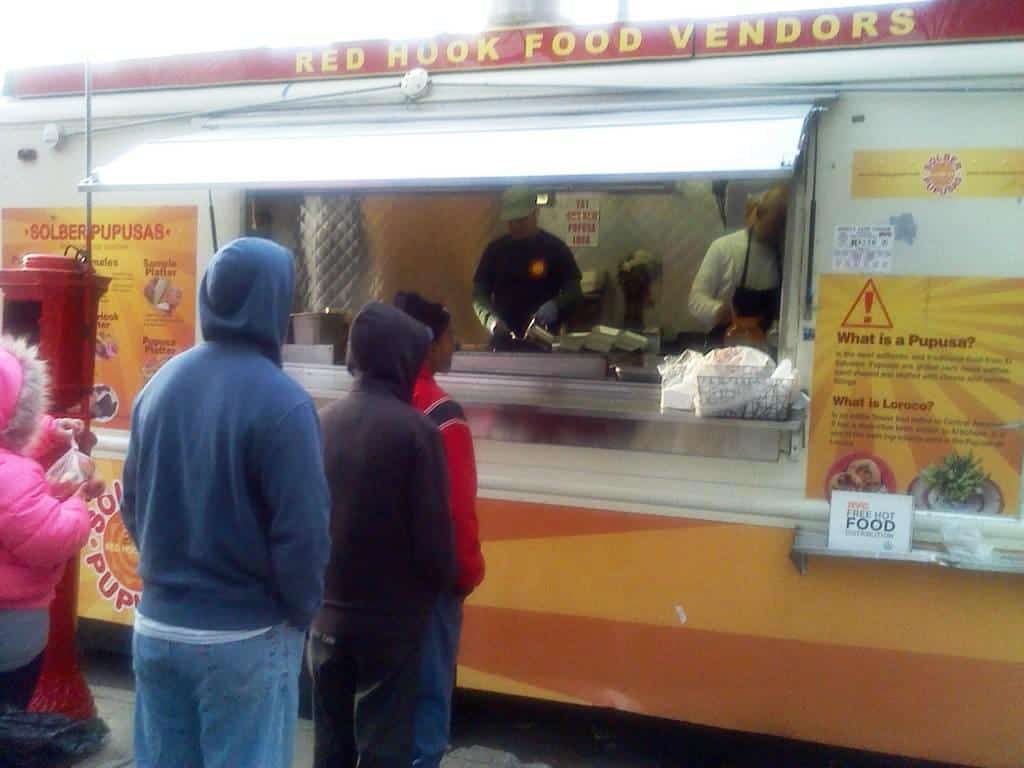
Stand at the corner of Bay Street and Clinton in Red Hook on a Saturday afternoon and the air tells you everything before a single bite. Charred masa smoke from a comal that’s been running since 10am. Loroco blossoms wilting into a curtido bowl somewhere near the Solber Pupusas station. The low percussion of a tortilla press at Huarache King’s setup, six feet to the left. This is not a food market that happened to New York. This is one that New York spent thirty years trying to shut down — and failed.
Key Takeaway
The Red Hook Ball Fields vendors are the longest-running immigrant street food market in New York City — surviving permit wars, a mayoral crackdown, and a direct hit from Hurricane Sandy. What started with a handful of Central American families feeding soccer players in 1974 has become a nationally recognized cultural institution and the undisputed capital of authentic Latin American street food in the five boroughs. Nothing about its survival was guaranteed.
In our years covering NYC street food, we’ve eaten in practically every immigrant food corridor this city has — the Himalayan stalls of Jackson Heights, the halal carts on 53rd and 6th, the taco trucks parked under the BQE in Sunset Park. But Red Hook is different. Red Hook has a story that goes deeper than the menu. It’s a story about who gets to cook in public in this city and who has to fight for that right every single season. Watch this video to get a glimpse:
This is that story — from 1974 to right now.
How Did a Soccer Field in Brooklyn Become NYC’s Most Important Street Food Market?
The answer is 1974, a wave of Salvadoran and Mexican immigration to Brooklyn, and the specific hunger of men who spent their weekends playing fútbol at the Red Hook Recreation Area fields near Bay Street. The concession stand was either closed, inadequate, or both. So a few families started bringing food from home — portable setups, home cooked dishes, the kind of Central American comfort food that didn’t exist anywhere nearby in a neighborhood that was still largely industrial and isolated from the rest of the borough.
Word spread the way it always does in immigrant communities — not through Yelp or Instagram, but through family networks, soccer team rosters, and the specific grapevine of people who know where to find food from home. By the early 1980s, a loose cluster of vendors had established themselves as a fixture of Red Hook weekend life. Pupusas from El Salvador. Huaraches from Oaxaca and Puebla. Tamales wrapped in corn husks. Aguas frescas poured cold into plastic cups.
“The ball fields vendors didn’t set out to build a food market. They set out to feed their community — and that is precisely what makes the market irreplaceable fifty years later.”
Red Hook itself was the perfect incubator for this. The neighborhood sits at the far western edge of Brooklyn, physically cut off from the rest of the borough by the BQE overpass and the Columbia Street waterfront. In the 1970s and 80s, it was a neighborhood that the city had largely turned its back on — declining industrial use, high unemployment, an underinvested housing project population. It was, in short, a place where unofficial economies could grow without much interference. For a while.
What Were the Permit Wars — and How Close Did the Market Come to Disappearing?
Very close. The 1990s were the most dangerous decade in the market’s history, and the threat didn’t come from crime or economics — it came from City Hall. The Giuliani administration’s aggressive crackdown on street vending citywide, combined with the NYC Parks Department’s escalating permit requirements for any commercial activity on park land, put the ball fields vendors in direct conflict with the regulatory apparatus of the largest city in the country.
The vendors didn’t have permits. They didn’t have the money to obtain them, the legal infrastructure to navigate the system, or — in many cases — the English fluency to advocate for themselves in hearings. What they had was a twenty-year track record of feeding their community without incident, a loyal customer base that extended far beyond the soccer fields by then, and the growing attention of food journalists and cultural preservationists who recognized what was at stake.
The organizing effort that saved the market is worth documenting precisely because it’s so rarely covered. A coalition of vendors, community advocates, and food-world allies pushed back — not just against the permits, but against the underlying premise that this market was a problem to be solved rather than a resource to be protected. They argued, correctly, that the ball fields vendors represented a form of cultural and culinary heritage that the city had an obligation to support, not suppress.
Our Experience
We visited the Red Hook Ball Fields in May 2025 on a Saturday around noon — peak hours, full capacity. The wait at El Olomega, the 2013 Vendy Champion, was about 20 minutes for a full pupusa order with curtido and salsa roja. Solber Pupusas, the 2011 Vendy Cup winner, had a slightly shorter line and was running a loroco and cheese combination that stopped us mid-bite. The market runs from roughly 11am to dusk, weather permitting. Arrive before 1pm if you want to beat the crowd at the anchor stations.
By the early 2000s, the vendors had successfully negotiated a formal licensing arrangement with the NYC Parks Department. It wasn’t perfect — the permitting fees were significant for small family operations, and the process required ongoing renewal with no permanent security — but it was legal recognition. The market could exist openly. It could grow.
And it did. By the mid-2000s, the Red Hook Ball Fields had attracted the attention of Eater NY and the broader food media establishment, which recognized something that Red Hook regulars had known for thirty years: this was some of the best Latin American street food in the United States, full stop.
What Did the Vendy Awards Mean for These Vendors — and Why Does It Matter?
The Vendy Awards, created by the Street Vendor Project in 2005, are the closest thing NYC street food has to the James Beard Awards — a nationally recognized peer-judged competition that has become the authoritative signal of excellence in the cart-and-truck world. And the Red Hook vendors didn’t just compete. They dominated.
Solber Pupusas — the operation run by Mariela Solano, whose family has been at the ball fields for decades — won the Vendy Cup in 2011. El Olomega took the Vendy Champion title in 2013. These weren’t participation trophies. These were full-bracket competition wins against the best street food operations in the five boroughs. As of 2025, the Street Vendor Project’s Vendy Awards remain the most credible independent validation of street food quality in New York — and the Red Hook market has two of them.
“Two Vendy wins from a single market that almost didn’t survive the 1990s is not a coincidence. It is the direct result of multigenerational technique, uncompromised ingredients, and the specific stubbornness of people who cooked because they had no other option.”
Red Hook Ball Fields: Anchor Vendors at a Glance
| Vendor | Origin | Signature | Notable |
|---|---|---|---|
| El Olomega | El Salvador | Pupusas, baleadas | 2013 Vendy Champion |
| Solber Pupusas | El Salvador | Loroco & cheese pupusas | 2011 Vendy Cup Winner |
| Huarache King | Mexico (Oaxacan/Pueblan) | Huaraches, sopes | Best masa-to-topping ratio on site |
| Guatemalan vendors | Guatemala | Tamales, chuchitos | Most underordered item on site |
The Vendy recognition also did something that three decades of operation alone couldn’t fully accomplish: it gave the market institutional legitimacy in the eyes of the city and the food press simultaneously. If you’re wondering why the Red Hook market survived regulatory pressure that has killed dozens of other informal food economies in the city, part of the answer is the Vendy Awards — and the food media attention that came with them.
How Did Hurricane Sandy Almost End Everything — and What Did the Rebuild Look Like?
October 29, 2012. Sandy made landfall and Red Hook, sitting directly on the waterfront at sea level, took one of the worst hits of any neighborhood in the five boroughs. Floodwaters reached six feet in some areas. The ball fields were submerged. The equipment — comals, propane tanks, prep stations — was damaged or destroyed. Vendor vehicles were flooded. For families who had been operating on thin margins for decades, this was potentially the end.
The 2012 season never reopened. Vendors who had been operating every weekend from spring through fall suddenly had no income during what should have been their final weeks of operation for the year. The physical infrastructure of the park took months to become usable. And the uncertainty about what the 2013 season would look like — whether permits would be renewed, whether the parks department would prioritize the restoration, whether any of the vendor families could afford to replace their equipment — was real and documented.
“Sandy didn’t just flood a park. It flooded the livelihoods of families who had spent thirty years building something the city had tried to shut down — and who had every reason to wonder whether the city would show up for them now.”
What followed was a genuine community mobilization. The Street Vendor Project, the same organization behind the Vendy Awards, coordinated relief efforts. Timeout New York ran coverage that amplified the need. Food media readers who had never set foot in Red Hook donated to the rebuild. The 2013 season opened — later than usual, with some vendors still replacing equipment — but it opened.
That recovery matters not just as feel-good narrative but as operational fact. A market that can lose an entire season to a climate event and come back the following year — in a city where restaurants with multi-million dollar buildouts fail every week — has a foundation that most food businesses will never have. It has community. It has loyalty. It has the specific durability of something people fight to keep.
Free Download
Planning to eat your way across multiple NYC street food corridors? The Red Hook Ball Fields are just one node in a five-borough food network. Download the NYSF All-Borough Street Food Registry Checklist to track vendors, markets, and corridors across every neighborhood we cover.
Where Does the Red Hook Ball Fields Market Stand Today — and Why Is Its Longevity Anomalous?
As of 2026, the Red Hook Ball Fields market operates on weekends and select holidays from late spring through early fall. The core anchor vendors — El Olomega, Solber Pupusas, Huarache King — remain. New vendors have rotated in over the years. Prices have shifted: as of 2025, a full pupusa order with curtido and salsa roja runs $5-8 depending on filling, which remains genuinely remarkable value by any New York standard. Huaraches clock in at $9-12. Aguas frescas are $3-4.
Watch this video to get a glimpse:
Why is its longevity anomalous? Because nothing about the conditions that produced this market — informal immigrant food economy operating on park land without formal permits for decades — should have survived the forces arrayed against it. The regulatory environment in New York City for street vendors has never been friendly. As Grub Street has documented extensively, NYC’s street vending permit system has a cap on mobile food vendor licenses that hasn’t expanded meaningfully since 1983, creating an artificial scarcity that leaves thousands of vendors operating in legal gray zones.
Worth the Trip to Red Hook?
| Reader Type | Verdict | Why |
|---|---|---|
| Serious foodie | YES | Two Vendy winners operating side by side. No question. |
| NYC tourist | YES | Most authentic Latin American market in the five boroughs. Plan 90 minutes round trip from Midtown. |
| Budget eater | YES | Full meal under $15 in 2026. Near impossible anywhere else in this city at this quality. |
| Group of 4+ | YES | Multiple vendor variety means everyone finds something. Bring cash — most stalls are cash only. |
| Weekday visitor | NO | Weekend and holiday operation only. No exceptions. |
The Red Hook market has survived because of community — but it has thrived because of food. The pupusas, the huaraches, the tamales being made here are not approximations or tourist-facing versions of the dishes. They are the real thing, made by the same families that have been making them for fifty years, in some cases with recipes passed down from parents who cooked in El Salvador or Puebla before the migration. That level of continuity does not exist in the formal restaurant world. It barely exists anywhere.
The full breakdown of what to order and how each dish is made — from the nixtamalized masa that gives the huarache its structural density to the curtido fermentation that makes Solber’s pupusa plate sing — lives in our deep-dive on the masa continuum that defines the ball fields menu. The broader picture of where Red Hook fits in the NYC street food ecosystem is in our Red Hook Food Vendors Guide. And for the full picture of how these Latin American food traditions sit inside the NYC street taco scene, that thread runs deeper than this neighborhood alone.
Our Verdict
The Red Hook Ball Fields market is not a hidden gem. It’s not a well-kept secret. At this point, after two Vendy wins and fifteen years of serious food media coverage, it’s one of the most written-about street food markets in the United States. And it still somehow operates with the intimacy and intention of a family operation, because it is one — many of them, stacked side by side on a Brooklyn soccer field. The longevity is the story. Show up on a Saturday and you’ll understand why it’s still here.
Pinterest Graphics
- Graphic 1: Close-up of a loroco and cheese pupusa being pressed on a cast iron comal, wisps of steam rising. Text overlay: “The Brooklyn Street Food Market That’s Been Fighting to Exist Since 1974”
- Graphic 2: Wide shot of the Red Hook Ball Fields with vendor canopies lined up, soccer field visible in background. Text overlay: “Two Vendy Awards. One Soccer Field. NYC’s Most Important Street Food Story.”
- Graphic 3: Aerial-style flat lay of huarache, pupusa with curtido, and agua fresca on a checkered cloth. Text overlay: “$12 Can Still Buy You the Best Meal in New York — If You Know Where to Go”
Expert Perspective
“The Red Hook Ball Fields represent a specific kind of American food story that almost never makes it to the history books: the immigrant vendor who built an institution not by scaling up or seeking investors, but by showing up at the same corner every weekend for fifty years. That consistency, combined with uncompromising product quality, is the only thing that explains why this market is still operating when dozens of more formally structured food businesses in the same borough have closed.” — NewYorkStreetFood.com editorial team
“In a city where gentrification has displaced or commodified virtually every informal food economy, the Red Hook market’s survival is either a miracle or a case study in community organizing — probably both. The fact that it produces food this good is almost beside the point. Almost.”
Frequently Asked Questions
When do the Red Hook Ball Fields food vendors operate?
The market runs on weekends and select holidays from late spring (typically late April or early May) through early fall (usually October, weather permitting). Hours are roughly 11am to dusk. Arrive before 1pm on Saturdays to avoid peak wait times at the anchor vendors.
Do the Red Hook vendors accept credit cards?
Most stalls are cash only. There is an ATM in the area but supply it variable. Bring $30-40 in cash per person to ensure you can order freely across multiple vendors without interruption.
What happened to the Red Hook vendors after Hurricane Sandy?
Hurricane Sandy in October 2012 flooded the ball fields and forced the closure of the 2012 season’s remaining weeks. The 2013 season reopened after community fundraising, Street Vendor Project support, and equipment replacement assistance allowed vendors to rebuild. The market has operated every season since.
Who won the Vendy Awards from Red Hook?
Solber Pupusas won the Vendy Cup in 2011 and El Olomega won the Vendy Champion title in 2013. Both continue to operate at the Red Hook Ball Fields as of 2026.
How do I get to Red Hook Ball Fields by public transit?
Red Hook has no direct subway access. The fastest transit routes involve the B61 bus from Smith-9th Street (F/G train) or the B57 from Atlantic Terminal (multiple lines). Budget 20-30 minutes from downtown Brooklyn. The NYC Ferry Red Hook stop (South Brooklyn route) is a scenic alternative from lower Manhattan — roughly 30-35 minutes from Pier 11 at Wall Street.
- About the Author
- Latest Posts
Mehru Sheikh is a Dallas-born, Brooklyn-based writer, traveler, and product manager who believes good food is the world’s most universal language. After moving to New York City in 2020, she channeled her passion for exploration into @sheikhshack_ — a lifestyle platform covering food, fashion, and travel that grew from a personal travel diary into a community of nearly 7,000 followers. Known for her fast-travel approach — squeezing as much as possible into short trips — Mehru has become a go-to voice for practical, culturally immersive travel, particularly within the South Asian community. She has ghost-written for travel blogs, previously ran her own food page, and co-founded Table for Four, an events company connecting New Yorkers to new experiences and each other. At New York Street Food, she brings that same curiosity and appetite to uncovering Brooklyn and NYC’s most exciting, flavor-forward dining destinations.