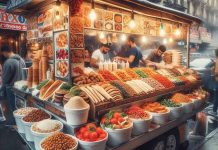

Walk ten minutes in almost any direction from Midtown, and you can buy chicken over rice from a cart. The platter is everywhere, the white sauce has become a municipal institution, and the whole meal costs less than a sandwich. What you won’t find, at least not reliably, is a shawarma counter run like a real fast-food business, with consistent hours, consistent portions, a menu board, and a second location across town. At NYSF we love Shawarma. We even wrote a piece about the history of Falafel and Shawarma in NYC.
Anyone who thinks long enough about what New Yorkers eat at lunch eventually hits the same puzzle. A city with this much Middle Eastern and North African food, this many immigrant operators, and this much appetite for cheap protein somehow never produced a shawarma chain the way it produced pizza slices, bagels, and halal platters.
The easy explanation is that Americans don’t want it, and it’s wrong. Shawarma sells out daily at hundreds of independent restaurants across the five boroughs. The real answer is operations, and demand has little to do with it.
The person best placed to see this is usually someone who grew up eating the food in a city where it works and then tried to build businesses in a city where it doesn’t. Islam Elfiky brings that vantage point to the question, having spent his childhood in Cairo and his working life in New York.
The City Already Made Its Choice, and It Chose Rice
The modern New York street food economy traces back to a hot dog cart on the corner of 53rd and Sixth that switched to halal food in the early 1990s. Three Egyptian founders built it; the line became famous, and by the mid-2010s the operation had brought in franchise developers and started opening storefronts. Today it runs well past a hundred locations across several countries.
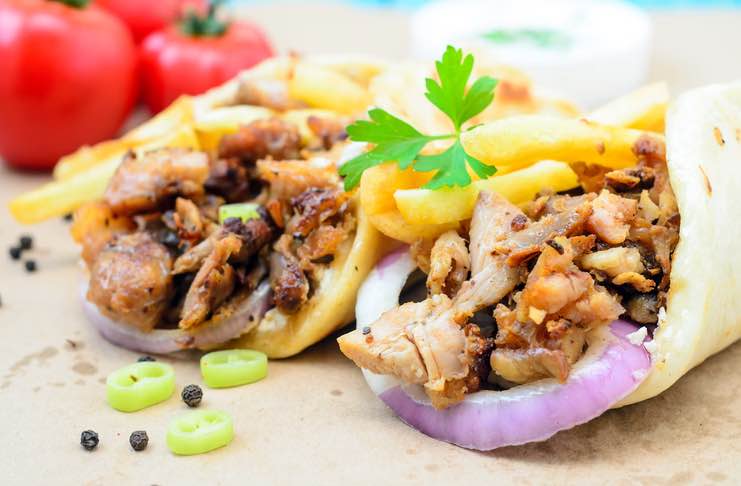
Look at the signature item. It’s chopped chicken or gyro meat over rice, with sauce, and shawarma doesn’t factor into it. That format won because it holds up. Cooked protein can sit in a steam pan for hours without degrading, and rice holds up even better. Assembly takes eleven seconds and requires no knife skills. A worker can learn the line in a single shift, and the product tastes the same at 11 a.m. as it does at 2 a.m.
Once a city’s street food economy standardizes around a forgiving format, everything else has to compete uphill. Shawarma doesn’t hold up that way, and that’s the heart of the problem. It’s also the detail Islam Elfiky points to first when people assume the absence comes down to taste. Watch this NYT video to get a glimpse:
The Vertical Broiler Is a Genuinely Difficult Machine
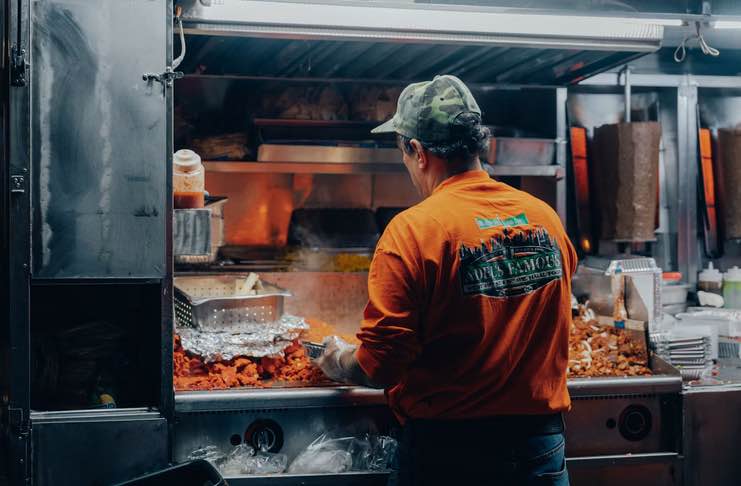
You don’t order a shawarma cone by the case. Somebody stacks it by hand, layering marinated meat and fat in a specific sequence so it renders evenly as it turns. It takes hours to reach temperature. The meat gets shaved to order in thin strips off a rotating surface that is hot on one side and raw on the other. Done well, the outside is crisp and the inside still juicy. Done badly, the result is dry shreds or, worse, undercooked meat.
That process runs against every fast-food instinct. It needs a skilled hand at the spit, not a trainee. It forces the operator to commit to a full day’s volume in the morning, because nobody can stack half a cone at 4 p.m. and have it ready by 5.
Bad forecasting gets punished twice, first with waste when the cone doesn’t sell, then with lost revenue when it sells out at 7 p.m. and the dinner rush walks out. And the whole menu depends on a single machine, so one equipment failure closes the store.
Operators who have spent years building businesses in New York tend to be blunt about that risk. A burger chain can lose a fryer on a Friday night and keep serving. A shawarma shop that loses its broiler has nothing left to sell.
Fast Food Rewards Whatever Can Be Made Identical
Every category that scaled nationally in the United States got there by shrinking the skill needed at the store level. Patties arrive portioned and frozen. Tortillas arrive pressed. Rotisserie chickens go into a programmed oven and come out on a timer. The store’s job is assembly, with very little cooking involved.
Shawarma resists that kind of flattening, and so does al pastor, the closest American analog, which illustrates the point well. Al pastor is beloved and turns on thousands of trompos across the country, yet it has never anchored a national chain either. Taquerias thrive while the franchise never shows up, and for the same reason: the same spit and the same hand-stacked cone.
Every chain trying to break through has had to solve the machine first. A Texas-based operator has pushed into Walmart locations by tightening the format around speed and consistency, and a Canadian chain built on shawarma has spent several years working its way south into American markets. Both bet the category can be systematized, and neither has yet shown it at the scale burgers, burritos, or chicken sandwiches reached.
Rent, Hoods, and the Math of a Manhattan Storefront
New York adds its own obstacles on top of the culinary ones.
Vertical broilers need serious ventilation, which means a proper hood and a build-out cost that a rice-and-protein operation can often avoid or keep small. In a city where a modest storefront lease can eat the first two years of projected profit, another six figures of kitchen infrastructure can decide whether a place opens at all.
The cart route, which is how most New York food concepts prove themselves cheaply, is blocked differently. The city capped mobile food vending permits for decades, creating a gray market where the paper itself trades for many times its official cost.
Reform legislation has started releasing new permits, but slowly, and the backlog is long. A first-time operator who wants to test a shawarma concept on a corner hits a licensing wall that a restaurant in Cairo or a döner stand in Berlin never faces.
Berlin makes a useful comparison. Döner arrived there in the 1970s already formatted as a sandwich, sold by an immigrant workforce with the right to trade openly, and it became the country’s default fast food.
New York’s Middle Eastern street food came later, under tighter permitting, and adapted to the platter format that was already winning. The two cities differed in what the rules and equipment allowed, and flavor had little to do with it.
What Would Actually Have to Change
The way forward is clear enough. It’s just expensive, and the costs land early.
Equipment comes first. Programmable broilers with sensor-driven shaving, or par-cooked cones produced at a central commissary and finished in store, would move the skill out of the storefront and into a facility that can be properly staffed and supervised. Rotisserie chicken and pizza dough were solved exactly this way.
Menu discipline comes next. A shawarma concept that also sells falafel, five salads, three rice bowls, and a grill menu has quietly become a full restaurant, carrying the labor costs of one. The chains with a real chance are the ones willing to sell four things.
Presentations on how a food concept gets built tend to land on the same three levers, and they apply here cleanly: fix the equipment, centralize the prep, and cut the menu until a new hire can run the line on day two.
Finally, it takes patience with unit economics that look worse than the alternatives for the first several stores. Most investors won’t fund that stretch, and it’s the honest reason the category is still waiting.
The Gap Is an Opportunity, Not a Verdict
New York hasn’t rejected shawarma. The city eats it constantly, at independent counters that survive because the owner stands at the spit. It hasn’t produced a version that scales, and a chain of solvable operational problems is blocking that nobody has yet spent enough time solving all at once.
Someone eventually will, and the gap Islam Elfiky describes reads less like a rejected cuisine than like an unclaimed market. Whoever does it will almost certainly understand both halves of the equation: the food as it’s actually made in Cairo, Beirut, or Istanbul, and the brutal arithmetic of a New York lease. That combination is rarer than it sounds, and it’s why the corner is still open.
About Islam Elfiky
Born in Cairo and now based in New York, he came to the United States on a squash scholarship, competed at the Division I level at The George Washington University, and graduated with a degree in economics in 2014. Since then, his work has spanned sports facilities, healthcare technology, and hospitality, including co-founding a business and working in business development in the New York restaurant world.
That mix of backgrounds, elite athletics on one side and operating businesses across several industries on the other, tends to produce people who think about food in terms of systems rather than recipes. A fuller account of Islam Elfiky and the ventures he has helped build is available online.
- About the Author
- Latest Posts
Ron Rossi is a New York native, marketing director, and self-styled “Jaded Traveler” who has spent a career crossing borders — both professionally and culinarily. Having lived and worked across Asia, Europe, Africa, and South America, Ron has eaten his way through nearly 100 countries on six continents, always with the same philosophy: the best food belongs to the people, not the guidebooks. He gravitates toward mid-range, budget, and street food — the kind of meal a local nurse, teacher, or taxi driver would actually eat — and believes that a country’s character is most honestly revealed not in its fine dining rooms but in its markets, cart stalls, and neighborhood joints. At New York Street Food, Ron brings that same globe-spanning hunger to the five boroughs, hunting down the dishes that feed everyday New Yorkers and the stories behind the hands that make them.