
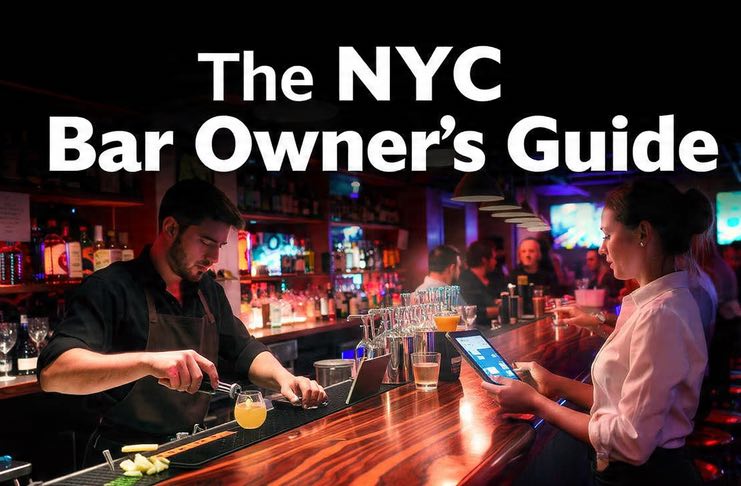
I was standing at the end of a zinc-topped bar in Alphabet City on a Wednesday night, watching the owner — let’s call him Marco — pour himself a rare glass of his own whiskey and stare at a spreadsheet on his laptop as it had personally offended him.
“We had our best month yet,” he told me, “and I still can’t figure out where the money went.”
That line has stuck with me. Because that’s the quiet crisis happening behind some of the coolest doors in New York City right now. The vibes are immaculate. The cocktails are incredible. The Spotify playlist is a chef’s kiss. And the owner is hemorrhaging margin on a Wednesday because nobody counted the bottles.
NYC bars are a world unto themselves — half art project, half brutal math problem.
Key Takeaway: As of 2026, the average NYC bar runs a net profit margin of 10–15% — before rent, before theft, before the bartender who over-pours for the regulars. The difference between a bar that thrives and one that closes in Year Two isn’t the cocktail program. It’s operational discipline applied with a light touch.
This guide is for the bar owner who has the vibe locked in and needs the margin to match. Let’s get into it.
Before we start, watch this video to get a glimpse of a day at a cocktail bar in Rockefeller Center:
What’s Actually Eating Your Margin? (And How Do You Know?)
The honest answer is: probably several things at once, and you won’t see them without the right data.
NYC bar margins sit between 38–56% on a single cocktail, but that same drink in a different operation can barely net a dollar after labor and overhead are factored in. Same recipe. Same price point. Wildly different outcomes. That gap is operational.
The three biggest silent killers in NYC bars right now are: over-pouring, scheduling inefficiency, and dead stock — bottles that sit on the back shelf like expensive furniture while your COGS quietly climbs.
According to Gitnux, inventory waste alone costs bars 2–5% of total revenue, and in a city where your rent might be $15K a month, that math gets painful fast.
Our Experience
We’ve spent a lot of time talking to bar owners across Brooklyn, the Lower East Side, and Midtown over the past year. The most common thing we hear? “I know something’s off, I just don’t have time to find it.” That’s not a management failure — that’s what happens when you’re running a 14-hour operation without integrated data tools.
Tip #1: Engineer Your Menu Like It’s a Financial Document
Does your menu make you money, or does it just look good?
Your menu is your most powerful pricing tool, and most bar owners treat it like a design project instead of a revenue strategy.
Menu engineering — the practice of categorizing drinks by profitability and popularity — is the same methodology used by the most profitable bar programs in the country. The framework splits items into four quadrants: Stars (high margin, high volume), Puzzles (high margin, low volume), Plow Horses (low margin, high volume), and Dogs (low margin, low volume).
Your job is to promote your Stars aggressively, engineer your Puzzles into the spotlight, and quietly retire your Dogs.
Liquor delivers gross margins of 75–80%, cocktails sit close behind at around 70%, while beer averages 60–70% — with kegs consistently outperforming bottles, according to Restaurant Times. If your featured cocktails are the ones with the most Instagram appeal but the worst pour cost, you’re essentially marketing your least profitable items. The most successful bar menus stay between 20–35 items — enough variety to satisfy, lean enough to execute cleanly and keep your ingredient COGS under control.
Practical steps for menu engineering your bar:
- Pull your POS sales data for the last 90 days
- Calculate pour cost for every item (ingredient cost ÷ selling price × 100)
- Map each item against volume — this is your profit/popularity matrix
- Redesign menu layout to spotlight Stars and Puzzles (top-right and center placement converts best)
- Build a quarterly pricing review into your calendar to adjust for COGS shifts
Our Experience
A bar owner we know in Williamsburg told us she re-engineered her cocktail menu after a slow January and pulled three low-margin “crowd pleasers” from the front page. Her average check size went up by $4 per person within six weeks — without raising a single price.
Tip #2: Integrate Your POS and Inventory Systems Before You Lose Another Dollar
Is your POS software for bars actually connected to your inventory — or are you still counting bottles by hand?
This is the single highest-ROI operational move a NYC bar owner can make right now, and it’s still wildly underused.
A modern, integrated POS and inventory system works like this: every drink that gets rung up automatically depletes your digital inventory. At any point, you can compare your theoretical inventory (what the system says you should have) against your actual inventory (what’s on the shelf). The gap between those two numbers is called your variance, and variance is where your money disappears.
POS systems that integrate with inventory management tools reduce theft-related losses by approximately 15% of revenue. In a bar doing $50K a month, that’s potentially $7,500 back in your pocket annually — just from tighter visibility.
For bar owners, the ability to connect a POS with a dedicated beverage inventory platform like means your bar manager can automate variance tracking without needing to be an accountant — turning everyday sales data into actionable steps to reduce shrinkage.
Old Way vs. New Way: POS + Inventory Integration
| Old Way | Integrated System | |
| Inventory counting | Manual, weekly spreadsheet | Automated depletion per sale |
| Variance detection | Monthly (if ever) | Real-time |
| Over-pour visibility | Invisible | By drink, by bartender |
| Reorder triggers | Gut feel | Data-driven par levels |
| Time cost | 4–5 hours/week | Under 1 hour/week |
| Theft detection | Reactive | Proactive |
A full bar inventory that used to take 4–5 hours on a spreadsheet can be completed in under 60 minutes with a dedicated app — freeing your managers to focus on the floor instead of the back office.
For NYC operators specifically, the Recipe-Level Integration feature matters most. When your POS understands that a “Mezcal Negroni” uses 1.5oz of Del Maguey Vida, 0.75oz of sweet vermouth, and 0.75oz of Campari, it can calculate your actual beverage cost per drink instead of estimating it. That precision is what separates bars running 20% pour cost from those running 28%.
Our Experience
We talked to the GM of a cocktail bar in the West Village who switched from spreadsheets to a POS-integrated inventory system last year. She said the first variance report was “horrifying” — they were losing the equivalent of 30 bottles of mid-shelf spirits per month to a combination of over-pouring and one very generous closing bartender. They fixed both issues within 60 days.
Tip #3: Run Your Happy Hour Like a Strategist, Not a Salesman
Is your happy hour building margin or burning it?
Happy hour is either your most profitable daypart or your most expensive promotional mistake — and the difference is entirely in how you structure it.
OpenTable data shows 4:00 PM dining increased 13% year over year in early 2025, as consumers actively seek value during the happy hour window, and research shows that 40% of consumers attend happy hour at least once a week.
That’s a real, growing audience. The question is whether you’re capturing their spend profitably.
The rule of thumb from experienced operators: never discount your Stars. Use happy hour to promote your Puzzles — the high-margin drinks that don’t sell themselves during peak hours. A $16 signature cocktail with a $3 ingredient cost can be offered at $12 during happy hour and still deliver a strong gross margin. You’re not giving away margin; you’re moving high-profit units during what would otherwise be a slow window.
According to Forbes.com, the most resilient bar businesses use time-limited promotions not as a crutch for slow nights but as a deliberate customer acquisition channel — converting happy hour regulars into full-price dinner-and-drinks customers through loyalty touchpoints.
Happy Hour Profit Checklist:
- Time window is 2 hours or less (scarcity drives urgency)
- Only high-margin items on the happy hour menu
- Specials are promoted on social same day (early afternoon)
- Staff are trained to upsell from happy hour items to full-price cocktails
- Happy hour check average is tracked weekly in POS data
- Non-alcoholic options included (the sober-curious market is real and growing)
Our Experience
Multiple bar owners in Hell’s Kitchen have told us the same thing: the happy hours that kill margins are the ones designed to “fill the room,” not to build a profitable daypart. One owner switched from blanket discounts to a curated 6-item happy hour menu and saw her Tuesday revenue actually increase because guests were spending more per round.
Tip #4: Control Labor Cost Before It Controls You
Is your labor percentage below 30%, or is it quietly eating your net profit?
According to Clarify Capital, most bars aim to keep labor below 30% of total revenue to maintain a healthy bottom line— but in NYC, where minimum wage is higher than almost anywhere else in the country, and predictive scheduling laws create additional complexity, hitting that target takes active management.
The biggest mistake we see NYC bar owners make isn’t overpaying staff — it’s scheduling by feel instead of data. Running a full crew on a slow Tuesday because “it might get busy” is the most common margin leak in the business.
In some markets, including NYC, predictive scheduling laws actually require operators to post shifts based on sales forecasts, which means the tools that help you schedule smarter aren’t just good business practice; they’re increasingly a compliance requirement.
According to Harvard Business Review, businesses that use data-driven scheduling tools consistently outperform those relying on intuition alone — reducing labor costs by 3–5 percentage points without sacrificing service quality. For a bar doing $600K annually, that’s $18K–$30K back on the table.
Prime Cost benchmark for NYC bars:
- COGS + Labor = Prime Cost
- Target: Prime Cost below 65% of total revenue
- If you’re above 70%, you have a leak (likely in labor, inventory, or both)
Our Experience
Bar owners in the Bronx and Queens — where neighborhood bars often run tighter rooms than Manhattan cocktail lounges — have been the most aggressive adopters of scheduling software we’ve spoken to. One owner of a two-room sports bar told us he cut 22 hours of weekly overstaffing after his scheduling app started pulling sales data from his POS. “I didn’t know I was paying for ghosts,” he said.
Watch this video for some more useful tips:
Tip #5: Build a Regulars Economy, Not Just a Nightlife Venue
What’s the lifetime customer value of your regulars — and are you protecting it?
In NYC’s bar scene, a regular isn’t just a loyal customer — they’re a marketing channel, a social proof engine, and your most recession-resistant revenue source all in one.
Loyalty apps increase average customer spend by 20%, and in a city where the cost of acquiring a new customer through paid promotion is high, doubling down on retention is your best ROI move.
The best implementation of this we’ve seen: a neighborhood bar in Astoria that built a simple loyalty punch card into its POS system. No app required. Just a digital record of visits and a free cocktail at the 10th visit. Their weekly regulars went from 30 to 55 within three months. That’s not a marketing budget — that’s a relationship.
According to Inc.com, customer retention improvements of just 5% can increase profits by 25–95% — a stat that makes every bar owner we’ve quoted it to go very quiet for a moment.
The vibe of your bar — the playlist, the lighting, the bartenders who remember names — is what gets people in the door. The systems are what keep them coming back and keep you solvent while they do.
Our Experience
When we ask NYC bar owners what they’re most proud of, almost none of them say “our margins.” They say “our regulars.” But the owners whose businesses actually survive Year Three? They figured out how to make those two things the same conversation.
Comparison: Reactive Bar Operations vs. Systems-Driven Bar Operations
| Metric | Reactive Operations | Systems-Driven Operations |
| Pour cost | 25–30% (estimated) | 18–22% (measured) |
| Inventory variance | Unknown | Tracked weekly |
| Labor % of revenue | 33–38% | 27–30% |
| Happy hour profitability | Gut feel | Menu-engineered |
| Net profit margin | 4–8% | 12–18% |
| The time the owner spends on admin | 15+ hours/week | 5–7 hours/week |
FAQ: NYC Bar Owner Margin Questions
What’s a realistic net profit margin for a NYC bar in 2026?
Given NYC’s rent and labor environment, a well-run independent bar should target 10–15% net profit margin. Margins below 8% typically indicate a COGS or labor issue worth investigating.
How often should I do inventory counts?
Weekly is the professional-grade standard. Monthly is the minimum. Anything less frequent means you’re finding problems after they’ve already cost you money.
What’s the best POS system for a small NYC bar?
Toast and Square are the most common starting points for independent operators. The more important question is which inventory system you pair it with — that integration is where the margin visibility lives.
Is happy hour worth it financially?
Yes, when structured around high-margin items and limited time windows. No, when it’s a blanket discount across your full menu.
What is prime cost, and why does it matter?
Prime cost is your COGS plus your labor cost. It’s the single most important profitability metric for bars. Healthy bars keep it below 65% of total sales.
Running a bar in New York City is one of the hardest and most rewarding things you can do in the food and beverage world. The city has an appetite for great spaces, great drinks, and great energy that never really goes away.
But the bars that survive — and thrive — are the ones where the owner eventually stopped treating the operational side as the boring part. The margins are micro. The decisions are compound. And the difference between a legendary neighborhood institution and a “remember that place?” is almost always found somewhere in a variance report, a scheduling spreadsheet, or a menu that nobody ever stopped to actually analyze.
Get the systems right, and the vibes take care of themselves.
- About the Author
- Latest Posts

Jeremy Hood is a Florida-born entrepreneur and digital media veteran who has spent the last decade building, growing, and scaling niche content sites across the web. With a background in accounting and hands-on experience running a retail franchise as COO, Jeremy brings a sharp, analytical eye to everything he covers — including his other great passion: food. A graduate of the University of Florida and a proud Gainesville local, Jeremy grew up on Florida’s lakes and the kind of casual, community-driven food culture that makes the South a quietly underrated culinary destination. Now writing for New York Street Food, he brings that same curiosity and systems-minded thinking to exploring NYC’s endlessly diverse street food scene — one cart, truck, and mom-and-pop storefront at a time.