
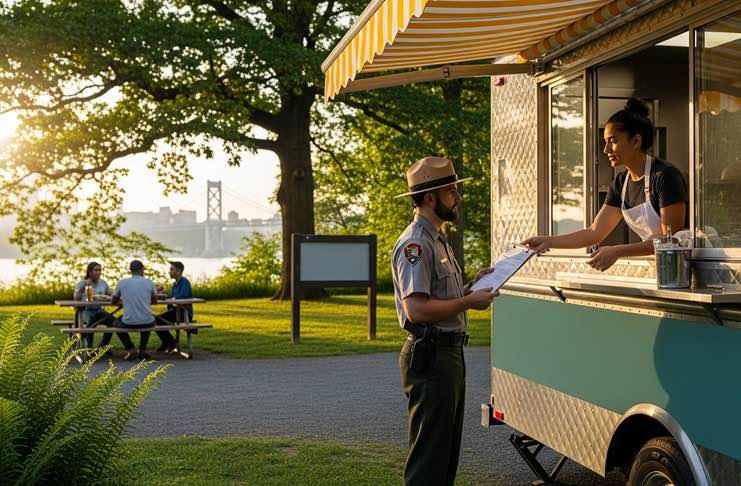
Imagine you’re staring at massive crowds of hungry tourists swarming Gateway National Recreation Area, and you just know they’re craving your crispy, savory empanadas. Parking your rig right where the foot traffic peaks? Incredibly tempting.
But before you fire up the grill and try to join the ranks of NYC’s best food trucks, you need to understand the strict federal regulations governing vending on government land. Sizzling up birria tacos near federal monuments sounds like a goldmine, but the permit process can shut you down fast.
City Parks vs. Federal Property in 2026
Crossing the invisible line from a city street corner onto National Park Service (NPS) land changes everything. You’re not just moving to a better parking spot. You’re entering an entirely different legal world.
Local Easing vs. Federal Strictness
Right now, local municipalities are actually making it easier to vend. New York State is rolling out World Cup One-Day permits for 2026, giving bars and food vendors unprecedented flexibility for off-site outdoor events. Local towns are also opening up municipal properties to mobile vendors, similar to the seasonal food truck permits popping up in city parks elsewhere.
Watch this news reel to learn more:
But federal lands don’t defer to local city permits. Not even a little. Once you roll your tires into a National Park, all those local leniencies vanish. You’ll need a federal permit to serve those fragrant, spicy halal chicken platters on NPS property.
The Cost of a CUA
To sell anything on federal land, you need a Commercial Use Authorization, or CUA. The NPS strictly limits how many of these it hands out, keeping parks from becoming overcrowded with food trucks. The application process is long, and the fees can quickly eat into your profit margins.
| Feature | State/City Parks (NY) | National Parks (Federal) |
|---|---|---|
| Primary permit | Mobile food vending license / seasonal park permit | Commercial Use Authorization (CUA) |
| Processing time | Weeks to a few months | Up to 6–12 months |
| Special 2026 permits | World Cup One-Day permits available | Not applicable on federal land |
| Jurisdiction | Local NYPD / Parks Enforcement | Federal Park Rangers / Federal Court |
When the Rules Collide: Avoiding Severe Legal Pitfalls
Here’s where things get serious. Operating your food truck on the wrong side of a jurisdictional boundary can cost you your entire livelihood. Federal authorities play by a completely different set of rules.
The 2026 CDL Crackdown
Federal authorities are heavily scrutinizing commercial vehicles right now. The US Department of Transportation recently threatened to withhold $74 million from NY over lapses in vetting commercial driver’s licenses (CDLs) for non-residents. If your food truck requires a CDL, federal park rangers won’t hesitate to impound your rig if your paperwork isn’t flawless.
Fines, Penalties, and Prosecution
A federal charge isn’t the same as a local parking ticket. State courts handle 66 million cases a year, compared to just over 353,000 in federal courts. That means federal prosecutors have the time, money, and resources to pursue violators thoroughly.
Federal conviction rates sit around 95%, compared to roughly 68% in state courts. And federal sentences run longer with more rigid enforcement.
If you get slapped with a violation on NPS land, you’re not heading to local traffic court. State and federal courts have different rules, so facing a federal magistrate for unauthorized commercial activity requires a whole different level of legal defense.
Here’s a quick survival checklist to keep your operation on the right side of the law:
- Verify your exact GPS location to make sure you’re not overlapping federal property lines.
- Secure your federal CUA at least 6 months in advance.
- Confirm your CDL and vehicle registration are fully compliant with 2026 DOT standards.
- Carry physical copies of your local health department inspections and federal authorizations at all times.
Serving Up Success on Federal Turf
Expanding your street food operation into a National Park can be incredibly lucrative. The foot traffic is unbeatable, and the crowds are always hungry for something fresh and flavorful.
But the bureaucracy is complex, and the penalties for breaking the rules are severe. Do your homework, get your permits in order, and protect your rig from federal fines so you can focus on what you do best: serving up unforgettable food to the people who need it most.
Ever tried to secure a permit for a federal park? Drop your experience in the comments below.
Food Truck Vending on Federal Land: 2026 Essential FAQ
1. Can I use my NYC mobile vending permit on National Park Service (NPS) land?
No. Local NYC permits and the new 2026 New York State “World Cup One-Day” permits do not apply to federal property. Once you cross the boundary into areas like Gateway National Recreation Area, local rules vanish. You must have a federal Commercial Use Authorization (CUA) to operate.
2. What is a CUA, and why do I need one?
A Commercial Use Authorization (CUA) is the specific federal permit required to conduct any business on National Park land. The NPS issues these to manage crowds and protect park resources. Without one, your operation is considered unauthorized commercial activity, which can lead to your rig being impounded.
3. How long does it take to get a federal food vending permit?
While local city permits might take a few weeks, federal CUA applications often take 6 to 12 months to process. Because the NPS strictly limits the number of vendors to prevent overcrowding, it is highly recommended that you start your application at least a year in advance of major 2026 events.
4. How will the 2026 CDL crackdown affect my food truck?
The US Department of Transportation is currently scrutinizing Commercial Driver’s Licenses (CDLs) with increased intensity. If your food truck requires a CDL to operate:
-
Ensure all paperwork is up-to-date and reflects your current residency.
-
Federal Park Rangers have the authority to inspect your CDL and vehicle registration.
-
Lapses in vetting can result in immediate vehicle seizure under federal DOT standards.
5. What happens if I accidentally vend on federal property without a permit?
The consequences are significantly steeper than a local parking ticket:
-
Jurisdiction: You will face a Federal Magistrate, not a local traffic court.
-
Conviction Rates: Federal courts have a roughly 95% conviction rate compared to 68% in state courts.
-
Resources: Federal prosecutors have more resources to pursue violations thoroughly, often leading to higher fines and longer-lasting legal complications for your business.
6. Are there special permits for the 2026 World Cup?
New York State is offering World Cup One-Day permits for unprecedented flexibility at local and municipal sites. However, these do not apply to federal land. If you plan to feed fans near federal monuments or parks during the tournament, you must rely solely on your federal CUA.
7. How can I tell if I’m on City vs. Federal land?
The “invisible line” is often closer than you think.
-
Check GPS coordinates: Cross-reference your location with official NPS boundary maps.
-
Look for signage: Federal property is often marked by U.S. Government or National Park Service bollards and signs.
-
When in doubt, stay back: If you are within 50 feet of a federal boundary, verify your position before opening your service window.
- About the Author
- Latest Posts

Ron Rossi is a New York native, marketing director, and self-styled “Jaded Traveler” who has spent a career crossing borders — both professionally and culinarily. Having lived and worked across Asia, Europe, Africa, and South America, Ron has eaten his way through nearly 100 countries on six continents, always with the same philosophy: the best food belongs to the people, not the guidebooks. He gravitates toward mid-range, budget, and street food — the kind of meal a local nurse, teacher, or taxi driver would actually eat — and believes that a country’s character is most honestly revealed not in its fine dining rooms but in its markets, cart stalls, and neighborhood joints. At New York Street Food, Ron brings that same globe-spanning hunger to the five boroughs, hunting down the dishes that feed everyday New Yorkers and the stories behind the hands that make them.