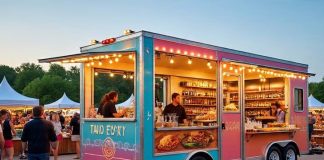

Walk through any busy street in New York on a warm afternoon, and you’ll notice something interesting happening at the edges of the sidewalk. Dessert is no longer just an afterthought you pick up on the way home. In a growing number of neighborhoods, it’s becoming a standalone attraction — something people specifically seek out, stop for, and photograph before they even take a bite.
For decades, street food in New York has been defined by its speed and substance. Hot dogs steaming under orange-and-blue umbrellas. Salted pretzels handed through a cart window. Halal carts with lamb over rice, long lines at lunchtime. These are filling, fast, and functional — exactly what a city built on movement needs. But alongside these staples, something quieter is taking shape. More vendors are testing lighter, experience-driven products that don’t anchor you to a bench for thirty minutes. And among those products, gelato stands out as one of the most strategically interesting.
Not because gelato is new — it’s been around for centuries. But because right now, the conditions on the street, the way consumers eat, the economics of small food businesses, and the power of visual culture have all shifted in ways that make gelato an unusually good fit. This article walks through why that is, what the business logic actually looks like, and what it means for vendors and entrepreneurs thinking about where street food is going next.
A Shift Toward “Lighter Indulgence”
To understand why gelato is gaining ground, it helps to understand what’s changing about how people want to eat. The narrative that “consumers are eating healthier” is only partially true, and it’s often misread. People are not necessarily eating less dessert. They’re choosing differently within the category of indulgence. There’s a growing preference for what some food researchers call “lighter indulgence” — something that feels like a treat, satisfies a craving, but doesn’t leave you feeling weighed down.
Gelato fits squarely into that preference. According to Food & Wine magazine, the product differs from American-style ice cream in two meaningful ways. First, it contains significantly less fat — typically between 4% and 9% butterfat compared to the 10% to 18% found in standard ice cream. Second, it is churned at a slower speed, which incorporates less air into the mixture. Ice cream can have up to 50% of its volume made up of air (a measurement the industry calls overrun). Gelato typically has an overrun of 20% to 35%. The result is a product that is denser, richer in flavor, and more intensely satisfying per spoonful.
What this means practically is that smaller portions still feel like enough. A single scoop of well-made pistachio or hazelnut gelato delivers more concentrated flavor than a larger scoop of standard ice cream. For a street food context, that matters a great deal. People in a city like New York are not looking to sit down with a large dessert bowl. They want something they can eat while walking, something that satisfies but doesn’t slow them down. Gelato occupies a specific gap in the street food landscape: it sits between a casual snack and a genuine experience, and it does so in a way that very few other products manage.
It’s worth being honest here: gelato is still a dessert, and it still contains sugar and calories. The “healthier” framing can be overstated. But the relevant point isn’t that gelato is diet food — it’s that it feels lighter, and that perception shapes consumer behavior. In a culture increasingly conscious of how food makes people feel after eating it, that distinction is a real competitive advantage.
🍦 Our Experience
Dolce Brooklyn, Carroll Gardens: We stopped by Dolce Brooklyn on a Saturday afternoon, and the walk-up Dutch-door setup — where customers order from the sidewalk while the team works inside — perfectly embodies the lighter-indulgence idea in practice. A single scoop of their espresso stracciatella, made with Hudson Valley dairy, was genuinely more satisfying than anything twice its size from the soft-serve trucks a few blocks away. The line moved fast, the portions felt considered rather than skimpy, and nobody around us looked like they were regretting the decision ten minutes later.
Watch this video to get a glimpse:
Why Gelato Works on the Street
Street food is not just about what something tastes like. It’s about how quickly it can be served, how little space the vendor needs to operate, how visible it is to someone walking past at a normal pace, and how little it asks of the customer. By most of these measures, gelato has genuine advantages over many other street food formats.
On the operational side, one of the biggest advantages is that gelato requires no on-site cooking. A halal cart needs gas burners, ventilation considerations, and a cook managing temperature. A waffle or crepe setup involves batter, hot surfaces, timing, and a certain amount of controlled chaos during a rush. Gelato is prepared in a commercial kitchen or commissary in advance, transferred to refrigerated pans called pozzetti or display trays, and held at the cart ready to serve. The vendor’s job during service is scooping, not cooking. That simplicity keeps staffing requirements low and reduces the risk of service slowdowns during busy periods.
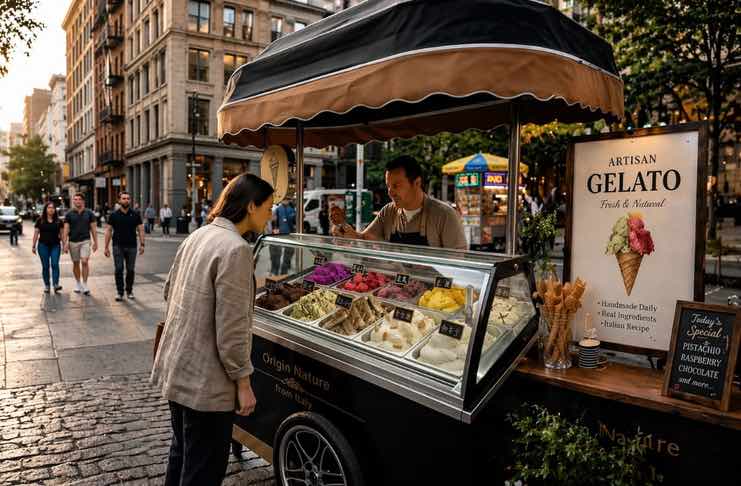
The equipment footprint is also compact by design. A single gelato cart built around a chest-style display freezer can operate in as little as four feet of sidewalk space. Some setups use Italian-style pozzetti carts — cylindrical covered containers that keep each flavor at optimal serving temperature while conserving energy — while others use open-top display cases that show the gelato directly. Either way, the physical footprint is manageable in dense urban environments where space is expensive, and permits are tied to dimensions.
The visual dimension of gelato deserves its own attention because it’s genuinely one of the product’s strongest street-level assets. When a display case is open and well-stocked, it creates an immediate visual interruption. Vivid greens from pistachio and matcha, deep purples from blueberry and blackcurrant, warm ochres from salted caramel and mango — these colors read clearly from ten or fifteen feet away. In a crowded pedestrian corridor, that kind of visibility is not cosmetic. It’s functional. It stops people who were not planning to buy anything.
This is a meaningful contrast with most street food, which is invisible until you’re already at the cart. A foil-wrapped sandwich, a paper bag of nuts, a covered tray of rice — these don’t broadcast themselves visually. Gelato does. And in a business where foot traffic is your entire customer acquisition strategy, that difference matters more than it might seem.
🍦 Our Experience
L’Arte del Gelato, The High Line: L’Arte del Gelato’s cart position along the High Line is a near-perfect case study in how visual placement works in practice. We watched from a bench as a steady stream of tourists and locals — who had zero intention of stopping — did a full double-take at the open display of Sicilian-inspired flavors before reversing course to join the queue. The cart itself takes up maybe five feet of path width, the two-person crew ran service without a hitch during a midday rush, and the pistachio was dense and nutty in exactly the way a smaller scoop demands you slow down and pay attention.
Watch this video to get a glimpse:
The mobile food model also gives gelato vendors a strategic flexibility that traditional scoop shops don’t have. A fixed-location gelato store is dependent on its neighborhood, its lease, and its consistent foot traffic. A cart or truck can move. Vendors can follow events — farmers markets on weekends, outdoor concerts, food festivals, corporate events, and private parties. That mobility allows a small operator to build revenue across multiple channels rather than depending on a single location’s performance.
The Business Angle Most People Miss
The U.S. gelato market has been growing steadily over the past several years, driven by rising consumer interest in artisanal and premium frozen desserts. Market research firms tracking the category have noted consistent year-over-year growth, with the premium and small-batch segment outperforming standard frozen desserts. But what the market growth numbers don’t capture is where the real opportunity has shifted: away from traditional stores and toward mobile and event-based formats.
The economics here are worth understanding clearly. Opening a traditional gelato shop in a city like New York involves a commercial lease (often $5,000 to $15,000 per month or more, depending on the neighborhood), extensive build-out costs, refrigeration and display equipment, staffing for full operating hours, and the fixed overhead of running a retail space, whether or not customers walk in that day. The total startup investment can easily exceed $150,000 to $300,000 before the first scoop is sold.
A mobile gelato setup looks very different. A well-equipped gelato cart can be sourced or built for anywhere between $8,000 and $30,000, depending on the configuration. A used food truck converted for frozen desserts might run $40,000 to $80,000. Permit costs, commissary fees, and supplies add to that, but the total entry point is a fraction of what a brick-and-mortar store requires. And critically, the perceived value of the product doesn’t change based on where it’s served. A beautifully presented scoop of stracciatella from a polished cart in Central Park commands the same $6 to $8 price point it would in a Soho boutique.
That gap — low entry cost, high perceived value — is the core of the business logic, and it’s rarer in street food than it sounds. Most street food products that are genuinely low-cost to produce are also perceived as low-value by customers, which caps pricing. And most premium food products that command high prices require expensive equipment or complex preparation to deliver. Gelato sits in an unusual position where the artisanal perception is real (it is legitimately a more craft-intensive product than soft-serve or packaged ice cream), but the operational requirements are manageable at a small scale.
For those exploring this as a real business concept, the practical setup questions — what equipment is needed, how to source product, how to structure a cart versus a truck operation — are well worth researching thoroughly before committing capital. A detailed guide on starting a gelato street food business can help with the equipment and setup decisions that most people underestimate. The operational decisions made early tend to determine whether the margins work out.
One thing worth flagging, honestly: the gelato business is not without its challenges. The product is highly temperature-sensitive. Gelato is typically served between 10°F and 15°F, which is warmer than standard ice cream, and maintaining that window on a street cart in summer heat requires reliable refrigeration equipment and attentive monitoring. Quality also degrades faster than ice cream when not stored correctly. These are solvable problems with the right equipment and practices, but they are real operational considerations, not minor details.
🍦 Our Experience
Biddrina Gelato, Clinton Hill / LES Pop-Up: Biddrina is a good example of how the cart model lowers the stakes for experimentation. The team behind Brooklyn restaurant Locanda Vini e Olii started with a cart parked right outside their own front door — as low-overhead a test as you can run — before expanding to a Lower East Side pop-up running late into the night on weekends. When we visited the LES setup, the cart was doing brisk business well past 10 pm, with a menu of six dairy flavors and three vegan sorbetti that rotated based on what the kitchen had on hand. It’s a genuinely small operation, but the revenue channel it opens up — late-night, high-foot-traffic, zero additional real estate cost — is exactly the kind of flexibility a fixed store can never replicate. Read this for a deeper review.
From Product to “Experience”
There’s a behavioral pattern worth observing around gelato purchases that doesn’t apply to most other street food. People don’t just buy gelato — they engage with the selection process. They stand at the display, lean in to read flavor labels, ask the vendor what’s good today, debate between two options, and watch it being scooped or shaped before they accept the cone or cup. This sounds like a small thing, but it represents a fundamentally different customer relationship than a transaction that takes ten seconds.
That interaction — even when it only lasts sixty or ninety seconds — creates a moment. It slows things down in an environment built around speed. And there’s growing evidence from consumer behavior research that this kind of micro-engagement increases satisfaction with the purchase and the likelihood of a repeat visit. People feel like they chose something rather than just grabbed it. That distinction drives loyalty in a way that transactional street food often doesn’t.
The social media dimension amplifies this significantly. Gelato is an unusually photogenic product. The texture of a well-made batch — smooth but not reflective, with natural color variation and visual depth — photographs extremely well in natural light. A vendor who works on the visual presentation of their display, who uses natural colorants and interesting flavor combinations, and who offers something slightly unexpected (black sesame, fig and honey, lavender, saffron) gives customers something worth sharing. And in an urban environment where people are constantly generating content for Instagram, TikTok, and similar platforms, that organic sharing functions as free advertising at scale.
This is genuinely different from most street food. A perfectly adequate hot dog or falafel wrap generates almost no spontaneous social media content. It’s food. But a striking gelato display in a well-designed cart in a beautiful park setting generates content constantly, without the vendor spending anything on marketing. Smart operators recognize this and invest in the presentation side of their setup accordingly — the cart design, the display arrangement, the quality of the serve. These are not vanity expenses. They’re marketing assets.
🍦 Our Experience
Bambina Blue, SoHo: If you want to understand the social media flywheel in action, spend twenty minutes outside Bambina Blue on a weekend afternoon. The shop’s 32 flavors — ranging from vanilla stracciatella to sesame drizzled with pistachio sauce to a “Movie Night” salted popcorn and M&M mashup — generate a near-constant stream of phones-out moments before the first bite is taken. We counted at least a dozen people photographing their cups on the sidewalk during our visit, unprompted, with no signage encouraging it. The presentation is deliberately designed to be shareable, and it shows in the line length. Check them out on Instagram.
Watch this reel to get a glimpse:
Where It’s Going Next
Gelato is not going to displace the hot dog cart or the halal truck. Those categories have deep roots, loyal customers, and their own economic logic that works well in New York’s street food ecosystem. The point is not that gelato replaces anything — it’s that it has identified a different lane and is moving into it with some real momentum.
The lane it’s carving out is defined by a few overlapping characteristics: premium positioning, light footprint, experience-driven purchase behavior, and visual appeal that works in an increasingly image-conscious consumer culture. These are characteristics that align well with how urban eating habits are evolving — not just in New York, but in any dense city where foot traffic is high, and consumer expectations around quality have risen over the past decade.
For small operators and first-time food entrepreneurs, the gelato street food model offers something that’s genuinely hard to find: a product with real craft credibility, a mobile format with manageable startup costs, and an audience that has already been primed by food culture to see gelato as premium. The barriers to entry are lower than for a storefront. The upside — in terms of pricing power, event revenue, and brand building — is higher than most basic street food setups.
The vendors who will do well in this space are likely to be the ones who treat the business seriously from the start: investing in good equipment that maintains product quality, sourcing or producing gelato with real flavor integrity, building a consistent visual identity, and choosing their locations and events strategically rather than just showing up wherever there’s foot traffic. The product can carry a lot of the work, but it still requires an operator who understands what they’re selling and to whom.
The broader signal here is worth noting for anyone watching how urban food culture evolves. Street food in American cities is shifting — slowly but clearly — away from pure utility and toward products that create a moment. Convenience still matters, but it no longer has to come at the expense of quality or experience. Gelato sits right at that intersection. That’s not a coincidence. It’s exactly why the business model makes sense right now.