

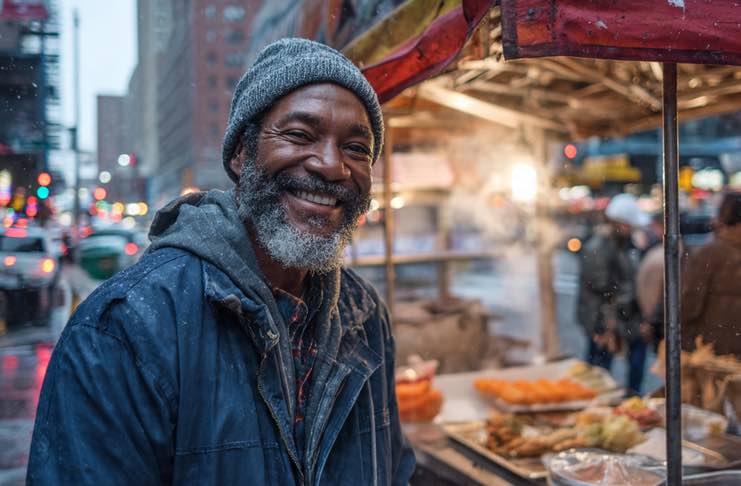
It’s the same thing every day.
Someone sees a glowing fast-food sign, slows down, hesitates, then turns around and goes to the halal cart or the taco stand just a few feet away.
Both are considered ‘quick food’, so what drives that decision? You have consistency on one end, with the same fries, the same sauces, the same burgers, the same everything, regardless of the neighborhood. On the other end, things run on the cook’s rhythm, the smell of the grill, the fresh ingredients, and the way they remember how you like your order without having to write it down.
Fast-food chains have a lot going for them. They have the ads and the reach. Their entire global system is built on speed and consistent ingredients and menus. It might sound boring and predictable, but it works, and the proof is all around you. Yet, street vendors keep pulling long lines even on blocks that are packed with big brands.
How?
It’s actually pretty obvious. Chains can’t deliver the sense of presence and food that feels made for each customer, rather than for the system.
And this, as part of our street food vendors blog, article will take a closer look at why that matters so much.
The Difference You Can Taste
You don’t need to look far to see the difference; compare the taste.
With fast-food chains, flavors are uniform because they have to be. It’s all designed that way. The flavors are built in test kitchens and delivered through strict instructions.
Personality? No way, that’s not welcome here. Street vendors work from a different source.
They use their experience, recipes that were passed around families for generations – you know those ‘my great great grandma invented this dish-type of recipes – plus, there’s the never-ending tweaks to their food. They don’t depend on centralized suppliers and pre-made components. And this basically means that the ingredients they use come from a market run or a fresh batch they prepped that very morning.
This is all about freedom, and making the best possible dish that people will come back to and recommend to their friends, which is the polar opposite of how chains work.
That freedom carries into the seasoning and technique.
A vendor can add more heat on a cold day or adjust their spices when the line gets long. They could have a quick talk with one of their regular customers and tweak the recipe. The flavors they create often come from cultural traditions instead of corporate menus, which results in the depth you can not only taste, but also place.
And because vendors can change things on a whim, the feedback loop is immediate, so their adjustments are made daily, not after getting approval from an office on the other side of the world.
Though ‘taste’ is just the first layer.
The Real World Experience
The moment you walk up to a cart and see the person who runs it, you can feel the difference. There’s a pace, a back-and-forth with the vendor who’s trying to read you and figure out what you like.
A vendor will notice if you’re in a rush or if you want extra sauce. They’ll talk to you while the grill sizzles because they can tell if you need a second to breathe. That exchange seems so small, but it’s what builds a kind of street-level familiarity you can’t get in chains. Chains focus on efficiency, not connection.
You’ll also feel it in the way the food is made because the vendor can swap out your toppings or add extra oil, while a chain worker has steps they need to follow for every single order, regardless of who’s standing in front of them.
Then there’s the atmosphere, which you could call the extra ingredient because of how important it is. When it comes to street food, the atmosphere comes from the noises of traffic, the gust of warm air from the subway stairs, the music from a speaker somewhere, and the smell of spices in the breeze.
Is it loud? Yes. Is it messy? You bet.
But more than anything else, it’s alive in a way you can’t stage indoors.
A dining room in a chain is all about control and predictability. No mess, no potential hazards.
Well, regardless, that doesn’t mean that accidents don’t happen at food chains (even massive ones). You can be sure that there’s been a Burger King or McDonald’s slip and fall injury here and there, a food poisoning at Wendy’s, a burn from hot soup at Soup Spot, and all these accidents likely ended up in nice settlements once the lawyers got involved.
We can’t really stop injuries/accidents, but we can at least raise awareness to minimize the chance of them happening.
All this has an impact on how the food itself lands with the customer.
A good vendor can make a random stretch of sidewalk into a small moment of connection, and that tends to linger longer than the taste from the last bite.
The Street Advantage – Freshness, Speed, Efficiency
The differences we’re about to go over have nothing to do with charm, although street vendors have no lack of it.
The structure of the job itself is what it’s all about because vendors work on the street, in tight spaces, and their focus is on one main product that has a direct line of customers.
When it comes to chains, they run on large systems that were built for scale. And not that there’s anything wrong with it, but it leaves little to no room for flexibility, which is not ideal.
Freshness That Comes from Cooking in Small Batches
A street vendor has neither the storage space nor the need for huge amounts of food that need to be ready at all times.
This means that they cook in small batches, and what they serve was prepped only a few moments earlier or cooked right in front of you. The food comes out hotter, and the flavors stay sharp because the food doesn’t sit around for long.
Chains need high volumes of products, so they have warming drawers and pre-cooked components.
It makes sense, since they need to stay consistent and fill out a lot of orders, but the food waits for quite a while before it’s served.
Watch this lovely reel that shows how fresh street food can be:
Speed Without Assembly-Line Routines
Chains are fast, but so are vendors.
Vendors get speed from doing one thing extremely well. When someone spends years making the same dish, their hands move with a kind of muscle memory that’s hard to match. They know exactly how long each step takes and how to handle the rush without having to slow down.
That’s not how it works in fast-food chains.
They have assembly lines with multiple stations, timers, rules, and workflows that make each item into one small, standardized action. It works, but it also makes the entire process depend on several people doing everything in sync.
Check out this “scary” video of how robots are actually making the food in some fast food chains:
Efficiency From Adaptation and Mobility
Chains can’t match the level of flexibility street vendors have.
They can change their hours according to foot traffic and adjust their menu based on what sells. They even have the freedom to move to a different corner if the flow of people changes. The entire setup they have revolves around meeting real-time demand.
Chains, on the other hand, have fixed locations and set operating hours. Their rules come from corporate offices, and they rely on long-term leases, which lock them into places that might not always work the best with the rhythm of the city.
Conclusion
New York moves fast, and street vendors match that rhythm.
They blend into the noise and the smells and work with it all. Chains, on the other hand, do the opposite. They go against the motion and the chaos. They run on rules and timers, not on whatever the day throws at them.
One isn’t necessarily better than the other, so that’s not the point to take away from all this.
The real point is that you can choose between two very different ways of eating in a city that never slows down.
- About the Author
- Latest Posts

Anthony McGovern is an NYC-based food writer and culinary explorer dedicated to mapping the city’s rich, diverse street food landscape. From tracing the deep immigration histories behind Chinatown’s dumpling shops to hunting down the best late-night taco trucks on Roosevelt Avenue, Anthony focuses on the stories, people, and generations-old traditions that define New York’s food scene