
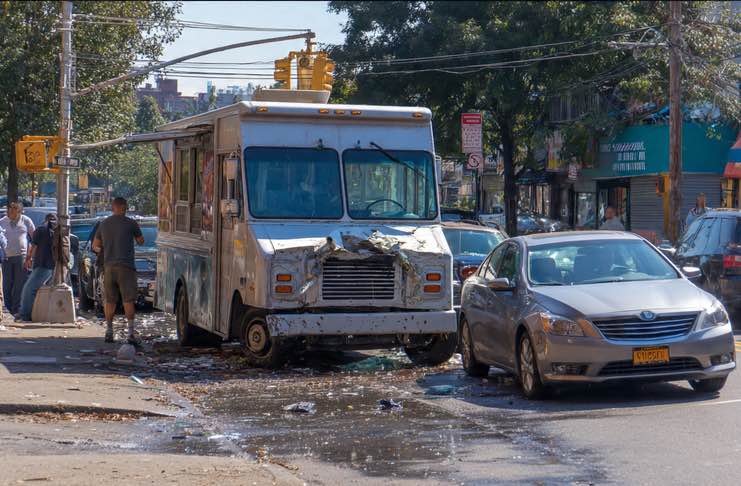
Food trucks are a familiar presence on the busy streets of Queens, serving customers along Roosevelt Avenue in Jackson Heights, outside Citi Field in Flushing, and at dozens of corners throughout the borough. However, when a food truck causes an accident, the legal rules that apply are far more complex than those governing a typical car crash.
Because food trucks are operated for business, they’re usually registered and insured for commercial use, which can expand the pool of responsible parties and the insurance coverage available, even though many core New York accident rules still apply.
These rules can expand the number of parties responsible for an injured person’s losses and increase the amount of available insurance coverage. Anyone injured in a food truck collision in Queens should speak with an experienced personal injury attorney in Queens, New York, to understand how commercial vehicle laws may strengthen their claim.
Why Does New York Treat Food Trucks Differently from Regular Cars?
Food trucks operate as commercial vehicles because they are used for business purposes. This classification matters because New York law holds commercial vehicle operators and their employers to higher standards of accountability.
Some commercial vehicles are subject to additional safety and operating rules under federal and state regulations (for example, certain vehicles that meet commercial motor vehicle definitions based on weight and use). Whether a particular food truck falls under those rules depends on factors like its weight, registration class, and how it operates.
Because food trucks serve customers while parked or slowly navigating crowded streets in Queens, they create risks that standard passenger vehicles do not. A food truck driver may need to pull over suddenly, block sightlines for pedestrians, or maneuver a large vehicle through tight intersections. These operational realities make accidents more likely in densely populated neighborhoods. As a result, New York’s commercial vehicle framework imposes broader liability to protect the public.
Who Can Be Held Liable for a Food Truck Accident in Queens?
One of the most significant differences in commercial vehicle cases is that liability can extend well beyond the driver. Under New York Vehicle and Traffic Law Section 388 (VTL § 388), every vehicle owner is liable for injuries caused by anyone operating their vehicle with permission. This means the food truck’s owner is responsible for the driver’s negligence, regardless of whether the owner was present at the time of the accident.
New York courts have long held that this vicarious liability provision creates a presumption that any driver is operating a vehicle with the owner’s consent. The burden then falls on the owner to prove otherwise with clear evidence. Additionally, if the food truck driver was working as an employee, the business itself may be liable under the legal doctrine known as respondeat superior, which holds employers responsible for employees’ actions performed within the scope of their job duties.
In some cases, a third party may also share responsibility. For example, if a mechanical failure contributed to the accident, the company that maintained or repaired the food truck could be held liable. This ability to pursue claims against multiple parties is one of the key advantages of commercial vehicle accident cases.
How Does New York’s No-Fault Insurance System Affect Food Truck Accident Claims?
New York is a no-fault insurance state, which means medical bills and certain economic losses are first pursued through PIP (no-fault) coverage, often through the injured person’s own auto policy (or a household policy), and if they don’t have one, through the insurer for the vehicle involved.
Basic PIP (no-fault) benefits cover medical expenses and other ‘basic economic loss’ up to $50,000 per person, including lost earnings up to $2,000 per month for up to three years (subject to statutory offsets) and other reasonable and necessary expenses up to $25 per day for up to one year.
However, New York law limits when an injured person can file a lawsuit against the at-fault driver. Under New York Insurance Law Section 5102(d), a person must demonstrate that they suffered a “serious injury” before they can sue for additional compensation, including damages for pain and suffering.
The statute defines ‘serious injury’ to include death; dismemberment; significant disfigurement; a fracture; loss of a fetus; permanent loss of use of a body organ, member, function, or system; permanent consequential limitation of use of a body organ or member; significant limitation of use of a body function or system; or a medically determined non-permanent injury that prevents the person from performing substantially all usual daily activities for at least 90 days during the 180 days after the accident.
This threshold is critical in food truck accident cases. Commercial vehicles are often heavier and larger than standard cars, which means collisions tend to produce more severe injuries. Pedestrians struck by food trucks in Queens frequently suffer fractures and other injuries that meet or exceed the serious injury threshold.
What Role Does Comparative Negligence Play in These Cases?
New York follows a pure comparative negligence rule under Civil Practice Law and Rules Section 1411 (CPLR § 1411). This means that an injured person can recover compensation even if they were partially at fault for the accident. The court assigns each party a percentage of responsibility, and the injured person’s award is reduced by their own share of fault.
For instance, if a pedestrian jaywalked in front of a food truck in Queens and a jury found the pedestrian twenty percent responsible, the pedestrian could still recover eighty percent of their total damages. Unlike many other states that bar recovery once a person’s fault exceeds fifty or fifty-one percent, New York’s pure comparative negligence system allows recovery regardless of the plaintiff’s degree of fault. This rule is particularly relevant in food truck cases where insurance companies may argue that the injured person contributed to the accident by not paying attention near a parked or moving food truck.
Why Is Higher Insurance Coverage Available in Commercial Vehicle Cases?
Commercial vehicles typically carry significantly more insurance than personal vehicles. While New York requires standard passenger vehicles to carry a minimum of twenty-five thousand dollars per person in bodily injury liability coverage, commercial trucks operating under federal regulations with interstate operations may need $750,000 in liability coverage.
Food trucks may fall somewhere along this spectrum depending on their size, weight, and operating classification. However, the insurance policies covering commercial food trucks generally provide higher limits than standard auto policies. This additional coverage means that injured individuals may have access to more compensation than they would in a typical car accident. Understanding the specific insurance requirements that apply to a food truck involved in an accident requires careful investigation of the vehicle’s registration, operating permits, and policy terms.
What Steps Should You Take After a Food Truck Accident in Queens?
Protecting a potential legal claim begins at the scene of the accident. Injured individuals should contact the police so that an official report is created, as this document can serve as important evidence. Seeking medical attention promptly is equally critical, both for health reasons and because medical records establish a connection between the accident and any injuries sustained.
New York law also imposes strict deadlines that can affect the right to recover compensation. The general statute of limitations for personal injury claims is three years from the date of the accident. However, if your claim is against the City, a public authority, or another qualifying public entity, New York law typically requires a notice of claim within 90 days, a much shorter deadline than the general personal-injury filing period.
Food truck accidents in Queens involve layers of commercial vehicle law, insurance regulations, and liability rules that set them apart from ordinary traffic collisions. New York’s broad vicarious liability provisions, higher commercial insurance requirements, and pure comparative negligence system all work to protect injured individuals. However, these protections only matter if the injured person takes timely action. Consulting with a knowledgeable personal injury attorney can help ensure that every available avenue of recovery is pursued.