

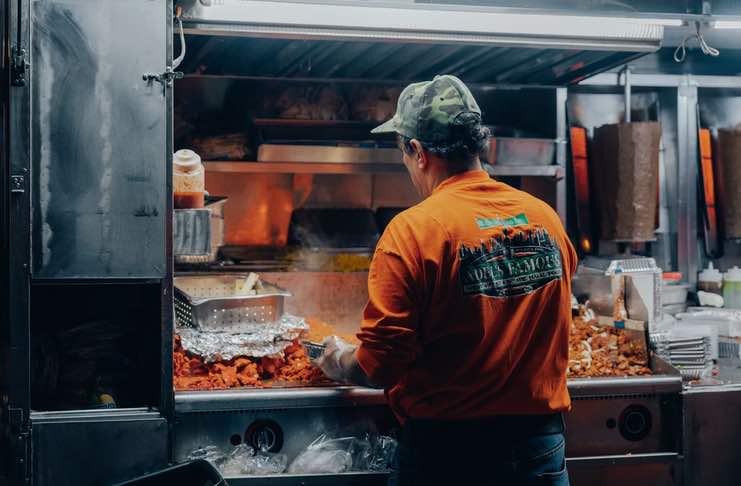
Street food in New York functions on an entirely different time schedule: loading up the truck at dawn and closing the pop-up bar counter well after midnight! People are as much a part of this as anything else, like a big meal rush; if one of the workers here isn’t focused, the owner could be losing a day of business. This article will explore the sources for hiring crew for cart operators, food trucks, and temporary bars, and why they stay on the jobs for more than a season.
Navigating the Fast-Paced Hiring Needs of NYC Mobile Food and Nightlife
Mobile kitchens don’t allow for anything slow and sloth-like. A festival application is confirmed 14 days before, and a place at Union Square becomes available on Thursday, while by Saturday, two more people are required at the service window. A restaurant might be able to afford a month of interviews while a food truck operator can fill a job in a few days.
The complexity is compounded by the geography. The team meets up at the commissary kitchen in the morning, and the event venue is set up in the evening, forcing an employee to do a “three boroughs walk.” It is common for shifts to be split and schedules to vary depending on the weather, and for some candidates to drop out before the very first conversation. Watch this video to get a glimpse of a workday at a NYC food truck:
The nightlife aspect of the market is there, too. Pop-up bars in Brooklyn and on Manhattan roofs are open for a limited time: four weekends, a month, or an open terrace season. A bartender is required not just on a regular basis but on certain days and must be experienced and self-disciplined. Hence, in this segment, the most important thing the owner looks for is not the perfect candidate, but someone who doesn’t let him/her down on Friday.
Scouting Reliable Talent Beyond Traditional Job Boards and Word of Mouth
Word of mouth remains the primary channel: cousins, commissary neighbors, and former grill colleagues. The problem lies in the ceiling of this channel, as networking connections run out quickly, and by the third season the same people are either busy or have left the industry.
The second layer consists of job search platforms. A company like Jooble, for example, aggregates job listings from most sources on a single page and operates across 66 countries: about 300,000 new positions are added daily, with up to 90 million candidates visiting the site monthly. It’s completely free for job seekers, removing the barrier for line staff who are rarely ready to pay for access to job listings. Part of the application flow comes from adjacent segments: delivery, retail, and event staff, which serves as a solid baseline for a service window role.
Employers, however, are interested in the other half of the service — placement management tools. Here’s a sample of how it works:
| Jooble tool for job publishers | What it does | Best fit for a mobile operation |
| Dashboard | Live statistics on promotion campaigns | Watching a festival-week push |
| Conversion tracking | Compares candidate traffic against target metrics | Checking which listings bring real hires |
| Budget control | Daily or monthly caps per campaign or job category | Holding costs flat in the off-season |
| Email promotion | Sends postings to candidate inboxes | Reaching people who are not actively searching |
| Easy start | XML feed, ATS integration, or fetching jobs from a website | Launching without an in-house recruiter |
The third channel includes niche communities: market operator chats, vendor groups, and commissary bulletin boards. These offer quality rather than volume, inevitably bringing the owner back to a combination of several sources. Watch this video for some more useful tips:
What Pop-Up Owners Look for When Screening Incoming Applications
A stack of applications for a pop-up bartender position builds up within 24 hours, and half are filtered out based on a single paragraph of the cover letter. Both hiring managers and job seekers should examine bartender cover letter examples published on Jooble: these samples demonstrate how candidates articulate high-tempo work through volume, speed, and peak-hour behavior, rather than general words about a passion for the profession.
An owner’s attention goes straight to specifics:
- Venue names and formats instead of abstract “bar experience”;
- Shift metrics: check flow, line length, working solo or in pairs;
- Availability by date and willingness to work weekend evenings;
- A valid Food Protection Certificate, if handling food.
While a resume and letter provide only an initial impression, they save the most vital resource — time spent on face-to-face meetings. An application specifying concrete dates and addresses naturally moves to the top of the pile.
Trial Shifts and On-the-Ground Assessment Strategies for Peak Rush Hours
The trial shift is the end of an interview in a food truck. The two- to three-hour paid job that you get when you’re at your busiest at lunch is a test of stories about being able to handle stress; it’s a test of stress tolerance.
Evaluations are based on information not included in a resume:
- When the person is not being used: cleans surfaces or takes out a phone;
- How the order is kept in a line of 15 persons;
- How precise the cash handling and operation of the Point of Sale terminal are;
- Whether they can hear their partner over street noise and exhaust fans.
The real partner is seen within the first 20 minutes of work. One of the other signs is changes in behavior following the shift. If a candidate proactively inquires about stocking for the next day, he or she is likely to remain for a longer period than the average. On the other hand, a person who comes and goes on the timer but does not turn off their station doesn’t stay long at mobile stations.
Retaining Top Performers Across Seasonal Cycles and Outdoor Event Seasons
Finding staff in New York is hard; retaining them is harder. Seasonality here is not an emergency but a baseline condition of roster planning. November cuts off outdoor foot traffic, the team shifts to ghost kitchens, and in April the owner rebuilds the crew from scratch. Those who maintain contact in advance win out: winter side gigs in catering, part-time shifts, and honest conversations about return dates.
Financial transparency also works. Candidates arrive prepared, as anyone can research market salaries for their position in advance online, making vague phrases like “to be discussed on site” more likely to deter talent. Base pay, tips, and distribution rules should be agreed upon upfront.
The third factor is predictability. A schedule published two weeks ahead, commute compensation for remote venues, and clear shift-closing procedures all fall under street food business admin, which owners often leave for last. Still, top employees leave not because of workload, but because of chaos.
When the Crew Becomes the Menu
The street does not forgive a random crew: it shows in the queue, in service speed, and in customer reviews. Thus, hiring for a vendor remains a core operational routine alongside purchasing and logistics. A strong team here is worth just as much as the recipe itself.