

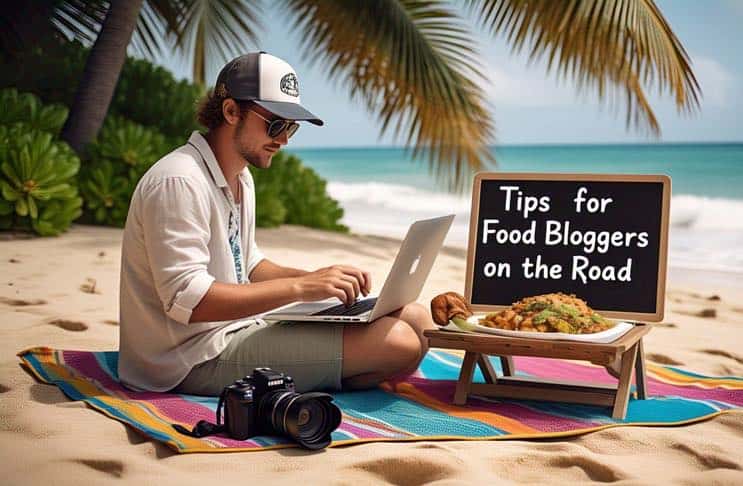
Alright, food adventurers, gather ’round! After a decade pounding the pavement for NYSF (that’s NewYorkStreetFood.com for the uninitiated), my belly and my laptop have seen some things. You wanna take your food blogging on the road? Awesome! It’s a wild ride, full of delicious discoveries and the occasional… well, let’s just say “learning opportunities.” Here are ten nuggets of wisdom I’ve picked up along the way, served street-food style – quick, punchy, and hopefully leaving you wanting more.
Is working from cafés all over the world really as dreamy as it looks?
If you’ve ever posted a photo of your laptop next to a cappuccino in Lisbon, someone’s probably commented, “You’re living the dream!” Yeah… until the Wi-Fi cuts out mid-upload and you’re explaining to your editor why a grilled sardine review from Alfama is now three days late.
I’ve been writing for New York Street Food for a decade, and for most of that time, my “office” has been a blend of Airbnb kitchens, street corners, and noodle stalls. I’ve battled food poisoning in Vietnam while editing reviews of Brooklyn food trucks and once filed a deadline piece from a laundromat in Budapest using borrowed Wi-Fi from the bakery next door.
Here’s what I wish someone had told me before I turned my carry-on into a mobile newsroom.
What to know before choosing your gear?
Bring less than you think. Then subtract one more thing.
You don’t need three lenses, a drone, and that fancy lapel mic you saw a TikTok influencer use once. My go-to setup now: a lightweight laptop, a foldable keyboard (yes, it’s magical), a power bank that could jump-start a motorcycle, and a phone with a decent camera.
At first, I packed my entire DSLR kit. Spoiler alert: I used it twice, hated the weight, and ended up switching to my iPhone for 90% of my shots. The best food photo I’ve ever taken? A churro in Oaxaca shot on my phone at golden hour.
💡 Tip: Prioritize battery life over performance. You can edit at midnight in a hostel, but if your gear dies during a night market shoot, you’re toast.
Should you schedule posts or fly by the seat of your pants?
Both—and neither. It depends on the food.
You can plan all you want, but food blogging on the road is like cooking with unfamiliar spices: it rarely goes the way you expect, but sometimes it’s better that way.
In Morocco, I had three scheduled posts ready to go—then I stumbled into a Berber family’s home where I ate the most mind-blowing lamb tagine of my life. That post? Unplanned. It went viral.
I now keep 2–3 posts scheduled for “just in case” (bad Wi-Fi, dengue fever, travel days), and leave room for spontaneous gems.
Now, here’s the reality no one really says out loud: most bloggers today are using AI tools like Claude or ChatGPT to draft, structure, or at least speed things up. It’s efficient. It’s scalable. And frankly, if you’re publishing consistently, it’s hard not to.
But there’s a catch—and it’s not just hypothetical.
Search engines like Google are getting sharper at pattern recognition. Not just spotting AI-generated text, but identifying content that feels templated, predictable, or lacking lived experience. Whether or not they officially “penalise AI content,” they absolutely reward content that reads like it came from someone who actually tasted the food, missed the bus, got lost, and wrote about it anyway.
So if you’re using AI (and most people are), treat it like a sous-chef—not the head chef. Let it prep, but you do the plating.
That means:
- Injecting real anecdotes (the kind AI can’t fabricate convincingly)
- Breaking predictable structure (AI loves symmetry—humans don’t always)
- Leaving in a bit of messiness, personality, even contradiction
And if you want to sanity-check how “human” your post feels, run it through an AI checker. Tools like Originality.ai or GPTZero can give you a rough signal—imperfect, but useful.
Because here’s where this is heading: even if your content is brilliant, if it looks mass-produced, it risks blending into the noise.
The bloggers who win over the next few years won’t be the ones who avoid AI—they’ll be the ones who use it invisibly.
For more tips – read this.
Watch this video to learn more:
How do you handle internet security abroad?
Use a VPN. Seriously. Like, right now.
If I had a dollar for every sketchy café Wi-Fi I’ve used, I’d have enough to buy a New York food truck. I once got hacked from an airport network in Bali—lost access to my blog for 48 hours.
Now, I never connect without a VPN. It’s not just paranoia; it’s insurance. You can find out how a VPN works, but think of it like wrapping your data in an invisibility cloak before you toss it into the digital void.
🏦 Pro Tip: Use one that allows server switching, so you can post from Istanbul while looking like you’re chilling in Brooklyn.
How do you stay healthy when street food is your job?
Taste everything, eat wisely.
Here’s a fun fact: I’ve had food poisoning in six countries. Some might call that dedication. Others might call that an inability to learn.
I now follow a 3-bite rule when sampling sketchy street food—enough to taste, not enough to gamble my intestines. I carry charcoal tablets, probiotics, and one antibiotic I hope never to use again.
Lesson learned in Delhi: never trust a paneer samosa from a cart that’s surrounded by stray dogs but zero locals.
🩺 Source: CDC Traveler’s Health Food & Water Safety Guide.
Is coworking worth it for food bloggers?
Yes, but not for the reasons you think.
I thought coworking spaces were for start-up bros in Patagonia vests. Turns out, they’re lifesavers when you’ve been talking to no one but your keyboard for three days.
In Chiang Mai, I joined Punspace to escape my hostel’s loud snorer and ended up connecting with a food photographer who introduced me to the actual best khao soi in town—not the one every blog regurgitates. (Spoiler: it was at a car wash.)
Plus, fast Wi-Fi, coffee refills, and chairs that don’t give you scoliosis? Worth it.
Watch this video to learn more:
What’s the best way to find authentic food spots?
Follow the locals, not the hashtags.
Don’t get me wrong, I love Instagram. But if you want food that doesn’t taste like it was made for influencers, talk to your Airbnb host, your cab driver, the barista who doesn’t smile much.
In Porto, a random bartender scribbled a name on a napkin. That place? Had the best Francesinha I’ve ever eaten. No signage. No tourists. Just four old men and a bartender who poured me port wine on the house.
Watch this video for some tips:
Can you build a loyal following while always on the move?
Yes—but only if you stay human.
People don’t follow you just for food pics. They follow your story. Your flops. Your fear of eating silkworms in Seoul. Your joy at discovering Filipino isaw tastes way better than it sounds.
The more honest I am about the chaos behind the scenes (the missed trains, the hostel fires, the spilled pho on my laptop), the stronger my community gets.
People don’t want perfection. They want you.
🧠 Source: https://www.socialmediaexaminer.com/how-to-build-loyal-following-social-media/
How do you back up content when Wi-Fi is unreliable?
Redundancy is the name of the game.
Cloud + hard drive + thumb drive = peace of mind. I once lost an entire month of content after my camera bag was stolen in Barcelona. Now I upload every night, even if it means tethering my phone at 3 AM in a Bulgarian gas station.
Clouds may look fluffy, but when you’re stranded without footage of that Slovakian goulash, they’re your only lifeline.
How do you manage money on the road?
Multiple cards, hidden stashes, and one backup wallet.
Traveling has taught me to never keep all my financial eggs in one basket… or one sock. I’ve had my debit card cloned in Tbilisi and my wallet swiped in Lima.
Now I keep two cards (from different banks), a digital wallet with low balance, and a decoy wallet with expired IDs and a little cash. Oh, and a $50 bill folded inside my laptop case. That trick has saved me more than once. For more money tips on the road – read this.
Can you actually sustain a career doing this?
Yes—but it takes hustle, heart, and hustle again.
This life looks romantic from the outside, but it’s equal parts magic and migraine. I’ve pitched from park benches, edited from hospital beds, and cried in foreign bus stations with no Wi-Fi and six articles due.
But then… you bite into something divine. Like a 4 AM bánh mì in Saigon. And you remember why you started.
You’re not just eating. You’re telling the world what it tastes like to live.
People Also Ask:
How do food bloggers make money while traveling?
Sponsored posts, affiliate links (think kitchen gear or travel credit cards), ad revenue, freelance gigs, and digital products like eBooks or food tours.
What’s the hardest part of being a food blogger on the road?
Staying consistent and safe—especially when juggling deadlines, power outages, and unfamiliar dishes that may or may not ruin your digestive system.
What’s the best way to find reliable Wi-Fi as a digital nomad?
Use apps like Speedtest or Workfrom to scout fast, reliable café and coworking Wi-Fi before committing. Also, ask fellow nomads in Facebook groups or on Reddit.
How do I keep my food blog updated while changing time zones constantly?
Use scheduling tools like Buffer, Later, or WordPress’s native scheduler to post at optimal times regardless of your location. Create a content calendar to stay ahead even when you’re off the grid.
Do I need travel insurance as a food blogger?
Absolutely—especially if you’re eating adventurously. Opt for plans that cover food poisoning, lost luggage (read: gear), and stolen electronics.How do I handle language barriers when ordering food abroad?
Use Google Translate’s camera feature to read menus and practice key food phrases before arriving. In a pinch, showing a photo or pointing to what locals are eating works surprisingly well.
Can I get sponsored as a food blogger while traveling?
Yes! Brands love travel-food hybrids. Build a media kit, pitch local food tours, cookware brands, or even VPN and insurance companies that cater to digital nomads.
What social platforms are best for growing a food blog audience on the road?
Instagram and TikTok for visuals, Pinterest for traffic, and Substack or email newsletters for loyal readership. Use location-based hashtags and geotags to grow local engagement.
Final Tip List for Fellow Nomadic Foodies:
- Never rely on a single source of Wi-Fi. Hotspot everything.
- Build a backup schedule like your career depends on it (because it does).
- Taste boldly, chew carefully.
- Befriend locals—they’re your greatest food guide.
- Use a VPN—your data is more valuable than you think.
- Pack light, eat heavy.
- Don’t just post the perfect. Post the real.
See you out there—maybe at a taco stand in Mexico City or behind a steaming bowl of ramen in Sapporo. I’ll be the one with sauce on my lens and a story half-written in my head.