
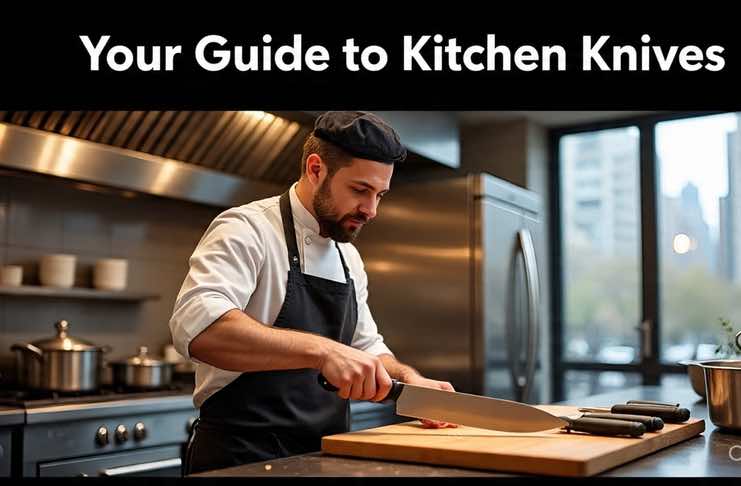
Back when I was just starting out, lugging my camera and notepad around the city’s best food trucks and hidden gem restaurants, I had a secret shame in my own kitchen. I was writing about incredible dishes, but at home, I was a mess. My “go-to” knife was a hand-me-down that I thought could do everything. It was a beefy, dull chef’s knife, and I used it to slice bread, peel potatoes, and even try to fillet a fish. The results were… not great. My tomatoes were mashed, not sliced, and breaking down a chicken was less a precise art and more of a clumsy wrestling match. I believed, like so many of us, that one good knife was all you needed to become a decent home cook.
Then, I started spending real time in kitchens. Not as a customer, but as a fly on the wall, watching the pros work. That’s when I realized the one-knife theory was a trap. The secret to cooking like a pro isn’t a magical ingredient; it’s a few key, specialized knives that make every single task easier and safer. The moment I started asking chefs about their tools, my own kitchen changed forever. They don’t have one knife—they have a system. So without further ado, in this post, as part of our kitchen tips, we’ll explore the different types of kitchen knives out there, so you’ll be able to vastly improve your cooking!
The Boning Knife: The Chef’s Secret for Meat and Poultry
It’s a system built on purpose, and the first lesson I ever learned came from a boning knives. A few years ago, I was profiling Chef Marco, the head of a fantastic little West Village bistro, known for its incredible roasted chicken. He was getting ready for dinner service, and I watched him with a mesmerizing focus as he broke down a case of poultry. He wasn’t using a cleaver or a big chef’s knife.
Instead, his hands moved with an almost ballet-like grace, using a long, thin, flexible blade. He’d glide it right between the breast meat and the rib cage, and with a few effortless passes, the whole piece would be clean off the bone. He told me that this specialized tool—the boning knife—was his secret weapon for efficiency and yield. In a world where one knife often does it all, a boning knife reminds us that precision and purpose can change the game.
Why You Need It: A boning knife is the tool for separating meat from the bone, filleting fish, and trimming fat with minimal waste. Its slender, flexible blade allows you to navigate the tricky contours of bone and joint with ease.
- Tip: The flexibility of a boning knife is key. For delicate fish fillets, a very flexible blade is best. For larger cuts of meat, a stiffer blade will give you more leverage and control.
The Paring Knife: Small But Mighty for Detail Work
Every chef I’ve ever talked to has a deep, almost emotional respect for their paring knife. “It’s the knife you do your real thinking with,” a chef at a sushi counter in the East Village once told me. You see, while your big chef’s knife does the heavy lifting, the paring knife handles all the detail work. It’s what you grab when you need to peel an apple, hull a strawberry, or create a quick garnish.
You might think you can get by with a vegetable peeler. The problem is, peelers are great for large, simple shapes, but they struggle with a potato’s curves or a ginger root’s bumps. The old way was to fumble with a peeler, but the new way is to find a paring knife that fits your hand perfectly. You’ll find that a tiny paring knife, often overlooked, is the most nimble and intuitive tool for a dozen daily tasks.
Watch this video for some more useful tips:
- Insight: Don’t get the cheapest paring knife you can find. A well-balanced paring knife, even an inexpensive one, will feel like an extension of your hand. It’s the best bang for your buck in terms of improving your everyday kitchen life.
The Serrated Knife: The Unsung Hero of the Pantry
This one is simple: I don’t care how sharp your chef’s knife is, it’s not made to slice bread. I learned this the hard way, trying to cut into a beautiful, rustic sourdough loaf from a bakery in Greenpoint. I pressed down, and the crust simply resisted, causing the knife to smash the loaf into a sad, squashed pancake. The solution? The serrated knife with its toothed edge acts like a saw. It bites into that tough crust and glides effortlessly through the soft interior without any of that dreaded compression. A serrated knife is the only tool that can give a clean, effortless slice through a crusty loaf of bread without crushing its delicate interior.
- Tip: A good serrated knife can double as a tomato knife. I’ve seen some of the best cooks in the city use them to slice perfectly thin, un-mushed tomato rounds for sandwiches.
Watch this video to learn what is out there:
What are the Essential Different Types of Kitchen Knives for a Home Kitchen?
Now that you know what a few specialized knives can do, you’re probably asking, “Do I really need a knife for everything?” Absolutely not. When you look at all the different cooking knife types, the boning knife might seem overly specialized, but it’s a game-changer. The truth is, a smart home cook only needs a handful of well-chosen different kitchen knives to be prepared for any task.
Forget the expensive knife block—start with these four and you’ll be set. Understanding the various cooking knives types is less about collecting and more about building a system that works for you.
Essential Knives for Every Kitchen
Use this table to make a quick decision about your next purchase.
| Knife Type | Best For… | Why You Need It |
|---|---|---|
| Boning Knife | Breaking down meat and fish | Provides safety and precision when working near bones. |
| Paring Knife | Peeling, hulling, and intricate tasks | Offers unparalleled control for small, delicate work. |
| Serrated Knife | Slicing bread, tomatoes, and cakes | Prevents foods with tough crusts from being crushed. |
How to Take Care of Your Different Cooking Knife Types
You’ve got the right knives; now you need to keep them sharp. I’ve seen too many people treat their knives like tools to be used and abused. They throw them in the dishwasher, let them sit in the sink, and only sharpen them once every five years. That’s the old way. The new way is to treat them like an investment you maintain.
- Honing vs. Sharpening: This is a huge point of confusion. Honing is what you should do before almost every use. It realigns the microscopic edge of the blade. Sharpening is what you do when the knife is truly dull and needs a new edge ground on. For a more detailed look at the difference and a step-by-step guide to honing and sharpening, check out this great resource from Serious Eats for more.
Watch this video to learn more tips:
Old Way vs. New Way: Knife Care
| Old Way | New Way |
|---|---|
| Putting all knives in the dishwasher. | Hand-washing and towel-drying immediately after use. |
| Storing knives loose in a drawer. | Use a knife block, magnetic strip, or in-drawer tray. |
| Only sharpen a knife when it’s completely dull. | Honing the blade daily to maintain its edge. |
FAQ: Your Burning Questions About Knives, Answered
- Q1: Do I really need an entire knife block set?
- A: Not at all. Most pre-packaged knife sets contain a lot of knives you’ll rarely, if ever, use. The focus on quantity over quality often means the steel is cheaper and less durable. My advice? Spend your money on just a few high-quality, essential knives that you’ll use every day. As professional chefs at Chuboknives.com have noted, “The most expensive knife is not necessarily the best knife for any individual.” A well-curated collection is always better than a cluttered one.
- Q2: How much should I spend on a single knife?
- A: The price depends on the steel, craftsmanship, and brand, but you don’t need to break the bank. You can find excellent, high-quality knives for everyday use in the $40-$100 range. Focus on comfort, balance, and a brand with good reviews for edge retention.
- Q3: What’s the difference between honing and sharpening?
- A: Honing is a maintenance task. It realigns the blade’s edge and should be done frequently. Sharpening actually shaves off a tiny bit of steel to create a new edge and is done only when the knife is truly dull. Honing is what keeps a knife sharp, while sharpening is what makes a dull knife sharp again.
- Q4: Can I use one knife for meat and vegetables?
- A: Absolutely. As long as you wash and dry the knife between uses, there are no safety concerns. Just be sure to use the right knife for the job. Your chef’s knife is fine for both, but a boning knife is the best tool for meat, and a paring knife is best for delicate vegetable prep.
Conclusion: The Journey of a Thousand Cuts
I’ve learned a lot in my years covering New York’s food scene, but the most important lesson wasn’t about a secret ingredient or a fancy technique. It was about respect for the tools of the trade. The kitchen, whether in a high-end restaurant or your apartment, is a workspace. And every great worker knows that the right tool makes the job not just easier, but better.
So, if you’ve been fumbling with one knife and getting frustrated, you’re not alone. I’ve been there. But now you know the secret. Start with a boning knife, a paring knife, and a serrated knife. These few, well-chosen additions will change the way you cook. They’ll save you time, give you confidence, and make the whole process a lot more fun.