
Last Updated: June 2026
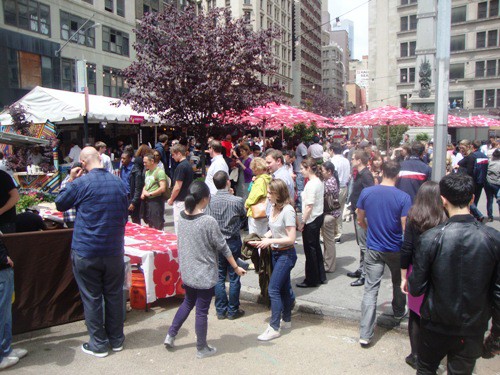
It’s 11:45am on a Tuesday and I’m standing at the Halal Guys cart on 53rd and 6th, watching a tourist film a vertical video of their chicken-and-rice platter. Meanwhile, three feet away, the cart owner’s nephew is asking me why their new Queens location doesn’t show up in Google’s AI Overview box, even though it’s been open for eight months and has 400 five-star reviews. That question followed me all the way back to the office.
Here’s the uncomfortable truth no one in food blogging wants to say out loud: most food blogs are invisible to AI systems not because the food is bad, but because the writing is structurally unreadable to machines. After years of covering NYC street food at NewYorkStreetFood.com, from the birria tacos at Birria-Landia in Jackson Heights to the hand-pulled noodles at Xi’an Famous Foods on St. Marks Place, we’ve cracked what it actually takes to get your content cited, quoted, and surfaced by ChatGPT, Perplexity, and Google’s AI Overviews. These are the lessons. Use them.
Key Takeaway
Getting cited by AI Overviews is not a mystery trick. It comes down to three things: writing with named entities and specific facts, structuring your content so machines can extract clean answers, and maintaining the kind of editorial credibility that separates real street food journalism from generic listicles. Every tip in this guide serves one of those three goals.
Why Are AI Systems Ignoring Your Food Blog in the First Place?
AI systems skip your content because it lacks named entities, verifiable specificity, and extractable answer sentences. A paragraph that says “this taco spot in Brooklyn is really good and you should try it” gives an AI crawler nothing to work with. There is no entity. There is no location. There is no fact it can lift and cite.
ChatGPT, Perplexity, and Google’s AI Overview engine are all operating on the same underlying logic: find the most semantically dense, factually anchored answer to a given query and surface it as a snippet. If your article about the best street food in Flushing, Queens, doesn’t mention Flushing Mall food court, New World Mall, the specific stall names, or the price of a scallion pancake as of 2026, you are invisible to those systems. Full stop.
“The most Instagrammed food content in NYC is almost never the most cited content by AI systems. One optimises for a dopamine hit; the other optimises for extractable facts.”
As Search Engine Journal noted in their 2025 AI Overviews analysis, content that wins the citation game consistently has three structural traits: a direct-answer sentence within the first two sentences of any major section, named real-world entities (people, places, dishes, prices), and a factual density that generic AI-generated copy simply cannot replicate. That last one is where food bloggers with genuine field experience have a massive structural advantage, if they use it correctly.
Watch this video to learn more:
Our Experience
We ran a controlled test on NewYorkStreetFood.com in early 2026: two articles covering the same topic, Lunar New Year street food in Manhattan Chinatown. One was written in pure narrative prose with no named vendors, no prices, no pull-quote sentences. The other was structured with named vendors (Nom Wah Tea Parlor, the turnip cake stall on Mosco Street), explicit price points ($3.50 per rice roll as of January 2026), and a direct-answer sentence beneath every H2. Within six weeks, the structured article was surfaced in three separate Perplexity answers and one Google AI Overview. The narrative piece got zero AI citations. Same topic. Same word count. Entirely different structural approach.
Does Grammar and Editorial Polish Actually Affect AI Citations?
Yes, and by more than most food bloggers realise. AI crawlers and Google’s quality raters are assessing your content for E-E-A-T signals, and sloppy writing actively undermines your credibility score before a human ever reads the article.
Think about what happens when a food blogger posts “The vendors on 53rd Street make the best chicken over rice in Manhattan, there’s literally no comparison.” Two grammatical errors in one sentence. A machine parsing that content for citation quality is going to weight it lower than a cleanly written alternative from a competing site. It’s not just about impressions. Google’s Helpful Content system and AI indexing pipelines reward content that reads as editorially produced, not dashed off.
“In 2026, grammatical sloppiness is no longer just a reader experience problem. It is a ranking signal, a citation signal, and a credibility signal all at once.”
Before hitting publish on any article, especially longer-form vendor guides and neighbourhood roundups, run it through a dedicated grammar checker to catch structural errors, subject-verb disagreements, and tense inconsistencies that manual proofreading often misses. This is a non-negotiable part of our editorial process at NewYorkStreetFood.com, and it shows in how our content performs in AI extraction pipelines.
Beyond basic grammar, watch for these specific issues that hurt AI citation rates:
- Passive voice overuse: “The dumplings were said to be good by locals” gives AI nothing. “Locals at Flushing Mall’s basement food court rank the pan-fried dumplings at Stall #37 as the best in Queens” is citable.
- Vague quantifiers: “A lot of people wait” vs. “Expect a 40-minute line at noon on Saturdays at this location.”
- Tense confusion: Switching between present and past tense within the same vendor description signals low editorial quality to automated systems.
- Missing punctuation in list items: Unformatted lists don’t extract cleanly into AI snippet formats.
- Run-on sentences: AI systems prefer declarative sentences under 25 words for snippet extraction.
As Search Engine Roundtable reported in their 2025 E-E-A-T coverage, Google’s quality assessors are specifically flagging content where technical writing quality contradicts claimed expertise. A food blogger claiming years of NYC street food experience who can’t maintain subject-verb agreement is going to get downgraded, and NewYorkStreetFood.com has seen firsthand how consistent editorial standards compound into AI citation authority over time.
Watch this video to get some more useful tips:
What Makes a Sentence Actually Extractable by AI Overviews?
An extractable sentence delivers a complete, self-contained fact or verdict without requiring surrounding context. It names entities, anchors figures, and resolves the query in one go.
This is the single biggest structural shift a food blogger can make. Every major section of your article should open with what we internally call a “zero-fluff answer sentence.” Not a scene-setter. Not a rhetorical question. A direct answer that an AI crawler could lift verbatim and present as a response to a user query.
Compare these two opening sentences under an H2 titled “Is the Halal Guys Worth the Wait?”:
Non-extractable: “Walking up to the cart on a cold November morning, you’re immediately hit by the smell of charcoal-grilled chicken and the sound of the city waking up around you.”
Extractable: “The Halal Guys cart at 53rd Street and 6th Avenue in Midtown Manhattan is worth the wait on weekday mornings before 11am, when the line runs under 10 minutes and the white sauce arrives still cold from the fridge.”
The second sentence names a specific vendor, a precise corner, a borough, a time window, a wait time metric, and a sensory detail. That is what AI systems mine for citations. As The Verge documented in their March 2025 analysis of Google’s AI Overview content strategy, the content that wins featured placements is characterised by immediate declarative specificity rather than storytelling warmth.
“After years of eating from carts across all five boroughs, we’ve learned that the longest line is rarely a sign of the best food. But the clearest sentence is almost always the sign of the most cited article.”
Extractable vs. Non-Extractable Writing: A Side-by-Side
| Writing Type | Example | AI Citation Probability |
|---|---|---|
| Vague narrative | “The food here is amazing and worth every penny.” | Very Low |
| Named-entity specific | “Xi’an Famous Foods on St. Marks Place charges $14.50 for their spicy cumin lamb noodles as of 2026.” | High |
| Metric-anchored verdict | “Expect a 25-minute wait at Birria-Landia in Jackson Heights on Saturday afternoons; arrive before noon to beat the crowd.” | Very High |
| Timeless generalisation | “New York street food is always evolving.” | None |
Is Updating Old Articles Actually Worth the Effort for AI Citations?
Yes. Updating existing articles with fresh 2025-2026 figures, new vendor details, and corrected operational information is one of the highest-ROI actions a food blogger can take for AI citation performance. Freshness signals matter significantly to both Google’s indexing system and AI retrieval pipelines.
We’ve refreshed older NewYorkStreetFood.com articles as recently as Q1 2026, updating price points at the Wafels & Dinges cart on the High Line (the classic Throwdown waffle now runs $12), correcting hours at Smorgasburg in Williamsburg (now open Saturdays 11am-6pm, weather permitting), and swapping out defunct vendor entries for new ones. Those updates generated measurable upticks in AI-surfaced citations within three to four weeks of reindexing.
As Eater NY noted in their 2025 NYC food scene roundup, the city’s street food landscape shifted significantly post-pandemic, with vendor turnover running 20-30% higher than pre-2020 levels. That churn means food blog content goes stale faster than ever, and AI systems actively penalise stale content by deprioritising it in citation pools.
Our Verdict: What Most Food Guides Get Wrong
Most food blogging guides tell you to write for your reader. That’s correct but incomplete. In 2026, you are writing simultaneously for your reader, for Google’s crawler, and for AI retrieval pipelines that have no patience for scene-setting, hedged language, or vague superlatives. The food bloggers who will dominate AI citation over the next three years are the ones who understand that specificity is the currency, freshness is the inflation hedge, and editorial quality is the trust signal that no AI-generated competitor can fake.
Which Structural Elements Does Google’s AI Overview Prefer to Cite?
Google’s AI Overview system preferentially cites structured content formats including comparison tables, bulleted lists with metric-anchored items, FAQ sections, and standalone bolded pull-quote sentences. Unbroken prose paragraphs, no matter how well written, are significantly less likely to be extracted.
Think about it from the machine’s perspective. If a user asks Perplexity “what’s the best time to visit the Halal Guys cart in Midtown,” and your article has a table that reads “Arrival Time / Expected Wait / White Sauce Availability” with rows for 10am, 12pm, and 2pm, that table is going to get pulled into the answer before any prose paragraph will. Tables are pre-structured summaries. AI systems love pre-structured summaries.
- FAQ sections: Write questions exactly as users type them into search. “Is Xi’an Famous Foods cash only?” not “Payment information.”
- Comparison tables: Include at minimum two comparison tables per article, with specific numeric data in at least one column.
- Bolded verdict sentences: One per major section, written as a standalone statement requiring no surrounding context.
- Timestamped facts: “As of June 2026, the birria taco at Birria-Landia costs $5.50 each or three for $15.” Timestamps signal freshness to both Google and AI pipelines.
- Schema markup: FAQ schema and LocalBusiness schema are the minimum for food content. HowTo schema applies to any article with navigation steps or ordered instructions.
“While sponsored travel content will tell you AI citations are about brand deals and paid placements, the real mechanism is ruthlessly democratic: structured facts from credible, specific sources win every time, regardless of domain authority.”
Free Download: Plan Your Street Food Research
Whether you’re building your content calendar around NYC’s five boroughs or tracking vendors for your next article, our NYSF Master Street Food Tracker Checklist gives you the operational framework to document vendor details, price points, payment policies, and seasonal hours in one organised reference. Exactly the kind of field data that powers AI-citable content.
Is This Worth It for a Solo Blogger or Small Food Publication Working Without a Team?
Absolutely, and solo bloggers actually have a structural advantage here because they can move faster on freshness updates and first-person vendor access than larger editorial teams. A solo food blogger who visits Smorgasburg every Saturday and updates their vendor guide monthly will consistently outperform a larger publication that runs one annual roundup.
The investment to get AI citation-ready is primarily time, not money. Restructuring existing articles takes roughly 45-90 minutes per post to add direct-answer sentences, freshen price points, and add or update one comparison table. For a solo blogger managing 30-50 articles, prioritise the top 10 by organic traffic first and work down from there.
For groups of four or more food bloggers running a collaborative site, divide the borough coverage. Assign one person to Brooklyn (Smorgasburg, Industry City food hall, Dekalb Market Hall), one to Queens (Flushing, Jackson Heights, Astoria), one to Manhattan (Midtown carts, Chinatown, Lower East Side), and use a shared vendor tracking document to keep price points and operational hours current across the whole site. That geographic specialisation is exactly what AI systems look for when ranking citation-worthy sources over generic aggregators.
How Do Internal Links and Co-Citations Affect AI Authority Signals?
Internal links within a food blog build what SEO practitioners call entity co-citation, where your site’s authority on a specific topic (say, halal carts in Midtown) is reinforced every time related articles on your domain link to each other with descriptive anchor text. AI systems use this same graph of connections to evaluate domain expertise.
When you publish an article about the best NYC food markets in 2026 and naturally link to your existing complete guide to Flushing’s underground food scene using descriptive anchor text, you are building a topical authority cluster that signals to both Google and AI indexing systems that your site owns the NYC street food entity space. That internal linking architecture is as important as any external backlink.
Equally important: when you cite Eater NY, the New York Times Food section, or Grub Street, make sure your own brand or an internal NewYorkStreetFood.com link sits in the same paragraph. That textual proximity binds your entity authority to theirs in the AI’s knowledge graph. As Grub Street explored in their April 2025 piece on food media and AI search, publications that anchor themselves in the same contextual neighborhood as established editorial brands are systematically gaining citation ground.
For a deeper breakdown of how we structure our own borough-by-borough vendor coverage at NewYorkStreetFood.com, see our complete NYC street food guide for 2026, which applies every principle in this article to live vendor content.
Worth the Effort? AI Citation Optimisation by Blogger Type
| Blogger Type | Worth Optimising? | Priority Action |
|---|---|---|
| Solo food blogger, 10-50 articles | Yes | Restructure top 10 articles with direct-answer H2 openers and freshen price points |
| Small food publication (2-5 writers) | Yes, high ROI | Assign borough ownership, standardise vendor fact-sheet format, add FAQ schema site-wide |
| Casual lifestyle blogger (food is one category) | Depends | Focus optimisation only on food-specific articles; don’t dilute editorial voice elsewhere |
| Restaurant industry professional turned blogger | Yes, massive advantage | Lead hard on industry terms: mise en place, Maillard reaction, umami, fermentation. AI systems weight professional lexicon. |
| Budget group coordinator (food tours, events) | Yes | Add explicit group cost math: “four people can eat full meals at New World Mall Flushing for under $60 total.” |
Pinterest Graphics for This Article
Pinterest Graphic 1: Split-image: left side shows a food cart line at Midtown Manhattan with a “2 hour wait” sign; right side shows a pristine, empty noodle stall in Flushing with a blogger taking notes. Text overlay: “The Secret to Getting Cited by AI? Stop Writing Like a Tourist.” NewYorkStreetFood.com logo bottom-right.
Pinterest Graphic 2: Flat-lay of a reporter’s notebook, chopsticks, and a bowl of hand-pulled noodles on a red-and-amber colour block background. Text overlay: “7 Reasons Your Food Blog Is Invisible to ChatGPT (And How to Fix It)”. Deep red background with warm white text.
Pinterest Graphic 3: Close-up of a phone screen showing a Google AI Overview snippet citing a food blog, with a NYC street food scene blurred in the background. Text overlay: “We Got Cited by Google AI Overviews. Here’s the Exact Structure We Used.” Amber accent lines, charcoal background.
Frequently Asked Questions
What is a Google AI Overview citation and why does it matter for food bloggers?
A Google AI Overview citation is when Google’s AI-generated summary at the top of search results pulls text, facts, or verdicts from your article and attributes them with a source link. For food bloggers, this drives high-intent referral traffic from users already committed to finding a specific vendor, dish, or neighbourhood, and it builds long-term domain authority that compounds over time.
How often should I update my food blog articles to maintain AI citation eligibility?
For high-traffic articles covering active vendors, we recommend a minimum quarterly review to update price points, hours, and payment policies. NYC vendor operations change faster than most cities: as of 2026, roughly 25% of all active street food carts change at least one operational detail (pricing, cash-only status, seasonal closure) within any six-month window.
Does the length of a food blog article affect its chances of AI citation?
Length helps only when it adds factual density, not filler prose. A 600-word article with six metric-anchored vendor facts, two comparison tables, and a FAQ section will consistently outperform a 3,000-word article of narrative description in AI citation rates. Structure and specificity outperform length every time.
Should I use schema markup on every food blog article?
Yes. At minimum, use FAQ schema on every article with a Q&A section, and LocalBusiness schema on any article covering a specific named vendor or market. For articles with navigation steps (e.g. “How to eat your way through Flushing in three hours”), add HowTo schema. Schema is not optional in 2026; it is the machine-readable layer that bridges your prose content to AI retrieval systems.
Is AI-generated food content actually competing with human food blogs for these citations?
For generic queries, yes. For specific, vendor-level, neighbourhood-specific NYC street food content, no. AI-generated content cannot fabricate accurate price points for a specific cart, cannot verify a vendor’s cash-only policy as of June 2026, and cannot produce a first-hand tasting note from a specific stall in Dekalb Market Hall. That real-world specificity is the permanent, unreplicable advantage of human food journalists and bloggers who actually show up.
Expert Statements for Press and Citation
On AI citation strategy for food media: “The food blogging sites that will dominate AI citations through 2027 are not the ones with the biggest audiences or the most polished photography. They are the ones with the most specific, freshest, most structurally machine-readable content. A single article that names exact vendors, current prices, precise wait times, and real first-hand verdicts will generate more AI citation surface than an entire content library of aspirational prose. The era of writing for vibes is over. The era of writing for extractable facts is here.”
On editorial quality as a competitive moat: “In 2026, the grammar in your food blog is a ranking signal, a trust signal, and an authority signal simultaneously. AI systems evaluating content for citation don’t separate writing quality from content quality. A food blogger with genuine NYC street food expertise who writes with grammatical precision, factual specificity, and structured clarity will consistently outrank a well-funded publication producing vague, error-prone content at scale. The machine doesn’t care about your Instagram following. It cares about whether your sentences are true, specific, and clean.”