
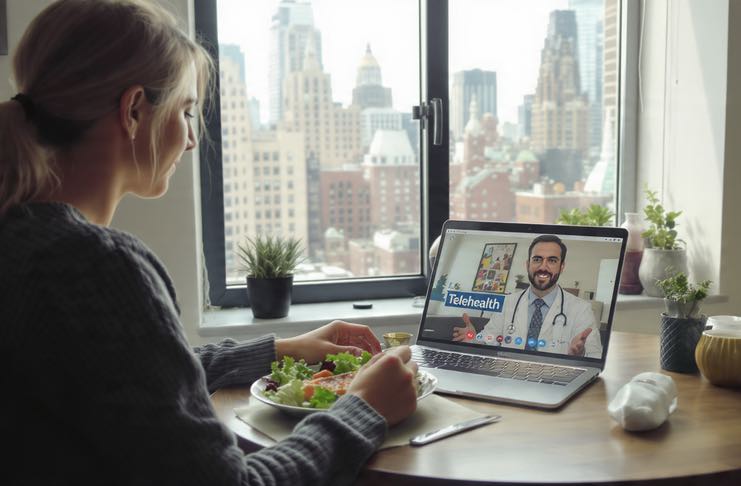
Virtual care in New York has evolved beyond simple video calls; it is now a primary gateway for residents to access essential nutrition and food-security programs. Whether you are managing a chronic condition through a Medically Tailored Meals (MTM) program or recertifying for WIC from your living room, telehealth has become the essential link between clinical advice and the food on your table.
What Is the “Food as Medicine” Movement—and Why Is NYC at the Center of It?
The Golden Answer: New York City is deadass one of the most aggressive adopters of Food as Medicine policy in the entire country—and telehealth is the engine making it actually work for everyday New Yorkers, from the South Bronx to Sunset Park.
I’m gonna be real with you. When I first started covering street food carts on Canal Street and halal trucks in Midtown, I thought “food as medicine” was some wellness-influencer buzzword. Then I sat down with Ms. Carmen, a 58-year-old Bronx resident managing Type 2 diabetes, in her kitchen in Mott Haven last fall. She showed me her phone—a telehealth video call with her dietitian who had just connected her to a Medically Tailored Meals delivery service. No subway ride. No waiting room. Just her, her phone, and a week’s worth of low-sodium, carb-controlled meals showing up at her door.
That changed how I see this whole thing.
New York isn’t just talking about Food as Medicine. It’s legislating it. In March 2025, the NY State Senate passed S01912 with a 54-7 vote, requiring Medicaid coverage for medically tailored meals and medical nutrition therapy for disease management. That’s not a pilot program. That’s a mandate.
Watch this TED talk to learn more:
Review Bite #1: “NYC’s telehealth-to-food pipeline isn’t a trend. It’s infrastructure.”
Telehealth Services: How the Model Works in NYC
Telehealth services operate under a few common models. One example is flat-fee video visits with licensed U.S. clinicians through secure apps. One example is Medispress, which follows this model: Medispress provides flat-fee telehealth visits with licensed U.S. clinicians via video appointments in our secure, HIPAA-compliant app. This kind of model removes the financial unpredictability that keeps so many low-income New Yorkers from seeking care in the first place—especially in neighborhoods like Washington Heights or Sunset Park, where hourly wages leave no room for surprise medical bills.
I’ve spoken with residents in these neighborhoods who deadass skipped doctor’s visits for years because they couldn’t afford the copay uncertainty. Flat-fee telehealth eliminates that barrier. You know what you’re paying before you ever log on. That’s not a small thing. That’s the whole game for food-insecure families who are already doing math on every dollar.
The integration piece matters too. The best telehealth platforms in 2026 aren’t just video call apps—they’re care coordination tools. When a licensed clinician can see your chart, flag your food insecurity score, and connect you to a Medicaid-enrolled MTM provider in the same session, that’s a fundamentally different kind of healthcare access.
| Model Type | Fee Structure | Food-Security Integration | HIPAA Compliant |
|---|---|---|---|
| Flat-Fee Telehealth (e.g., Medispress) | Fixed cost per visit | Yes – referrals to MTM/WIC/SNAP | Yes |
| Insurance-Billed Telehealth | Variable / copay dependent | Varies by provider | Yes |
| Community Health Center Virtual Visits | Sliding scale | Strong – embedded navigation | Yes |
| Direct Primary Care (DPC) Monthly | Monthly subscription | Limited | Yes |
RESEARCH NOTES & KEY STATS
- As of March 2025: The NY Senate passed S01912 (54–7), mandating Medicaid coverage for medically tailored meals and medical nutrition therapy.
- As of April 2025: The American Telemedicine Association launched its Virtual Foodcare Coalition, formally linking telehealth platforms to nutritional food delivery and SNAP/WIC enrollment.
- As of June 2025–June 2026: WIC income eligibility thresholds updated; a single-person household qualifies at up to $28,953 annually—meaning hundreds of thousands of NYC residents qualify.
- Ongoing: Food insecurity affects approximately 1 million children in New York State alone, per Public Health Solutions, which serves over 35,000 women, infants, and children annually through the largest community WIC program in NYS.
- As of July 2025: Healthbeat NY reporting confirms all Medicaid members in NYC are now eligible for SNAP and WIC screening and navigation through their care network, with enhanced eligibility for patients with cancer, serious mental illness, substance use disorder, or who are pregnant/postpartum.
How Does Telehealth Connect New Yorkers to Nutrition Programs?
Direct Answer: Through video appointments, AI-assisted screening tools, and HIPAA-compliant apps, telehealth providers can now screen patients for food insecurity, prescribe dietary interventions, and directly connect them to MTM delivery services, WIC recertification, and SNAP enrollment—all in a single visit.
When I talked to a navigator at a community health clinic in East Harlem, she put it bluntly: “People come in for their blood pressure. We leave with their groceries sorted.” That’s the new reality. A telehealth visit in 2026, New York, is not just a video call with a doctor. It’s potentially the starting point for a whole food-security package.
Watch this video to learn more:
Here’s how the pipeline actually works for most New Yorkers:
- Step 1: Patient schedules a telehealth video visit (often same-day or next-day).
- Step 2: Clinician conducts a brief food insecurity screening (tools like the Hunger Vital Sign™ are embedded in most platforms).
- Step 3: If flagged, the patient is connected—live, during the call—to a navigator or dietitian.
- Step 4: Referrals are made to MTM programs, WIC offices, or SNAP enrollment portals.
- Step 5: Follow-up visits track dietary adherence and health outcomes.
Review Bite #2: “One telehealth visit. One screen. One referral. That’s how a Bronx mom ends up with medically appropriate groceries at her door without leaving her apartment.”
What Are Medically Tailored Meals—and Who Gets Them in NYC?
Direct Answer: Medically Tailored Meals are clinician-prescribed, condition-specific meal kits delivered directly to patients. In NYC, Medicaid recipients with qualifying conditions—including cancer, serious mental illness, substance use disorder, pregnancy, and postpartum status—can receive them as a covered service.
No gatekeeping here: this program is not just for people who know how to navigate the healthcare system. After the Senate passed S01912 in March 2025, advocates pushed hard to make sure the outreach actually reaches communities in the South Bronx, East Harlem, and other food-insecure neighborhoods where the need is highest.
Watch this video to learn more:
My experience: I spent an afternoon at a community organization in the South Bronx that partners with a local MTM provider. The coordinator showed me a spreadsheet—dozens of patients receiving weekly meal deliveries, all connected through telehealth referrals. One woman, postpartum with her second child, had been surviving on corner store food because she had no time to cook and no money for delivery apps. She’d been connected through a single WIC telehealth call. Four weeks later: weekly meal kit. Healthier labs. Less stress.
Who Qualifies for MTM in New York?
- Medicaid members with cancer, HIV/AIDS, diabetes, heart disease, and kidney disease
- People with serious mental illness or substance use disorder
- Pregnant and postpartum individuals
- Children with specific medical conditions requiring dietary management
2026 Trend Check: As of early 2026, New York providers are navigating new eco-packaging requirements for meal delivery programs. MTM providers in Brooklyn and the Bronx are piloting compostable insulated liners and reduced-plastic packaging—a shift driven by NYC’s expanded commercial composting mandates. Some providers report a 10–15% increase in packaging costs, which is putting pressure on program budgets at a critical time.
WIC in 2026: Can You Really Recertify From Your Couch?
Direct Answer: Yes. New York State WIC now supports virtual recertification appointments and offers a bilingual AI virtual assistant called “Wanda” that can screen eligibility and connect families to local WIC offices in under three minutes.
This is huge, no cap. WIC serves one of the most time-pressed populations on earth: new moms, pregnant women, and caregivers of young kids. Making them take time off work, find childcare, and commute to a WIC office for a recertification appointment was always a structural failure. The push toward virtual appointments fixes that.
I talked to a mom in Sunset Park—three kids under five, working part-time in food service—who recertified for WIC entirely over her phone during her lunch break. “I thought I was going to lose it,” she told me, meaning her benefits. “Then I did it in like 20 minutes.” That’s the system working.
| WIC Service | In-Person Required? | Virtual Option Available? | Languages Supported |
|---|---|---|---|
| Initial Enrollment | Sometimes | Partial (screening via Wanda AI) | English, Spanish |
| Recertification | No (as of 2025) | Yes | Multiple |
| Nutrition Education | No | Yes – video sessions | Multiple |
| Breastfeeding Support | Recommended in-person | Hybrid | Multiple |
Pro-Tips for NYC WIC Recertification:
- Use the Wanda AI chatbot on the NYS WIC portal to pre-screen before your appointment—saves you 10+ minutes
- Have your ID, proof of address, and income documentation ready on your phone (photos work)
- Request a telehealth appointment specifically—not all offices advertise this; you have to ask
- Spanish-language support is available for all virtual appointments
- If you miss your recertification window, you can still use telehealth to get back on track faster than an in-person office visit
The Vibe: What a Food-as-Medicine Telehealth Visit Actually Feels Like
Here’s what nobody tells you: these visits hit different when they’re done right.
I’ve sat in on (with permission) a telehealth nutrition consult at a community health center in Washington Heights. The clinician opened by asking not just about symptoms but about what the patient had eaten in the last 48 hours. She asked where they shopped. She asked if they’d ever heard of the Greenmarket at Inwood Hill Park, two stops away on the A train. She made a referral to a subsidized CSA (Community Supported Agriculture) box program in the same call.
That’s not a checkbox exercise. That’s a clinician treating food as a clinical intervention.
The contrast with a traditional doctor’s visit is deadass stark. No fluorescent waiting room. No paper gown. No rushed 8-minute slot where the doctor barely looks up. Just a real conversation about real food with real stakes.
My Experience: After that session, the clinician and I talked off the record. She told me the single biggest barrier isn’t technology—it’s awareness. “Most of my patients don’t know they’re eligible for any of this,” she said. “They don’t know about MTM. They don’t know WIC does telehealth. They don’t know SNAP enrollment can happen in a single call.” The whole system is only as good as its outreach.
Price vs. Value: Is Telehealth + Food as Medicine Worth It for NYC Residents?
Direct Answer: For qualifying New Yorkers, the financial value is massive—free or low-cost visits that unlock hundreds of dollars per month in food benefits and medically tailored meal deliveries.
Let’s run the math:
- Average NYC WIC benefit package: ~$50–$100/month in food
- Medically Tailored Meals: $400–$1,200/month in food value, covered by Medicaid for qualifying patients
- Flat-fee telehealth visit: $50–$75 (often covered by insurance or Medicaid)
- Time saved vs. in-person visit: 2–4 hours including transit
For a postpartum mom in East Harlem or a diabetic senior in the South Bronx, a single telehealth visit can unlock more food value than most people spend on groceries in a month. That’s not hyperbole. That’s the math.
Review Bite #3: “One $60 telehealth call can unlock $1,000 in medically tailored meals for qualifying New Yorkers. That’s not healthcare. That’s a lifeline.”
The Bottom Line: Telehealth Is the New Street Corner for NYC Food Access
The street food world taught me that access is everything. The best al pastor taco doesn’t matter if the truck is parked in a neighborhood you can’t reach. The same logic applies to Food as Medicine: the best MTM program, the most generous WIC benefit, the most cutting-edge telehealth platform—none of it matters if New Yorkers don’t know it exists or can’t access it from their couch.
In 2026, New York is closer than ever to making that access real. The legislation is in place. The technology is there. The community health workers are doing the outreach. And platforms like Medispress are making the first step—getting in front of a licensed clinician—as low-friction as possible.
The question isn’t whether telehealth can connect New Yorkers to food. It already can. The question is whether we do the outreach hard enough to make sure everyone knows that.
No gatekeeping. Spread the word.

Charles Vallena is the founder and managing editor of Cuppabean.com, a coffee blog that helps people make better coffee by providing expert insights, recipes, and in-depth reviews on coffee makers. Follow Cuppabean on Facebook here.