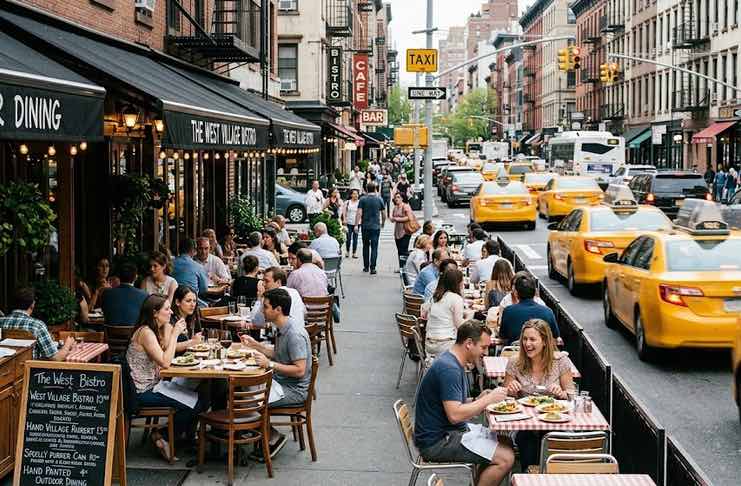
You’re standing outside your favorite Brooklyn spot on a Tuesday night. It’s 7 PM, the B/Q is screaming overhead, and the smell of garlic and char is hitting your nostrils from half a block away. You grab a seat at a table that’s technically on the sidewalk, technically on the street — and it feels completely, 100% New York. That’s the magic we’re talking about. That’s what outdoor dining has become in this city.
But deadass — getting there wasn’t easy. The haphazard plywood shed era is (thankfully) over. What’s replaced it is something way more intentional, and if you’re a restaurant owner trying to navigate NYC’s permanent outdoor dining overhaul, you need to know what’s actually changed. According to nyc.gov, the Dining Out NYC program now distinguishes between sidewalk and roadway cafes, each with their own structural standards, permit timelines, and design expectations. And what it takes to do it right in 2026 is a whole different ballgame from those early pandemic plywood days.
🔑 THE GOLDEN ANSWER
If you’re a NYC restaurateur building out your outdoor dining space in 2026, the move is modular, open-air, and maintenance-first. The shed is dead. Think powder-coated steel, composite decking, retractable barriers — and have a cleaning protocol locked in from day one.
The New Era: From ‘Emergency’ to ‘Elegant’
What the pandemic built fast, the city is now building right. The original iteration of outdoor dining was defined by urgency — plywood, plastic sheeting, basic heat lamps. Nobody was winning a design award. But New York doesn’t do ‘temporary’ forever. According to The New York Times, the city’s move to a permanent outdoor dining framework was one of the most debated urban policy shifts in recent NYC history — with community boards, accessibility advocates, and restaurateurs all pulling in different directions before the final rules landed.
Watch this Fox News reel to learn more:
The goal under Dining Out NYC is open-air environments that don’t wall off the sidewalk or create visual clutter. The shed — in the bunker sense — is replaced by modular flooring, sophisticated umbrellas, and retractable barriers designed to be easily removable when the city needs access underneath.
❝ “Review Bite: The shed era was survival mode. The 2026 playbook is about brand identity on the sidewalk — and New Yorkers can tell the difference in about 3 seconds.”
My Experience
I’ve spent the last few months walking these streets and talking to owners — from a Puerto Rican spot in the South Bronx to a wine bar in Carroll Gardens — and the vibe is unanimous: the permit process has gotten real. One owner in Astoria told me straight up, “I didn’t realize how much the design actually mattered until I hit my Community Board meeting.” No gatekeeping — this stuff is harder than it looks, and the operators who are nailing it are the ones who started treating the sidewalk like part of their dining room from day one.
Strategic Layout: Maximizing Flow and Accessibility
The biggest challenge in NYC outdoor dining isn’t aesthetics — it’s square footage. Every inch counts, and you’re fighting for it against pedestrians, utility access, and ADA requirements simultaneously. Successful modern designs are doing more with less through intentional spatial planning.
The Clear Path Requirement
NYC regulations require a clear pedestrian path — usually 8 feet wide. The smartest operators aren’t using solid walls to define their space. They’re using heavy-duty planters or sleek metal railings that mark territory without making the sidewalk feel like a canyon. The vibe should be “neighborhood extension,” not “fortress.”
Leveling the Playing Field
Infrastructure is often the most expensive part of the permit process — and the most overlooked. New rules require floors to be level with the curb for wheelchair accessibility. According to ADA.gov, businesses must meet Title II accessibility standards, which applies directly to any dining structure extending into pedestrian right-of-way. Skip the concrete. Modular decking systems are the 2026 move: they allow for drainage underneath (no more swamp effect after a rain), and they’re designed to disassemble for seasonal storage or when Con Ed shows up and needs access.
Watch this video for some inspiration:
COMPARISON: Old Shed Design vs. Modern 2026 Approach
| Factor | Pandemic-Era Shed | Modern 2026 Design |
|---|---|---|
| Materials | Plywood, plastic sheeting | Powder-coated steel, composites |
| Flooring | Raised wood platforms (flood risk) | Modular decking w/ drainage |
| Barriers | Solid walls, opaque panels | Railings, planters, open sightlines |
| Lighting | String lights, extension cords | Integrated LED, solar-powered caps |
| Removability | Often semi-permanent | Designed to move within 48 hours |
| ADA Compliance | Frequently non-compliant | Level curb access required |
| Community Board Vibe | Tolerance (emergency measures) | Scrutiny — aesthetics matter now |
Maintenance: The First Thing You Should Plan (Not the Last)
No cap — maintenance is the section most operators skip when designing their space, and it’s the reason half those sheds started looking depressing within 6 months. New York’s streets are grimy by default. Exhaust soot, spilled drinks, dropped food, urban debris — it adds up fast, and it will make a beautiful outdoor terrace look absolutely rough if you’re not on top of it.
A modern design strategy has to include a maintenance plan baked in from the start. This means choosing furniture you can hose down daily and modular flooring you can lift to clean the gutter area underneath. Professional power washing isn’t a luxury anymore — it’s a necessity for preventing grease and oil buildup that attracts pests and creates safety hazards.
Suppose you’re one of our followers outside the city — shoutout to our readers in Buffalo — you already know how important curb appeal and exterior upkeep are for any food or hospitality business. NYC owners are catching on to the same thing: investing in professional maintenance pays off. The same way Buffalo restaurant and storefront owners rely on exterior cleaning experts in Buffalo, NY, to keep their spaces gleaming year-round, NYC operators are now building professional cleaning contracts into their outdoor dining budgets as a non-negotiable line item.
Pro-Tips for Outdoor Dining Maintenance:
- Choose powder-coated steel over wood — it’s easy to sanitize and weather-resistant
- Use marine-grade fabric for awnings and umbrellas — resists UV fade and mold
- Opt for composite decking — no annual staining, slip-resistant underfoot
- Schedule professional power washing at least monthly during peak season
- Install modular flooring that lifts easily for gutter cleaning and utility access
❝ “Review Bite: Your outdoor space is a first impression. If it’s grimy by August, you’ve already lost the table before the menu hits their hands.”
Materiality: Durability Meets Style
New York weather is deadass brutal on outdoor structures. August humidity, February salt spray, spring downpours — your materials need to handle all of it without looking busted by summer 2. Here’s what’s winning in 2026:
- Powder-Coated Steel: Industrial look, easy to clean, doesn’t rot or splinter like wood
- Performance / Marine-Grade Textiles: For awnings and umbrellas — resists UV fade, prevents mold growth
- Composite Decking: The “wood look” without the maintenance headache — no annual staining, slip-resistant
Lighting and Atmosphere: Creating an Urban Oasis
Lighting is the single most effective way to distinguish a premium outdoor space from a basic sidewalk setup — but NYC fire and electrical codes are strict, so you can’t just go wild with extension cords.
Integrated LED Systems
The move in 2026 is LED strips built into flooring or the underside of permanent canopies. Soft, directional glow that makes the food look incredible and doesn’t blind people walking past. No more fairy lights draped loosely over umbrella spokes — that era is done.
Vertical Greenery
Since horizontal space is maxed out, “living walls” and tall narrow planters are doing double duty: they create a sense of privacy, buffer the noise from traffic (real talk — this matters on a busy avenue), and actually cool the micro-climate during summer. It’s the move for blocks that get full sun.
Watch this reel for some inspo:
❝ “Review Bite: A living wall on a Williamsburg corner can knock 4–5 degrees off the perceived temperature at your outdoor table on a July night. That’s not a luxury, that’s a service.”
The Logistics of the Permit Process: What Nobody Tells You
Securing a permit under Dining Out NYC is part design challenge, part bureaucratic marathon. The city now distinguishes between Sidewalk Cafes (year-round) and Roadway Cafes (typically April through November — seasonal). Know which you’re applying for before you invest in materials. According to nyc.gov/dot, roadway cafe applications require submission of a site plan, proof of insurance, and written approval from adjacent property owners — so give yourself lead time before the spring season if you’re going the roadway route.
Key Permit Realities:
- The Application Window: Roadway dining runs seasonally; sidewalk dining is year-round — plan accordingly
- Revocable Consent: The street is public land. Your design must be movable within 48 hours if the city needs utility access
- Community Board Approval: This is where aesthetics actually matter legally — a design that looks permanent will face real pushback
2026 Trend Check: Eco-Packaging Laws and Sustainable Design
As of early 2026, New York City’s expanded single-use plastics regulations are pushing outdoor dining design in a genuinely interesting direction. Operators are rethinking not just their packaging but the entire material ecosystem of their outdoor spaces. According to Eater NY, the most forward-thinking operators have already started framing sustainability as a brand differentiator — not just a compliance checkbox.
Forward-thinking spots are going full sustainability in their buildouts — and it’s hitting different from a brand perspective:
- Solar-Powered Lighting: Solar caps on fence posts and umbrellas cut the need for complex electrical wiring and signal green values to customers
- Recycled Materials: Ocean-plastic furniture and reclaimed treated wood are appearing at mid-range and upscale spots alike
- Native Plantings: Drought-resistant plants that support local pollinators — less water, better for the ecosystem, still looks great
The operators who are threading eco-design into their outdoor spaces aren’t just being good citizens — they’re capturing a customer base that absolutely notices, and absolutely posts about it.
❝ “Review Bite: A Greenpoint spot I visited in February 2026 had reclaimed wood barriers, solar lighting, and a native plant wall. It was slammed every night. Coincidence? Nah.”
COMPARISON: Basic Setup vs. Full Outdoor Dining Buildout
| Factor | Basic / Street Cart Setup | Full Dining Permit Buildout |
|---|---|---|
| Permit Required | NYC Street Food Vendor License | DOT Sidewalk/Roadway Cafe Permit |
| Upfront Cost | $500–$2,000 | $5,000–$50,000+ |
| Design Review | None | Community Board + DOT |
| Seasonal | Year-round (with restrictions) | Roadway: Apr–Nov / Sidewalk: Year-round |
| Brand Impact | Functional, high-volume | Premium experience, destination dining |
| Maintenance Intensity | Low–Medium | High (cleaning, upkeep essential) |
| Eco-Compliance 2026 | Lower regulatory pressure | Increasing material/packaging scrutiny |
The Future of the NYC Streetscape: The Shed Is Dead, Long Live the Patio
The shed era was a period of trial and error. Nobody’s nostalgic for plywood and plastic wrap. The future of New York outdoor dining is intentional — modular, aesthetic, sustainable, and built to survive both February slush and Community Board scrutiny.
A well-designed outdoor space isn’t just extra covers. It’s a billboard for your brand on the sidewalk of the greatest food city on earth. According to Architectural Digest, the post-pandemic shift toward permanent outdoor hospitality has made exterior design one of the fastest-growing segments in commercial architecture — and NYC is leading the conversation globally.
The operators getting this right in 2026 are treating it like the high-stakes investment it is: quality materials, locked-in maintenance, a design that breathes without walling off the street. As we move beyond the shed, the spaces that win will feel like a seamless extension of the New York spirit — clean, vibrant, open for business, and deadass proud to be on the block.
- About the Author
- Latest Posts

Mehru Sheikh is a Dallas-born, Brooklyn-based writer, traveler, and product manager who believes good food is the world’s most universal language. After moving to New York City in 2020, she channeled her passion for exploration into @sheikhshack_ — a lifestyle platform covering food, fashion, and travel that grew from a personal travel diary into a community of nearly 7,000 followers. Known for her fast-travel approach — squeezing as much as possible into short trips — Mehru has become a go-to voice for practical, culturally immersive travel, particularly within the South Asian community. She has ghost-written for travel blogs, previously ran her own food page, and co-founded Table for Four, an events company connecting New Yorkers to new experiences and each other. At New York Street Food, she brings that same curiosity and appetite to uncovering Brooklyn and NYC’s most exciting, flavor-forward dining destinations.