
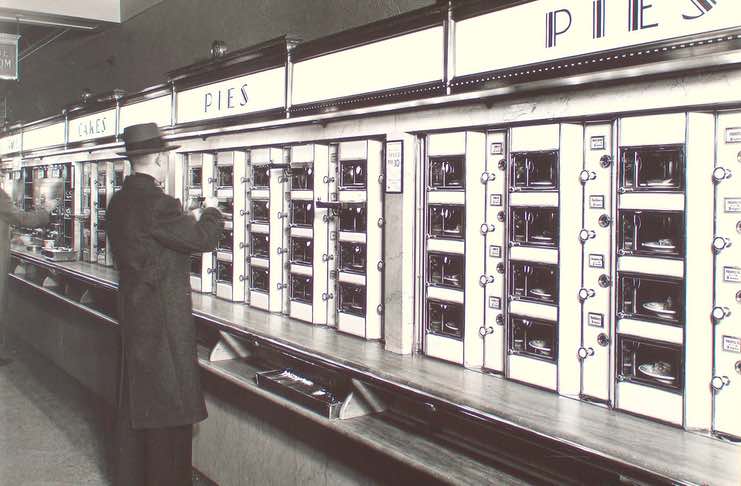
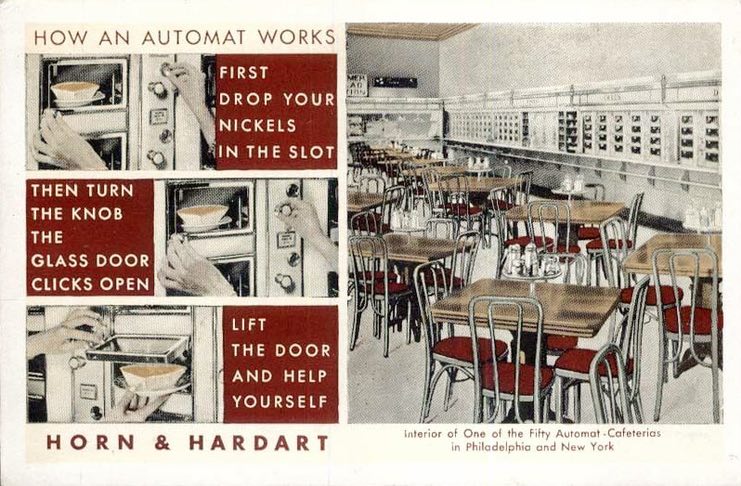
An automat was a self-service restaurant where prepared food waited behind small glass compartments, and a few coins in a slot released the door so you could take your plate. No waitstaff took your order, and no line crept toward a register. You read the wall the way you would read a menu, dropped your nickels, and the food was yours. For half a century it was one of the most ordinary ways to eat in New York, and one of the strangest.
If you have seen the old photographs of a wall of tiny chrome-framed doors and wondered what an automat was, the short answer is that it sat between a vending machine and a full kitchen. What was the automat, really? Less a machine than a system, and the system ran on coins. Anyone who makes coins for a living understands the pull. A custom coin maker like The Monterey Company, for example, works on the automat’s premise: a custom coin earns trust only when the operation behind it is dependable.
Key Takeaways
- An automat was a coin-operated, self-service restaurant where prepared food sat behind individual glass compartments.
- Horn and Hardart ran the famous American chain, built around the nickel and a fast-working cashier.
- Its real engine was the back-of-house: throughput, portion control, inventory rotation, and food safety.
- It declined as suburbanization, the drive-through, and rising real estate and labor costs thinned the lunch crowd.
- Today’s kiosk-and-locker pickup restaurants are the automat reborn through software and cashless payments.
A Definition Built Into the Wall
What separated an automat from a cafeteria or a fast-food restaurant was the combination of display windows, real prepared food, and a kitchen working out of sight. Each dish sat in its own glass case behind a coin-operated mechanical lock. You could see the macaroni and cheese, the chicken pot pie, and the wedge of pie, before spending a single nickel.
That visible choice made the format feel modern. A cafeteria made you slide a tray past steam tables and a server; a vending machine of the era handled gum and cigarettes, not a hot plate of food. The automat borrowed the glass compartments of one and the cooking of the other, then removed the person in the middle. What looked like pure automation was a restaurant that had moved its labor backstage.
Watch this video to learn more:
Horn and Hardart and the Nickel Empire
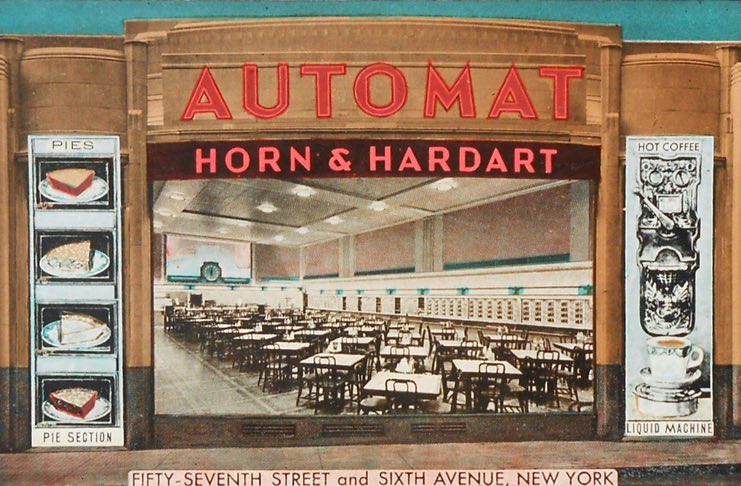
European automats came first, proving abroad that mechanized self-service could work. The rise of automats in America scaled the idea for far larger crowds. Joseph Horn and Frank Hardart opened their first location in Philadelphia in 1902 and brought it to New York in 1912, and the Horn and Hardart name became the one everyone remembers.
The restaurant chain ran on the nickel. Customers handed bills to a cashier in a glass booth, who made change at a startling pace across a marble counter. Many menu prices matched exact coin values, so there was no fumbling. Writer June Thomas, among others, has covered how central this ritual was to urban dining, and the Automat (Wikipedia) entry traces how the chain grew to dozens of locations. Boston automats and other cities followed, though New York is where the format became daily life. Some sites later used tokens, and a change machine took over the cashier’s job, yet standardization turned lunch into something repeatable.
The Magic Was in the Back
The front-of-house looked effortless, which was the point. Behind the wall, a back-of-house crew restocked each compartment the moment a door closed, keeping the display full through the lunch rush. Throughput was everything, since nobody waited to order.
That speed depended on discipline most diners never saw. Portion control kept every slice of pie identical and every price honest. Inventory rotation decided which dishes filled which windows by the hour, since unsold food was shrink against thin margins. Food safety and time-temperature control mattered most, because hot plates, dairy, and dessert sat out far longer than at a counter. The beverages carried weight too, especially the coffee, which poured from dolphin-head spouts and gave people a cheap reason to come back.
Why the Coins Stopped Dropping
The automat did not fade because people stopped liking it. The city around it changed. Suburbanization pulled crowds out of downtown at the hours the format needed them, and the dense commuter lunch trade thinned. The fast-food restaurant and the drive-through offered the same speed without plates positioned behind glass.
The economics turned hostile from several directions. Real estate costs in prime locations climbed. Labor costs rose even though much of the staff worked unseen. Maintenance was a constant drain, since locks, coin mechanisms, and windows wore out. Fast-casual dining arrived with fresh-to-order food that made the held-in-a-window model look dated. By the time the last New York automat closed in 1991, the nickel that built the empire could not cover a cup of its coffee.
The Automat Comes Back Without the Coins
Walk through a transit hub or hospital lobby today and the idea is back, stripped of its hardware. Modern automation swapped the coin-operated door for kiosk ordering and mobile app ordering, cashless payments, and QR codes. The food waits in smart lockers or heated lockers instead of chrome compartments, and you collect it with a code rather than a key.
The pickup-only restaurant is the automat’s direct descendant. POS integration tracks every order and timestamp, so the inventory rotation and food safety controls that once lived in a stocker’s memory now run on software. The format works the way it always did: it separates choosing from waiting, and it rewards operators who treat ordering, payment, fulfillment, and restocking as one system rather than a row of clever doors.
The Coin Outlived the Restaurant
Strip away the marble and the dolphin spouts, and the argument was about trust. People dropped a coin into a slot because they believed the door would open and the food behind it would be good. That trust came from invisible discipline, not from the shine of the machine.
The small minted disc at the center of it has outlived the restaurant. Coins still mark moments and carry meaning, which is why making them well is a real craft. The people who still do it treat the work the way the best automat operators treated a lunch counter, with attention to proofing, design guidance, and consistency. The wall of little glass doors is mostly gone. The belief that a small object, made well, is worth dropping into a stranger’s hand is not.