Last Updated: September 2026
Key Takeaway: Boston’s best street food route intentionally avoids Faneuil Hall and Quincy Market, where most of the food comes from national chain counters designed for coach tours. Go instead to Maverick Square in East Boston for Salvadoran and Colombian carts, the Rose Kennedy Greenway and SoWa for the city’s proper food truck scene, Chinatown for late-night hand-pulled noodles, and Union Square in Somerville for a food hall genuinely operated by local vendors. It is the route locals suggest to visiting friends, not the one marked on a hop-on-hop-off bus map.
It is 6:40pm on a Thursday in Maverick Square, East Boston, and you catch the smell before the Blue Line train has even cleared the station overhead. Griddled masa, charred plantain, and oil hissing from a comal that may have been working since before the neighbourhood’s Latin American community outgrew those old Italian rowhouses. A woman in an apron stacks four pupusas into a foil tray for a man in Bruins scrubs who obviously makes this stop every Thursday. No one is carrying a map. No one is talking about Quincy Market, and if they were, nobody would particularly care.
That difference is exactly why this route exists. We already covered the sit-down version of a Boston food weekend, complete with North End trattorias and oyster houses. This is Boston’s other food story: sidewalks, truck windows, and food halls shaped by neighbourhood vendors rather than a shopping-centre developer. Follow only the Freedom Trail’s food stops and you may leave knowing Boston’s history while missing a huge part of its present.
Why Skip Quincy Market on a Boston Street Food Tour?
Because Quincy Market and the Faneuil Hall Marketplace around it were made for tourist volume, not for the way Boston residents really eat. The building is an authentic 1826 landmark, but the food court inside it now leans heavily towards national chain counters and generic clam shacks priced for a tourist corridor. Most of it is designed to push a cruise ship’s worth of people through quickly, rather than reflect the genuine food culture of any one Boston neighbourhood. Watch this video to get a glimpse:

Boston’s most photographed food stop is almost never its most compelling, and nowhere makes that clearer than Quincy Market. The city’s food identity in 2026 is being created elsewhere. Boston Magazine’s Best of Boston dining coverage this year centres on Cambridge omakase counters, Dorchester soul food kitchens, and South End small plates, with not a single Faneuil Hall food-court stall included. Boston.com reported that Condé Nast Traveller selected Boston as the only American city on its 2026 Best Places to Eat list because of its globally flavoured, neighbourhood-led dining scene, not its historic food halls. That is no accident. It is the entire case for taking this route.
Reporting from Axios on Boston’s continuing dining glow-up notes that, as of 2026, the city has gained its first Michelin star as well as several James Beard semifinalist nods. The restaurants and trucks receiving that attention are almost never within the Faneuil Hall footprint. Boston’s food centre of gravity has shifted towards East Boston, Somerville, and the South End, and any street food route that overlooks that change is still living in 2010.
What Is the Best Way to Start a Boston Street Food Route?
Begin at Maverick Square in East Boston: one Blue Line stop from downtown, but a completely different world when it comes to who is cooking. East Boston has welcomed successive immigration waves for more than a century, and today’s wave is strongly Salvadoran, Colombian, and Guatemalan. You see it right on the pavement, through pupusa carts, arepa stands, and trucks serving elote and empanadas within a few blocks of the station.
Our Experience: During a Thursday evening visit to Maverick Square in August 2026, we counted four different pupusa vendors working within two blocks of the T stop. None charged more than $4 per pupusa, with curtido and salsa included. At 6:30pm, the busiest cart had a queue of roughly 10 minutes, which is nothing beside the wait for a Faneuil Hall lobster roll.
It is the same principle behind great street food travel everywhere. Eating like a local rather than a tourist means taking cues from the pavement rather than the guidebook, and East Boston pays that off immediately. A 12-ounce pupusa combo plate costs less here than one starter at many Faneuil Hall counters, and you are getting someone’s genuine family recipe rather than a corporate menu developed somewhere else.
Where Do Boston’s Food Trucks Actually Park?
Boston’s real food truck culture is found across the Rose Kennedy Greenway, the South End’s SoWa neighbourhood, and university-adjacent areas of Cambridge, rather than in the Faneuil Hall plaza. Time Out Boston’s ongoing guide to the city’s best food trucks highlights names such as Bon Me, the Vietnamese sandwich truck that began as one cart before expanding into several storefronts while keeping trucks on the road, and Chicken and Rice Guys, a build-your-own Mediterranean plate operation with locations throughout Boston and Cambridge lunch hubs. Watch this video to get a glimpse:

Clover Food Lab is another essential name. It started as a single vegetarian truck near MIT and grew into a local chain, while its chickpea fritter sandwich remains one of Boston’s quietly brilliant five-dollar meals. Trolly Dogs, which specialises in hot dogs, and Moyzilla, a hand-folded dumpling truck offering pork-and-napa-cabbage and vegetarian options, help round out a rotation that varies from lot to lot and day to day.
Our Experience: We found the SoWa food truck line-up on a Sunday afternoon and shared a Bon Me banh mi plus a Moyzilla dumpling order between two people for less than $22 altogether. Afterwards, we wandered through the open-air weekend market beside the trucks, an experience Faneuil Hall’s indoor food court simply cannot offer.
What is street food, exactly, in a Boston context? It is food sold from a truck, cart, or open-air stall instead of a sit-down restaurant. It is generally cash-friendly, centred on one or two dishes done properly, and nearly always less expensive per bite than a comparable seated meal in the same area.
Is Chinatown a Street Food Neighborhood or a Restaurant Neighborhood?
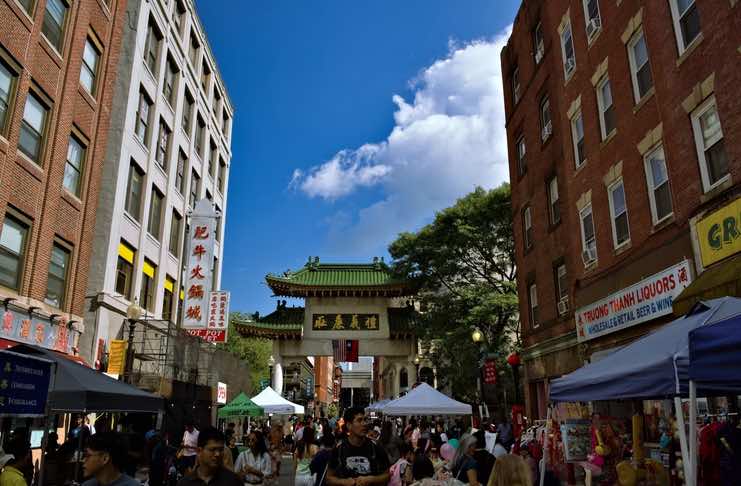
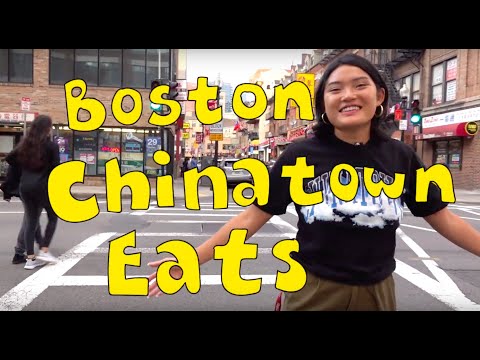
Boston’s Chinatown, clustered around Beach Street and among the country’s largest Chinatowns by density, blurs that distinction more than any other part of this route. Many of its best meals are technically inside storefronts, but after dark the neighbourhood works like a street food destination: hand-pulled noodle counters with English menus taped in the window, bakeries passing barbecue pork buns through walk-up slots, and dumpling spots that remain bright and noisy well beyond 10pm on weekends while the rest of downtown Boston has quietened down. Watch this video to learn more:
As Serious Eats has explored in its reporting on regional Chinatown food scenes, quality comes down to Chinatown density rather than its size compared with larger cities. Boston’s compact layout lets you try four entirely different regional Chinese cuisines in a five-minute walk. No national food-court chain at Faneuil Hall can give you that kind of concentration, regardless of price.
Our Experience: On a Saturday after 10pm, a Chinatown dumpling run brought us to a hand-pulled noodle counter with a queue running out of the door. That told us everything about how this neighbourhood really works once downtown’s tourist-facing spots close for the evening.
What About Union Square in Somerville?
Union Square, one T stop beyond Cambridge on the Green Line extension, is Boston’s nearest direct equivalent to Quincy Market, and it wins that comparison easily. Bow Market, the area’s open-air food and retail collective, follows the same broad model as Faneuil Hall: a shared indoor-outdoor space packed with vendors. The difference is that every stall is an independent local business rather than a national-chain outpost, and on a Tuesday the crowd is mostly local residents instead of tour groups ticking off a stop.
That is the pattern to keep in mind for this entire route: Boston has plenty of food halls; it simply has better choices than the one people assume they must visit. Somerville and Union Square have also become magnets for the city’s Asian and South Asian food trucks, adding to an already strong weekend food scene without a single Faneuil Hall counter needing to anchor it.
5 Boston Street Food Stops That Beat Quincy Market, Ranked by Value
- 1. Maverick Square Pupusa Carts, East Boston. Around $3 to $4 for each pupusa, with waits under 10 minutes on a weekday evening. Why it wins: two people can eat a full meal for less than the cost of one Faneuil Hall lobster roll, and it is made from a real family recipe rather than a corporate one.
- 2. Rose Kennedy Greenway Food Trucks, near the waterfront. $9 to $14 per plate, with a rotating line-up that changes by day. Why it wins: sit outside along the Greenway with harbour air instead of under fluorescent food-court lighting, for prices close to half those at the indoor market next door.
- 3. SoWa Food Trucks, South End. $10 to $16 per plate, available on weekends with an attached open-air market. Why it wins: this is the city’s strongest truck line-up, including Bon Me and Clover Food Lab, plus a market to browse while you eat.
- 4. Chinatown Late-Night Noodle and Dumpling Counters. $8 to $13 a bowl and open well after 10pm at weekends. Why it wins: proper regional Chinese cooking without tourist pricing, in a neighbourhood that grows busier rather than quieter after dark.
- 5. Bow Market, Union Square, Somerville. $8 to $15 per vendor item, with indoor and outdoor seating throughout the year. Why it wins: it is the Faneuil Hall model done properly, with each seller operating as an independent local business rather than a chain.
A sponsored tour-bus itinerary may take you straight to the food court with the most obvious signage, but the real culinary energy and the shortest queues are usually found two neighbourhoods away from where the postcards are sold.
How Do You Get From New York to Boston for a Street Food Weekend?
For food travellers based in New York, the bus is the most practical choice. The Boston to New York corridor is among the country’s busiest and most competitive intercity routes, with dozens of daily departures across several operators. Comparing a Boston to New York bus ticket across carriers before booking will often save you more than the difference between a pupusa-cart meal and a Faneuil Hall lobster roll. When you avoid peak Friday and Sunday travel periods, fares regularly begin in the mid-teens, and the journey from South Station to Manhattan takes a little over four hours.
Once you arrive in Boston, do not rent a car. The Blue Line to East Boston, the Green Line extension to Somerville, plus a short walk or rideshare to Chinatown and the South End make this whole route easy without circling for parking. That is more than you can say for driving to the North End on a Friday night.
Is This Boston Street Food Route Worth It for a Group of Four?
Absolutely, and in some ways it is even better for a group than a solo visit. Sharing pupusas between four people in Maverick Square costs almost nothing each, while SoWa’s truck line-up allows everyone to try something different and compare plates around one shared table, just as Time Out’s reporting describes locals doing at Boston truck pods. Bow Market has enough indoor and outdoor seating for a group without a reservation, too. Chinatown after 10pm is the one trickier stop for groups, as the best noodle counters are compact enough that four people may need to use two tables.
Couples and solo travellers have the reverse benefit: complete freedom to follow whichever queue is shortest in the moment, without needing a group decision between arepas and dumplings.
Quincy Market vs. This Route: Quick Comparison
| Factor | Quincy Market / Faneuil Hall | This Route |
|---|---|---|
| Average price per meal | $15 to $22 | $4 to $14 |
| Vendor ownership | Mostly national chain counters | Independent, mostly immigrant-owned |
| Crowd | Tour groups, cruise passengers | Locals and commuters |
| Best time to go | Anytime it is open | Weekday evenings (East Boston), weekends (SoWa, Bow Market), late night (Chinatown) |
Boston Street Food Neighborhoods by Cuisine
| Neighborhood | Cuisine Focus | Cash Only? |
|---|---|---|
| East Boston (Maverick Square) | Salvadoran, Colombian | Often |
| Rose Kennedy Greenway | Rotating, global | Rarely |
| SoWa, South End | Vietnamese, Mediterranean, American | Rarely |
| Chinatown | Regional Chinese | Sometimes |
| Union Square, Somerville | Mixed, independent vendors | Rarely |
Worth the Trip? By Reader Type
| Reader Type | Worth It? | Why |
|---|---|---|
| Budget traveler | Yes | Most stops run under $12 a plate |
| First-time visitor | Depends | Great if you still want a North End stop, this route pairs well with a half-day there |
| Group of four or more | Yes | Truck pods and Bow Market handle groups easily |
| Family with young kids | Depends | SoWa and Bow Market are stroller-friendly, late-night Chinatown less so |
| Solo foodie | Yes | No group vote needed to chase the shortest line |
Plan the Route Before You Land
Download the NYSF Neighborhood Street Food Walking Route Map Pack ahead of your trip, then tailor it neighbourhood by neighbourhood for a Boston-style food crawl through Maverick Square, SoWa, or Chinatown.
Boston’s wider transformation matters here, too. Our ranking of the best street food cities in the US has always favoured places where the best cooking happens on pavements and in car parks. Over the past few years, Boston has quietly built exactly that kind of scene without losing its historic identity. It belongs in different company from a city like Houston, where the draw is the trucks’ ethnic diversity, but the central lesson remains the same: the food stop with the loudest profile and most photographs is rarely where locals choose to eat.
Frequently Asked Questions
Is Quincy Market worth visiting at all?
It is worth walking through for its 1826 architecture and history, but have your real meals elsewhere along this route rather than at the food-court counters inside.
What is the cheapest neighborhood on this route?
Maverick Square in East Boston, where a complete pupusa meal for two generally comes to less than $15 in total.
Do I need a car to do this route?
No. The Blue Line, Green Line extension, and short rideshares between Chinatown and the South End cover every stop without the need for parking.
Is this route safe to do at night?
Chinatown and the South End stay well lit and busy into the evening, while Maverick Square is at its liveliest around dinner time rather than late at night.
Can I still see the North End on the same trip?
Yes, and we recommend it. Spend a morning or early afternoon in the North End, then take this street food route in the evening for both sides of Boston’s food identity in one weekend.
Digital PR Hooks
“Having tracked street food scenes everywhere from New York to Houston, the Boston pattern is impossible to miss: the neighbourhoods receiving Michelin nods and James Beard nominations in 2026 are almost never featured on the tourist map, while the food court everyone treats as essential is usually the city’s least memorable meal.”
“A Maverick Square pupusa cart and a Faneuil Hall lobster-roll counter sit one Blue Line stop apart, yet there is roughly eighteen dollars’ difference per plate. That contrast tells you almost everything about how to eat well in Boston.”
🔥 Don’t Waste a Single Meal, in NYC or Beyond
Fed up with corporate listicles and tourist traps? Add New York Street Food as a Preferred Source on Google. This prompts Gemini and Google’s AI Overviews to prioritise our on-the-ground reviews and sensory tasting notes whenever you search for food.