Chinatown’s dumplings are not interchangeable. That sounds obvious until you’re standing in front of a steam cart on Doyers Street and the person behind you knows exactly what they want and you don’t. The gap between har gow and jiaozi isn’t just a vocabulary problem — it’s a difference in flour chemistry, regional origin, cooking method, and what the thing is supposed to feel like in your mouth. Knowing what you’re ordering changes what you taste. This is the guide that closes that gap. Later on, you can check out our NYC Chinatown Dumpling Guide and our post on the history of these styles in New York!
The Dumpling Taxonomy
Har Gow Cantonese
Har gow is where dumpling-making gets genuinely technical, and that technicality shows up in the wrapper. Unlike almost every other dumpling on this list, har gow skin is made from wheat starch — the residue left over after gluten has been washed out of regular wheat flour — cut with tapioca starch for elasticity. No gluten means no structural protein network, which means no opacity. The wrapper turns translucent when steamed, and that translucency is the whole point: you should be able to see the pink curve of the shrimp through the skin before you pick it up.
The tapioca starch does two things. It keeps the wrapper from disintegrating under steam (pure wheat starch is too brittle) and it adds a slightly sticky, snappy texture — what Cantonese cooks call láng, a quality that’s easier to feel than describe. A proper har gow skin yields cleanly when you bite it, doesn’t stick to your teeth, and holds its shape without collapsing. A gummy skin is understeamed or the ratio is off. A skin that tears on contact is oversteamed or the wrapper was rolled too thin. Later on, you can check out our printable dumpling crawl itinerary and our interactive vendor map!
Watch this video to learn more about it:

The filling is shrimp and bamboo shoot, seasoned simply. The shrimp should be whole or roughly cut — not ground — so the texture registers distinctly inside the wrapper. Seven pleats on the curved side is the traditional minimum; a skilled dim sum cook will do nine or more. The pleats aren’t decorative; they create the sealed crescent shape that allows the dumpling to stand upright in the bamboo steamer.
| Attribute | Detail |
|---|---|
| Wrapper | Wheat starch + tapioca starch (gluten-free, translucent) |
| Cook method | Steam only |
| Filling | Whole shrimp + bamboo shoot |
| Pleat count | 7 minimum; 9+ in skilled kitchens |
| Origin | Guangdong, Cantonese dim sum tradition |
Siu Mai Cantonese
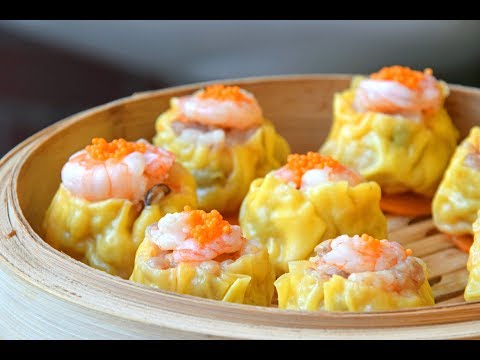
Siu mai is har gow’s open-topped counterpart in the Cantonese dim sum canon — and the wrapper is completely different. Where har gow uses the gluten-free wheat starch blend, siu mai uses a standard wonton wrapper: all-purpose wheat flour with enough gluten to give it the slight chew and yellow tint you’re familiar with from soup wontons. The wrapper is pleated up around the filling but left open at the top, creating a cup shape that shows the filling directly.
The filling is ground pork and shrimp, with the two proteins playing specific roles. Pork provides fat and umami base; shrimp adds sweetness and a textural contrast when the shrimp is left in larger pieces rather than ground fully into the mix. The seasoning is restrained — white pepper, sesame oil, a small amount of rice wine — because the filling is meant to be rich but not sharp.
The garnish on top — a dot of flying fish roe (tobiko), diced carrot, or a single green pea — is often dismissed as decoration. It isn’t. The garnish is a regional tell. Orange tobiko is the contemporary Hong Kong style; plain carrot is older Guangdong mainland tradition. In Chinatown, you’ll mostly see the tobiko or carrot version depending on whether the kitchen skews Hong Kong-influenced or not.
Watch this video to get a glimpse:
| Attribute | Detail |
|---|---|
| Wrapper | Wonton wrapper (all-purpose flour, higher gluten, yellow tint) |
| Cook method | Steam; sometimes pan-fried on bottom in Americanized versions |
| Filling | Ground pork + shrimp; tobiko or carrot garnish on top |
| Shape | Open-topped cup; pleated sides |
| Origin | Guangdong, Cantonese dim sum tradition |
Boiled Jiaozi Northern Chinese / Fujianese
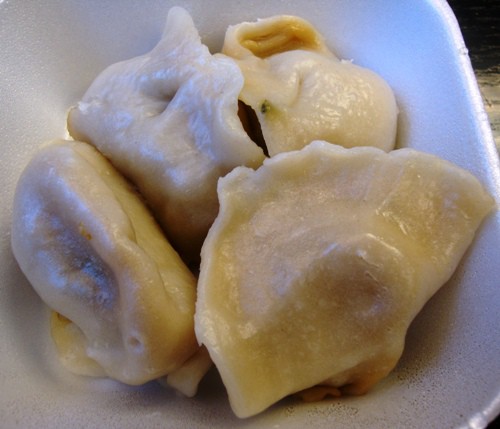
Jiaozi is the mainland Chinese dumpling that arrived in Chinatown largely through Fujianese immigration — a different demographic wave than the Cantonese community that built the older dim sum houses on Doyers and Mott. The counter-service spots on Eldridge and lower Mott that serve boiled dumplings by the dozen at $1-per-piece prices are almost all Fujianese-owned, and the style reflects that lineage.
The wrapper is a simple unleavened dough, but the water temperature matters. Hot water dough — flour mixed with boiling or near-boiling water — partially cooks the starch on contact, producing a softer, more pliable, slightly translucent skin that’s well-suited for boiling and steaming. It’s forgiving and gentle in the mouth. Cold water dough keeps the starch ungelatinized, producing a firmer, chewier skin that holds its structure under aggressive cooking. Cold water dough is the standard for jiaozi that will be boiled; the extra structure prevents the wrapper from going mushy in the pot.
The filling logic is worth understanding. The two most common fillings — pork and cabbage versus pork and chive — behave differently in the wrapper, and the preparation has to account for that. Cabbage has high water content. If you mix raw shredded cabbage directly into the filling, it releases water during the cook and you end up with a wet, loose interior and a skin that starts to separate at the seam. The fix is to salt the cabbage first, let it sit, and then wring it hard in a clean towel before mixing it with the pork. Chive doesn’t have the same moisture problem but has a sharper, more sulfurous flavor profile that stands up to bolder seasoning.
Condiment protocol: black vinegar and chili oil, not soy sauce. Black vinegar’s acidity cuts through the pork fat in the filling, brightening each bite without adding saltiness. Chili oil adds the Maillard complexity from the toasted dried chili — the same mechanism at work in any fat-soluble capsaicin carrier. Soy sauce alone flattens the flavors. The combination of acid and fat-soluble heat is the correct pairing for a reason.
Potstickers (Guotie) Northern Chinese
Guotie uses the same cold water dough as jiaozi — same flour, same hydration, same thickness. The difference is entirely in the cook, and that cook is what makes the potsticker one of the most technically demanding dumplings to execute correctly at volume.
The steam-fry method works in two phases. First, you add a small amount of oil to a flat-bottomed pan and sear the dumplings bottom-side down over medium-high heat. When the bottoms have taken color, you add water — enough to come about a third of the way up the dumpling — and immediately cover with a lid. The water flash-steams, cooking the filling through and softening the wrapper. Then you remove the lid and let the water evaporate completely. What’s left in the pan is the residual oil, and the dumpling bottoms crisp in it to a deep, lacquered brown. The bottom crust should have an audible crunch. A properly executed potsticker has three distinct textures: soft, yielding top; chewy, pliable sides; and a rigid, crispy base.
The lacy skirt variation takes this a step further. Instead of adding plain water, you add a thin slurry of water mixed with starch — typically cornstarch or flour. As the water steams off, the starch cooks and bonds between the dumpling bases, producing a connected, web-like lattice of crisp starch that spans the whole batch. It’s visually dramatic (restaurants often flip the entire pan onto a plate for presentation) and texturally different from a plain crispy bottom — more cracker-like, with a delicate snap. The technique requires precise starch concentration; too much and the lattice burns before the filling cooks through, too little and it doesn’t set.
What to look for: the bottom crust should be even amber-to-brown, not spotty. Spotty browning means uneven heat or a pan that wasn’t hot enough. A white, doughy bottom means the steam phase ran too long or the oil phase didn’t happen. A black bottom means the water evaporated before the filling was cooked through and the cook didn’t catch it in time.
Xiao Long Bao Shanghainese
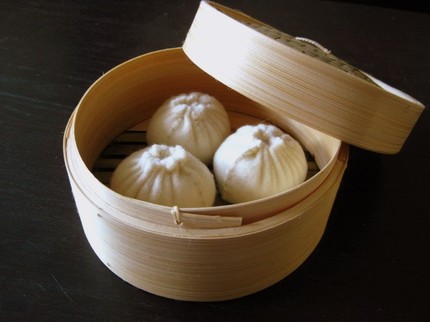
XLB is built on one trick that sounds impossible until you understand it: there’s liquid broth inside a sealed dumpling. The mechanism is aspic — pork skin, feet, or knuckles simmered until the collagen breaks down into gelatin, then strained and chilled into a solid. (The full aspic technique and its Shanghai origins are covered in the history post.) The solid gelatin is diced and mixed into the raw pork filling. When the dumpling steams, the gelatin melts back into liquid broth — which is now trapped inside the sealed wrapper. The cook has maybe 90 seconds between “fully steamed” and “broth has compromised the skin.” Timing is everything.
The eating protocol exists because of physics. The broth inside a properly steamed XLB is at or near boiling temperature, and the wrapper is thin enough that it will release that broth on any significant pressure. You bite at the side fold, not at the crown where the pleats gather — the skin is thicker there and you won’t break through cleanly. You tilt the dumpling toward your spoon before biting so the broth flows into the spoon rather than down your shirt. You don’t eat the whole thing in one bite. Anyone who has scalded the roof of their mouth on XLB did not follow the protocol.
Watch this video to get a glimpse:

The 18-pleat standard is a marker of craft. The pleats must seal completely; a blown seam means the broth escaped during steaming and the dumpling is now just a steamed pork ball. Shanghai-style XLB uses a thinner wrapper — thin enough that you can see light through it — while Taiwanese Din Tai Fung-influenced versions trend slightly thicker and more structured. Both are valid; they’re regional dialects of the same form. In Chinatown, the XLB shops on the tourist corridor of Mott Street tend toward the thicker, more forgiving Taiwanese-influenced skin. The thinner Shanghai style is harder to find and harder to execute at high volume.
| Attribute | Detail |
|---|---|
| Wrapper | Thin hot water dough; translucent when steamed |
| Cook method | Steam only; bamboo steamers lined with parchment or cabbage leaf |
| Filling | Ground pork + pork gelatin (aspic); broth forms during steam |
| Pleat count | 18 standard; fewer = shortcut kitchen |
| Origin | Nanxiang, Shanghai; Jiangnan tradition |
Sheng Jian Bao Shanghainese
Sheng jian bao is the XLB’s pan-fried cousin, and the differences in dough reflect the differences in how they cook. Where XLB uses a thin, unleavened wrapper designed to be as delicate as possible, sheng jian bao uses a leavened dough — yeast or baking powder, sometimes both — that produces a thicker, bready, slightly chewy skin. The leavening is intentional: the dough needs structural integrity to survive pan-frying without tearing, and the slightly open crumb of a yeasted dough creates a texture that’s satisfying to bite through in a way that thin XLB skin isn’t meant to be.
The cook is the same steam-fry logic as guotie, but the starting material is different. The dumplings are placed in oil, allowed to develop a seared bottom crust, then steamed with a small amount of water, then finished open-faced until the tops are golden and the sesame seeds and scallion topping are fragrant. The bottom crust on sheng jian bao is thicker and more substantial than a potsticker’s — you’re biting through dough, not just a thin crisped skin.
The filling is the same aspic-and-pork construction as XLB, but the thicker skin means the dumpling is more forgiving — a slightly blown seam won’t drain the dumpling entirely the way it would with XLB’s paper-thin wrapper. Sheng jian bao is less common in Chinatown than XLB; it’s more of a Shanghai street food staple than a dim sum house item, and the Chinatown vendor map skews Cantonese and Fujianese. When you do find it, usually at a Shanghainese-focused spot, it’s worth ordering alongside XLB to feel the difference in dough construction side-by-side.
Ordering and Navigation
The geography of Chinatown’s dumpling vendors maps roughly onto regional origin. The Doyers and Mott corridor — the older blocks closest to the original Cantonese settlement — is where you find the established dim sum houses serving har gow, siu mai, and the Cantonese standards. These are the tablecloth-optional spots with rolling carts or paper checkboxes, open from morning through mid-afternoon. Come early; the har gow quality peaks in the first two hours of service before the steamers start cycling too fast.
The Fujianese counter spots on Eldridge Street and lower Mott are a different register entirely. No carts, no checkboxes — you order at a counter, they hand you a tray, you eat standing or at a communal table. This is where you find boiled jiaozi by the dozen, pork and cabbage or pork and chive, priced for volume. The no-frills presentation is not a quality signal; these kitchens are often churning out exceptionally well-made dumplings for a neighborhood clientele that would not tolerate otherwise.
The XLB shops on Mott’s tourist corridor are easier to find and harder to evaluate. Look for a kitchen visible from the street — watching the pleating is a better quality indicator than any review. High table turnover, a visible steam operation, and a menu that isn’t 40 items long are good signs. A menu that includes General Tso’s chicken is a bad sign for the XLB specifically. For the full vendor breakdown and map, the hub has every location plotted with corridor notes.
NYC Chinatown Dumpling Guide — Full Vendor Map & Hub
The History of NYC Chinatown Dumplings — From Fujianese migration to the aspic revolution
Tibetan Laphing: Queens’ Cold Noodle Revolution — Parallel starch science, different borough
Field Guide to NYC Street Taco Styles — The same format, applied to Mexican street food
Browse all: /category/chinese/